Getting used to a dog

I have been struggling this past week because we have a new dog in the family. The reason I feel so stressed out and on edge all the time now is because I never actually wanted a dog, ever. My family have been pestering me for years, particularly my ASC daughter. However, I never grew up with dogs and am actually kind of freaked out by them, I never know what to expect from them. After a lot of talking over with my wife (who loves dogs, she's the other main voice on that side), I finally relented and we picked him up from the shelter last weekend.

I've now gone through a whole range of mixed emotions, from thinking this might be ok when he's calm, to thinking my life/marriage is over because I can't cope. I even had a meltdown on the 3rd day because the dog "bit" me (not actually, but exploring with his mouth while I was trying to stroke him), I couldn't take the uncertainty anymore. 

At this point I can start to see patterns now and understand the dog a bit better. But I know this isn't good enough, I do need to take joint responsibility too . I'm still scared to go near him when he's all jumpy and overexcited, and I don't want to live in fear in my own home. Currently there are times I have to force myself to be nice to him, it just does not feel natural to me.

Has anyone else ever had to go through something like this? I think things might be normalising slowly, but I need to imagine that my life will get better when I've had absolutely no previous experience of this.

  • Is it coincidence that the sites promoting this new approach of woke dog training are all selling courses on how to do it?

    For me, your "wokery" comment speaks volumes about your mindset, but I won’t dignify that particular element of your reply with any further response.

    Perhaps it might help you to know that other sites and organisations that recommend positive reinforcement training include:

    - The Kennel Club: 

    “Look on our website for training ideas or explore other sites on the internet. Whatever you find, make sure that the instructor is using kind, motivational methods and positive reinforcement only

    - RSPCA:

    “Look for reward-based training methods.”

    - The Canine and Feline Sector Group (CFSG), whose members include Battersea, Blue Cross, RSPCA, Dogs Trust, and many more. Their Code of Practice for Dog Breeding includes:

    All training and behaviour therapy should take an ethical approach. It should be positive and reward-based"

    "Current scientific knowledge should be applied at all times, and help sought if required. Contact the Animal Behaviour and Training Council (ABTC)

    - Guide Dogs:

    Uses positive reinforcement training for its dogs (including Labradors).

    - Statutory guidance for local authorities in England:

    Promotes positive reinforcement training by dog breeders.

    - The Animal Welfare (Licensing of Activities Involving Animals) (England) Regulations 2018: 

    Mandates using positive reinforcement training when keeping or training animals for exhibition.

    - PDSA:

    "Firstly, when you’re training your dog or puppy to do anything, you should always use positive, reward-based training. Dogs respond far better to positive training and are more likely to pick up what you are trying to teach them faster."

    The old way has proven very successful as it ties into the instincts of dogs. The appropriate application of psychology, boundaries and training used in conjunction with observation of the behaviour exhibited by the dog has been used by most dog trainers through history.

    This content from The Ethical Dog Training guide, published by the ABTC  (which sets and oversees standards of professional competence and animal welfare during training and behaviour therapy), refers:

    “Until scientific research started to question age old practices, nobody really understood what they were doing wrong or what the potential consequences might be.”

    “Sadly some of these methods are still delivered today and their use is defended by some who believe the end justifies the means. Thankfully they are in a dwindling minority”

    “Over the last twenty to thirty years scientific research has driven our understanding of animal behaviour, particularly domestic dog behaviour, forward at a phenomenal rate.”

    That is very condescending.

    It was offered as a positive, forward-looking note to finish on. It reflected my optimism that, having now learned about this newer, science-based approach to dog training, it could benefit any dogs in your life - and that I hadn’t expected your thinking to completely change overnight.

    However, you’ve since doubled down on your original view (and even made it worse with your wokery comment), so I no longer feel that way.

    I’ll leave you with the additional information above and step away from this thread (ie I won't be returning to it). At the very least, I hope that you will stop promoting outdated dominance theory to others, even if you personally choose to ignore the latest science and best practice when training any other dogs in the future.

  • Of course you use possitive reinforcement, but you may need to do it more and more rigorously with a breed like a doberman. Nobody wants to break a dogs spirit and if they do then I don't think they should have a dog.

  • Is it coincidence that the sites promoting this new approach of woke dog training are all selling courses on how to do it?

    The old way has proven very successful as it ties into the instincts of dogs. The appropriate application of psychology, boundaries and training used in conjunction with observation of the behaviour exhibited by the dog has been used by most dog trainers through history.

    I freely admit I don't know everything about dog training but have owned and trained 4 dogs in my life (a spaniel and 3 labradors) and have achieved good results with dogs that showed no signs of distress or unhappiness.

    Managing the early years "teenager" was always a challenge, especially with uncut male dogs but the traditional techniques resulted in very well behaved an sociable adult dogs.

    I’m glad to hear that you’ve now read up on the latest dog training advice, even if you haven’t yet fully changed your thinking

    That is very condescending.

  • Dobermans for instance need a lot of training and a very firm hand.

    Modern dog training experts agree that positive reinforcement is the safest and most effective method, especially for sensitive breeds like the Doberman.”

    Pets4Homes - Training and Managing a Doberman Pinscher: Expert Guide 2025

  • Honestly I think it depends on the dog and some breeds are more aggresive and hierachical and need a very frim hand, Dobermans for instance need a lot of training and a very firm hand. A Greyhound is often at the other end of the scale and is a 40mph couch potato, they obviously need training but often a lighter hand is needed as they're big wussies.

    A lot of working breeds, Dobermans and Greyhounds included need a much lower amount of protein in thier diets day to day, Greyhounds are usually only fed more than 20% protein just before a race. Spaniels, labs and sheepdogs the same, they get over excited and need far more exercise than most people can give them, but if they're actually working, especially in winter then they need the protein to keep going.

    Most people don't have a clue about getting the right breed for thier lifestyle and think a small dog will be best, sometimes they are, but that dosen't mean they will need less exercise or will be more managable than a bigger dog.

  • That seems to me like a very disingenuous reply.

    The hierarchy is very real, just not in the way you probably thought I meant.

    I’m not persuaded that I misinterpreted anything (including about hierarchy) in your original post, which made no mention of positive behaviour training.

    In a household, dogs often establish loose, situational hierarchies that can change depending on the resource in question. 

    This phrase (which you quoted from the article that you linked to, in support of your claim) relates to discussion of the relationships between dogs in a multi-dog household; it is not written in support of seeking to establish an understanding of hierarchy between a dog and its owner(s).

    Your original post, which you say remains relevant, states:

    For effective ownership of a dog you need to be consistent, exhibit alpha energy and behaviour (in order to be seen as an authority figure)”

    In contrast, one of the “key takeaways” in the article that you’ve just linked to confirms that:

    “Building a relationship based on trust and clear communication is the goal, not establishing yourself as the “alpha.””

    Another article from the same site states:

    ”Modern science has completely debunked the alpha dog and dominance hierarchy theories”

    “Positive reinforcement training proves far more effective than dominance-based methods for lasting behavioral change”

    Regardless, I’m glad to hear that you’ve now read up on the latest dog training advice, even if you haven’t yet fully changed your thinking.

  • I was brought up with dogs, I have always loved them, but I can understand where you are coming from as my sister did not cope well with dogs.

    My sister learned to ignore the family dog, in much the same way as  recounts, and soon the two learned to happily share the same room while respecting the other’s boundaries.

    If the time comes that you need to be involved in the ongoing care of the dog, including training, the one piece of advice I can give is for everyone involved to be consistent about the rules and teaching of behaviours. The timing of positive reinforcement is crucial and it is usually best learned through a training class with certified dog trainers who use positive reinforcement (reward based training).

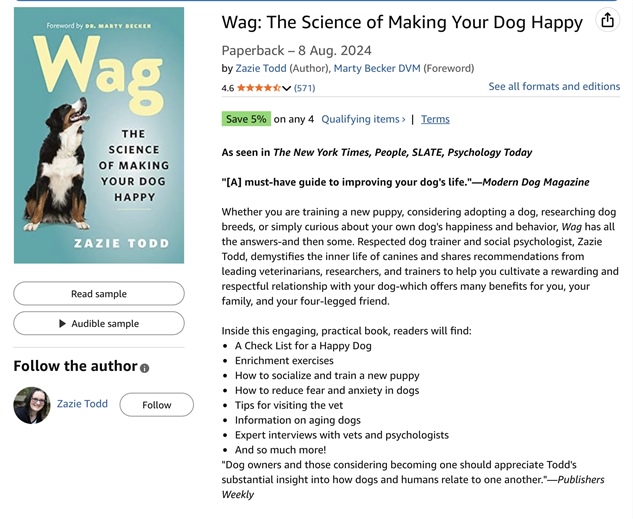
    If you are interested in knowing more about cultivating your relationship with your dog using the latest ethical methods backed up by science, I recommend this book. It is not a training book (although it does explain how dogs learn and how to train using reward based methods), rather it explains the science (in easy to understand language), of how behaviour is driven by consequences, and how to bring bring happiness to your dog’s life (and hopefully to yours).

  • This is now widely recognised as flawed and outdated thinking.

    I understand that the current thinking around dog psychology and it still requires the owner to be an authority figure BUT with an understanding of both the dogs body language and their psychology to be an effective owner.

    www.dwdogtraining.com/.../

    Dogs are social creatures, sure, but their relationships are way more flexible than the old dominance theory suggested. They’re more interested in figuring out what works to get the good stuff (food, toys, attention) than in who’s the boss.

    In a household, dogs often establish loose, situational hierarchies that can change depending on the resource in question. 

    Understanding how these hierarchies form and manipulating them can mean that a child is not pushed aside by the dog who wants the food the child has - if the dog did this and got away with it in the past then it becomes a learned behaviour.

    As the authority figure you need to correct the dog and prevent it doing the same thing again to ensure the child does not get hurt if nothing else.

    I'm not advocating cruelty but applied psychology and practical steps.

    The hierarchy is very real, just not in the way you probably thought I meant.

    So all my original statement remains relevant.

  • When I was a teenager, my household inherited an adult dog from a family who were no longer able to keep the animal.

    We hadn't had a dog before and I was apprehensive about the whole idea.

    Although the dog had been really well trained by the previous family, the dog still needed to learn about (and adapt to) the difference in energy levels of the characters in our household.  Not least of which ...me!

    I found the less I "spoke" with or instructed the dog and the more I simply spent time with the dog (doing "my" version of hobbies and just "being" my way) - then the quicker the dog was able to observe my ways and join in on my terms and tune-in accordingly.

    Before long, the dog had become a quick study and would demonstrate their adapted joining in with me (appropriate to me and often in quite a different style to their time spent in the company of others in our household). 

    We used to spend a lot of time just "being" and pottering about life's chores and pastimes.  The dog became welcome company.

    We learned to trust each others instincts about our environment and work together as a reliable team - if we decided something needed investigating.

    When the dog found it was time for seeking some more high energy / rambunctiousness - they tended to stand up, shake out their ears and wander off to borrow all of that with one of the other characters within the household.  No drama. 

    They would tend to pootle back my direction later on - when my vibe seemed like a good idea once again.

    Summary:

    Try "saying" less to the dog and just prioritise sharing "your true self as a character" more with the dog - so they can observe, understand and find ways of matching-in with your personal style of doing things and energy level of just "being".

  • Sounds like you are doing the best that you can! That’s good to hear that you are willing to be involved in training, since that is normally an “all-in” process that requires help from everyone in the household.

    I was hoping things were getting better because of the dog’s routine becoming more normalized. It’s good to hear that is happening! Kudos to you for bearing with it; I know it can’t be an easy process.

  • Hey, sorry for not replying to anyone, been busy. It's been two weeks now and things have started to settle down a bit. The more something happens, the more normalised it becomes. It was basically a sudden shock of my life going one way to suddenly feeling completely out of control!

    The good news is the dog is getting into a routine (of sorts) and when he's calmer I can actually approach him, maybe even like him. I'm still not confident what to do when he gets overexcited though, like when he has his evening "zoomies", a word I'd never heard before but he gets all his excess energy out before sleeping. He does sleep very well though and is quite clean at least.

    We are going to train him though, even my wife can see that, although he is generally good, he does have some bad habits before he can be considered well behaved. My wife is also doing the brunt of the work so far because she's trying to shield me from more chaos, but I want to be involved with the training too.

  • IF you are giving of a fear response then the dog will treat you as a lesser pack member and try to assert dominance over you. This is how the pecking order is established in their world
    For effective ownership of a dog you need to be consistent, exhibit alpha energy and behaviour (in order to be seen as an authority figure)

    This is now widely recognised as flawed and outdated thinking. This article explains more - including how the researcher on whose work that theory was based later recognised it wasn’t correct:

    Beyond the Dog - Debunking the “Alpha Dog” Myth

    As a Google AI summary notes, it can have a counterproductive impact on dogs:

    “The concept of the "alpha dog" in dog training is based on flawed research and outdated theories about wolf behavior. ... This "alpha" approach can be detrimental, causing fear, anxiety, and even aggression in dogs. Modern, positive reinforcement-based training methods are more effective and build stronger bonds between humans and their dogs.”

  • Hey, any changes since you posted this, pdaddio? I’m curious if things are getting better slowly for you or not.

  • I'm still scared to go near him when he's all jumpy and overexcited, and I don't want to live in fear in my own home.

    Dogs will instinctively pick up on your emotions and react to them, but not always in the way we may want.

    IF you are giving of a fear response then the dog will treat you as a lesser pack member and try to assert dominance over you. This is how the pecking order is established in their world so it will help a lot if you can get over this.

    The others are right about getting the dog trained, but I think you will need to be trained as well. For effective ownership of a dog you need to be consistent, exhibit alpha energy and behaviour (in order to be seen as an authority figure) and read up on dog psychology as they are remarkably straightforward creatures to train and manage when you know how.

    If you are the cause of the dog being given away then the kids will probably resent you for it - it is worth making every effort to adapt and learn how to manage the dog and pass these skills onto the kids as well. There are valuable life lessons in this for them.

    It is worth the effort in the end - dogs can be a great addition to the family.

  • I suggest going to a few dog training classes, this will not only help the dog to settle, but you too. It's a running joke that most of the dogs don't need training, but their owners do.

    If you take the time to develop a relationship with the dog, it will be really rewarding, dogs give you a reason to go out for a walk everyday, you interact with more people too, without having to worry about the normal small talk because people want to talk about thier dogs and yours. A dog can be a bit of a social passport.

    What sort of dog is it and whats it name and how old?

  • I'm not sure this is going to be what you were after but here goes...

    I was always terrified of dogs as a kid. It didn't help that I had a paper round where I would cycle around the village with a luminous yellow bag. I seem to think I may have been chased once, but managed to cycle away. At some point I seem to have mostly gotten over it. Maybe because of friends having a dog that was extremely timid, maybe interacting with them more, I'm honestly not sure. I'm not saying that will happen with everyone, but it is possible for fears to subside. I think it is particularly more likely if you are around dogs you get to know, know how they react for the specific dogs and as individuals, and that are well trained. No two dogs are the same, but there are common traits they can have.

    So being terrified of dogs as a kid, somehow getting over it, friends having dogs, when I went through an extremely tough period and ended up with my social circle in tatters, I started thinking on it more. I've lived alone for a long time, but this new period was very isolating. The perks of a dog were looking good. A companion that's always there, something to keep me busy, gets me out and about walk, gets me talking to people when I'm out. I discussed it with some close friends and family, and the main flaw they saw was the breed I was fixed on.

    So I got a beagle. He is now 10 months old, has far too much energy, is easily distracted, and has done exactly what I wanted. He has kept me busy (even if that's because he's been driving me mad), he's kept me company, he's been entertaining, he's gotten me out of the house, he's given me motivation, he's given me social interactions I would have never had, he's given me conversation starters, and many other things.

    You mentioned a shelter so I'm assuming it's a rescue. Is it still a puppy?

    My advice would be to try get involved in the training. It might help you, and it will definitely help the dog. Do it when the dog is calmer to start with as it's easier on both you and the dog, start with basics, and keep training short. Sit is probably the most useful. My brother has a great dane which is massive. It came running up to me once and I still flinched. One of the things he said was, if a dog is running towards you, tell it to sit. It's the command they hear the most and what they have the most practice in.

    For the biting, if the dog is playing or whatever and gets it's teeth on your skin, even if it didn't hurt you, let out a yelp and walk out of the room or face away from it. The yelp is what they and their siblings would have done, so it's signalling that they hurt you and they shouldn't do that. The walking out of the room or facing away is to link doing something wrong to end of play time.

    If it's a food motivated dog, feeding time is an ideal time for training, especially restraint training. It also gives you a routine then to make sure the dog (and you) are training every day.