Getting used to a dog

I have been struggling this past week because we have a new dog in the family. The reason I feel so stressed out and on edge all the time now is because I never actually wanted a dog, ever. My family have been pestering me for years, particularly my ASC daughter. However, I never grew up with dogs and am actually kind of freaked out by them, I never know what to expect from them. After a lot of talking over with my wife (who loves dogs, she's the other main voice on that side), I finally relented and we picked him up from the shelter last weekend.

I've now gone through a whole range of mixed emotions, from thinking this might be ok when he's calm, to thinking my life/marriage is over because I can't cope. I even had a meltdown on the 3rd day because the dog "bit" me (not actually, but exploring with his mouth while I was trying to stroke him), I couldn't take the uncertainty anymore. 

At this point I can start to see patterns now and understand the dog a bit better. But I know this isn't good enough, I do need to take joint responsibility too . I'm still scared to go near him when he's all jumpy and overexcited, and I don't want to live in fear in my own home. Currently there are times I have to force myself to be nice to him, it just does not feel natural to me.

Has anyone else ever had to go through something like this? I think things might be normalising slowly, but I need to imagine that my life will get better when I've had absolutely no previous experience of this.

Parents
  • I was brought up with dogs, I have always loved them, but I can understand where you are coming from as my sister did not cope well with dogs.

    My sister learned to ignore the family dog, in much the same way as  recounts, and soon the two learned to happily share the same room while respecting the other’s boundaries.

    If the time comes that you need to be involved in the ongoing care of the dog, including training, the one piece of advice I can give is for everyone involved to be consistent about the rules and teaching of behaviours. The timing of positive reinforcement is crucial and it is usually best learned through a training class with certified dog trainers who use positive reinforcement (reward based training).

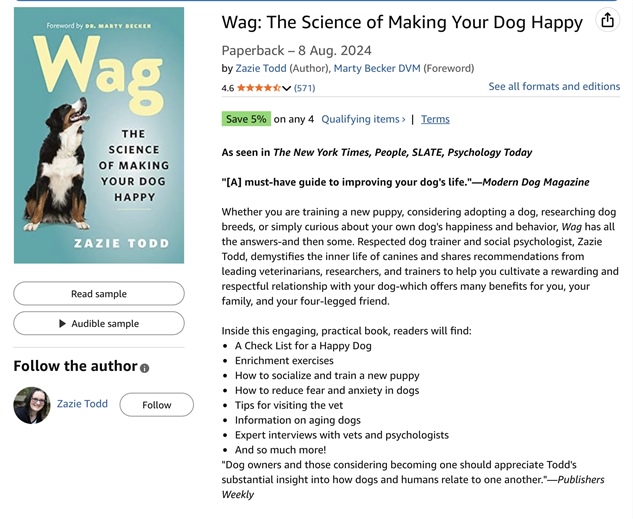
    If you are interested in knowing more about cultivating your relationship with your dog using the latest ethical methods backed up by science, I recommend this book. It is not a training book (although it does explain how dogs learn and how to train using reward based methods), rather it explains the science (in easy to understand language), of how behaviour is driven by consequences, and how to bring bring happiness to your dog’s life (and hopefully to yours).

Reply
  • I was brought up with dogs, I have always loved them, but I can understand where you are coming from as my sister did not cope well with dogs.

    My sister learned to ignore the family dog, in much the same way as  recounts, and soon the two learned to happily share the same room while respecting the other’s boundaries.

    If the time comes that you need to be involved in the ongoing care of the dog, including training, the one piece of advice I can give is for everyone involved to be consistent about the rules and teaching of behaviours. The timing of positive reinforcement is crucial and it is usually best learned through a training class with certified dog trainers who use positive reinforcement (reward based training).

    If you are interested in knowing more about cultivating your relationship with your dog using the latest ethical methods backed up by science, I recommend this book. It is not a training book (although it does explain how dogs learn and how to train using reward based methods), rather it explains the science (in easy to understand language), of how behaviour is driven by consequences, and how to bring bring happiness to your dog’s life (and hopefully to yours).

Children
No Data