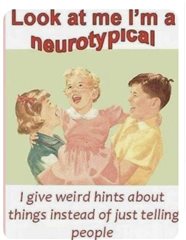
Do NT and ND speak different languages?

Sometimes a NT will ask me something and I don't understand what they are asking or misinterpret it. 

Then the opposite way around I will ask a question so I can make suitable adjustments personally if needed and it can be seen as criticism, because the reason for asking is not understood. 

I am trying to work out if this is simply a communication problem I have or it is to do with the different way a NT brain works.

  • I mean not linguistically like French to English but kind of it’s like we have different cultures different social rules so things may not mean the same. Non verbal language body language can be so

  • I have this with telephone appointments. I had some CBT support at the beginning of the pandemic. On the first call she was late which made me very anxious as I had prepared myself for it.

    Maybe my experience has helped others, as if I have to call someone back at work I try to keep to the time as far as possible, but always explain it may not be exactly.

  • I have found this too! Because I can only deal in certainties, to avoid misunderstandings, I repeat what I have said in a different way to ensure I've been understood correctly. It drives the NT lot barmy. If I don't do it, I can't understand what they mean....You can't win!

    I did have a breakthrough the other day though....A friend said they would call me at 10 am. I took this literally, as how else was I to take it. When they didn't call, I got really upset, and now we have agreed that in future, they will say they will call at ABOUT 10 am, but if something crops up, then it might be later. This seems to work.

  • Yes they do ,there is so much more to language than the meaning of the words ,i have learned over the years i have very slow processing, but usually work out what has happened in about 24 hours ,when i was young i never really understood what was happening around me . It's like being blind to inter personnal communication. The plus side is where i have learned to analyse thing's know ,i do pick up stuff NT's miss . Nt's are always in competition with each other  ,they lie , flatter ,brag, belittle ,praise each other . It's very exhausting trying to understand it all. I can only cope with very small doses of NT's .

  • My big problem with verbal communication face to face Is I lack facial expression and/or body language and depend on what I know to be true without expressing an opinion on what I do not know or what I am unsure about. Then I either go mute or stumble and bumble in a desperate attempt to keep conversational momentum going (babbling blather).  I'm useless at small talk.

  • You might be interested in this research:

    Autistic peer-to-peer information transfer is highly effective - Catherine J Crompton, Danielle Ropar, Claire VM Evans-Williams, Emma G Flynn, Sue Fletcher-Watson, 2020 (sagepub.com)

    Basically, yes, they are discovering that autistic communication is every bit as effective as non autistic people, but mix the two groups and all sorts of miscommunications ensue.  We are in effect speaking different languages.

  • That is interesting, apart from the words, as I don't tend to look at people when speaking I probably do miss the non verbal.

  • The other half does this (takes everything personally) but at most he's just allistic (can't be NT because he has hallmark signs of ADD, so it's possibly a catch on ADHD rejection sensitivity.) He's slowly learning though it's taken some years that it's just a straight forward tone of voice though, and if I really thought he was a w***er I'd just call him one to his face not dance around it like a NT lol.

  • I think we do use language differently. I'm usually fine with metaphor and humour, but sometimes I can't work out if someone is joking or not, or I know they're joking, but don't have a clue what the joke actually is.

    In recent years my communication with my father has got very bad, as he's taken to going off on digressions or jumping from topic to topic and I get confused, particularly as he often starts with a long and irrelevant prologue which I assume is going to be the focus of the communication, but it rarely is. Unfortunately, my mind fixates on the prologue and can't move on to the main topic. I think he struggles with my speech sometimes too, but I'm not sure why. This has led to a degree of mutual tension and frustration between us that I regret, but do not know how to deal with. I've tried explaining this to him, but to no avail, as he accepts my autism, but doesn't really understand it. I'm hoping to watch the Chris Packham autism documentary with my parents at some point in the hope that this might help them understand me better.

  • A Field Guide for Earthlings talks about this. Historically, philosophers have examined this as 2 different approaches to experiencing and relating with the world, I've categorised them as the difference between using language for Function vs Meaning.

    It's one of the main "bio-markers" or traits which differentiate Autism from NT.

    I've found after a painstaking amount of years, if I can remember NTs use words to command or dominate (like some kind of magic spell), when there's confusion, I just make sure to add a form of "light sadness", so I don't appear too confrontational. But just pausing to contain the intensity (this also takes an eye-rolling amount of practice) actually helps produce a response I want without their inability to frame everything within some moral framework. 

    In short: YES. 

  • Well we certainly don’t speak the ‘same’ language, though as time has gone on I have worked out a practical cipher, I know this because I seem to run into less friction.

  • A Field Guide for Earthlings talks about this. Historically, philosophers have examined this as 2 different approaches to experiencing and relating with the world, which I describe as the difference between Function and Meaning.

    It seems the NT brain has this design with it's synaptic pruning to create hyper-connexions in the lobes/areas responsible for language/semiotics (symbols) so words can have this sort of magic and mysticalness. A sort of theatrics with words to create Meaning. Autistics tend to use language as a Function, sensing meaning in the environment around if they're not overwhelmed by it.

    I often find myself re-thinking mid sentence or just before I respond to another now. I've found the most important thing to remember is everything said can be used or recieved as a form of command or dominance. The only way around this (when there seems to be confusion) is to try and express my responsibly within the framework of the question in a way that suggests a very light sadness, like the light sadness of a show you loved being cancelled or a fun moment from childhood you won't be able to relive. And it takes a moment to conjure up this kind of expression of 'light sadness' - a full breath. a pause. a hum or sigh. a remembering the sort of intensity I need not exhibit. I don't make this kind of effort for everyone, but when it matters. Over time, people begin to understand who I am through my expression of values: reliability, kindness, generosity, etc. Building few and specific key relationships seems the only way to prove our intent.

    The short answer is YES. And this is one of the key differences between Autism and ADHD internally (besides our neuro-friends appearing from a completely other dimension of time and seeming to only need half the amount of sleep! LOL)

  • I get really fixated on trying to ascertain what exactly was meant in a conversation. Why did they choose to use the exact words that they did. Why was emphasis placed on a certain word or words. Drives me mad haha

  • This is something I have often thought about too.

    Language and communication can be interesting at times. Words can be quite fluid depending on the various contexts they are used in. This makes communication via words sort of imperfect anyway, but even more so when you factor in the idea that the words themselves don’t really matter all that much in an NT conversation (this is a hypothesis based on observation and my on tangents of thought, rather than fact).

    Unfortunately, I think a lot of communication in the NT world can rely on non verbal aspects even during a conversation where there is an opportunity to use words to mean what they actually mean. Even in these moments, I think non verbal stuff can take priority and things like tone of voice (which I really struggle to pick up on) often overrides the actual word meaning. A classic example is “have I upset you somehow?” “No, I’m fine” etc. An autistic person might take these words at face value and move on, after all, they have been selected for what they represent right? This then is somehow seen as a huge deal and insulting etc. But someone else (possibly NT) will be listening out for tone of voice to suggest that this answer isn’t the case and react to this. But they might also be looking for body language (whatever that’s supposed to mean) and facial expressions that again suggest otherwise.

    The problem with this is that words become meaningless and guesswork based on subtle clues needs to be used to fill in the gaps.

    When you add in the often shared experiences that we describe here on picking up on these aspects of communication, or rather, not picking up on them and add this to the feeling of often being misunderstood for actually speaking our minds or being persecuted for the selection of certain words (which are often very technically accurate) I think we land on a difficulty in communication between the ND and NT populations. I think this is known as the Double Empathy Problem, or at least could be an application of it anyway.

    This is an imperfect explanation, but it is an attempt at putting some of my thoughts to paper on the matter. I still have work to do on understanding this really, but I’m happy with this as a starting point.

    Apologies for the essay.

  • Thank you. That's a helpful way of describing it.

  • My GP told me that being autistic means I have a different operating system to my neurotypical colleagues. Because of that any information I wish to give to them, I have to change into a way that their operating system can read, and any information that they share with me, I have to turn that into a format my operating system can read.

    I actually found her analogy to be quite helpful, hope it help you too Grinning