The Naming Ceremony: Is Diagnosis a Modern Shamanic Ritual?

While the clinical world is often obsessed with "disorders," most of us know that’s a fundamentally broken way to describe our experience. Lately, I’ve been thinking that for many in the neurodivergent community, getting that formal recognition—or finding your own path to self-understanding—feels less like a medical report and more like a naming ceremony.
I have to give a huge nod to TheCatWoman for this spark. In a recent chat, she used the brilliant analogy: trying to run a neurodivergent brain on neurotypical psychology is like trying to run Windows on an Apple. It got me thinking—if the "operating systems" are that different, then the people who originally built these theories weren't really scientists in the modern sense. They were more like 20th-century shamans trying to map a spirit world they didn't fully understand.
In ancient cultures, a naming ritual was a way to reintegrate someone whose "spirit" seemed at odds with the world. Once named, the "problem" became a "trait," and the person could finally take their rightful place in the tribe. Whether that name comes from a formal assessment or through the "vision quest" of self-diagnosis, it’s a powerful moment of literal recognition. It's like finally identifying with your own spirit animal—finding the creature that actually matches your tracks, rather than trying to pretend you’re a wolf when you’re actually a horse.
I also noticed NAS recently asking the community to share their own tips for securing reasonable adjustments. I suspect they may have been pivoting from my earlier post about being fed up with the lack of them! In this shamanic framework, when a group asks the tribe for their "how-to" guides, they are gathering the communal wisdom needed to help us become the Architects of our own Sacred Space.
These adjustments—whether it's noise-cancelling, flexible hours, or literal task lists—are the protective boundaries that stop our "Apple" OS from overheating in a "Windows" world and the horses getting predated by the wolves.
For those of you who have found your "Name"—whether through a clinician or your own research—did it feel like a clinical label, or did it feel like a ceremony that finally brought your soul home?
  • I'd say so up front when when asked to do the task and probably make myself unpopular by refusing to discuss it. Then I'd probably make it even worse by asking lots of questions about why the group is being run as it is and ask if anyone else felt as I do? I can't help it, I'm just a natural rebel and I've torn my dress and my face is a mess!

  • Those are really good questions.  I need to sit back and guard my energy for a bit so I won't jump back into giving what my answers to them might be right away and will sit and ponder them...  I wonder what  and the rest of the group or indeed yourself  have as answers to them?

  • What if you don't use stimming toys? Do you have to talk about them anyway? DO you have a chance to tell the wider group?

  • I want to start by sincerely apologizing for the delay in responding to your post  ; I’m navigating my own "processing traffic jam" and wanted to make sure I could give your words the focus they deserve.
    I really hear the weight of what you’re saying about "contrived" structures. There is a massive difference between the organic bonds we form on our own terms and the top-down rituals designed by systems that don't always prioritize our actual quality of life.
    When a group forces you into "NT group categorization"—like being required to break off into mini-chat groups to talk about specific toys—it can feel deeply unnatural. It often triggers a sense of distrust because, as you rightly pointed out, naming and subdividing have historically been used as methods of control and normalization. You aren't being "pessimistic" by questioning the intent behind these rituals; you are being analytically honest about a system that feels like another "long distance run around."
    This is exactly why I’ve been focusing on building my own "bridges" rather than following preconditioned goals. For me, "self-healing" isn't about fitting into a new set of boxes; it’s about stripping away those human rituals and trusting my own internal sense of equilibrium.
    We don't need to believe in "shamans" or "charlatans" to find a sense of belonging. Sometimes the most radical thing we can do is reject the rituals that don't serve us and connect through our shared experience of navigating these illegal or illogical systems. Thank you for bringing that critical inquiry to the thread—it’s a necessary anchor for all of us.
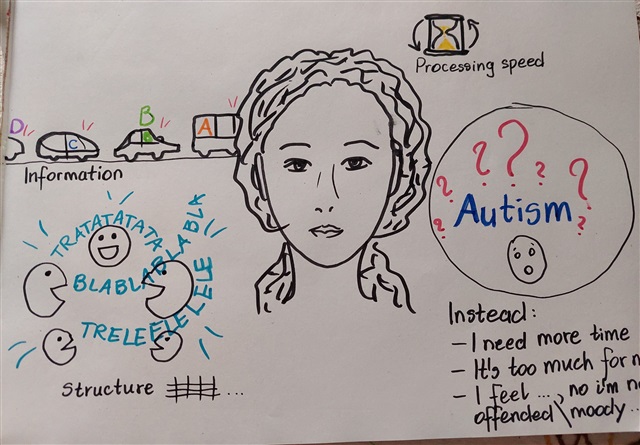
  • This is such a powerful visualization! You’ve captured the "traffic jam" perfectly. Seeing those cars (A, B, C, D) queued up behind the hourglass really highlights that your brain is handling a high volume of detail—it’s not a lack of speed; it’s just a lot of data!
    I especially love your "Instead" list at the bottom. By using phrases like "I need more time" or "It’s too much for me," you are doing exactly what we have been discussing—you are building a bridge. You are replacing that big, confusing "Autism?" question mark with practical tools that let people meet you halfway.
    The way you’ve drawn the "BLABLA" circle shows exactly why the internal switchboard can feel so overwhelmed. It’s a lot of noise to filter! But as you use those "Instead" phrases to protect your energy and lower that internal tension, you are helping those "cars" move through the hourglass much more smoothly.
    Excellent work on this—it’s a beautiful map of your own new construction!
  • I love that you’ve taken the "traffic jam" idea and turned it into a tool for self-kindness. It is so true that we are often our own harshest critics when our processing doesn't match the speed of the world around us.
    Using that phrase for your "self-talk" is a brilliant bit of personal bridge-building. In my own experience, when I get frustrated with a delay, my stress levels spike, which usually just makes the jam worse. But by being patient and saying, "We are all going to get there," you are sending a signal of safety to your own system.
    That shift into a kindly internal voice helps lower the "fight-or-flight" tension that caused the jam in the first place. You’re essentially giving your brain the green light to clear the queue at its own natural pace. It’s a great way to move from the "Monkey Mind" of self-criticism to the "Horse Mind" of structural patience!

  • Just a picture how I visualise it

  • traffic jam in my head

    What an excellent expression - I will try to remember that phrase. 

    I think it would be a useful way to encourage my more kindly "self-talk".

    We can sometimes be more kindly spoken to others than we remember to be to ourselves.

    Note to self: "Be patient; it is a traffic jam in my head, we are all going to get there: as it naturally resolves".

  • One last thing I’ve been diving into lately is how long this "new construction" actually takes. Since you mentioned being in self-healing mode, it’s helpful to know the biological timeline so you don't feel discouraged if it feels like a slow climb.
    From what I’ve gathered through my special interest in the nervous system, it usually takes about 8 weeks of consistent "safe" experiences for the brain to start physically settling that internal alarm system. By around 6 months, the resting levels of stress hormones in the body often start to recalibrate—this is when that "traffic jam" starts to feel less like a permanent state and more like an occasional glitch.
    By about a year, the new, relaxed pathways we’re building become "myelinated"—essentially, the brain puts high-speed insulation on them so they become your new default path of least resistance.
    I've found it really helps to look for the tiny shifts in resting arousal rather than waiting for a total overhaul. Even those reasonable adjustments you've made at work are like the first bricks in a year-long project. It’s a marathon, not a sprint, but the biology is definitely on your side!
  • It is so interesting that you mentioned being in "self-healing mode." I’ve actually made a bit of a special interest out of how our nervous systems handle stress, and there is a really cool connection there to that "neurological hearing" you mentioned.
    One seed I’d love to plant is that when we are in a high-stress state (the fight-or-flight mode), our brains actually change how our ears filter sound. It starts listening for "threats" and can accidentally gate out human voices. It’s like the brain prioritizes survival over conversation.
    The self-healing you are doing to lower that stress is actually the key to opening those gates back up. As you lower that internal tension and feel safer in your environment, the "switchboard" in your brain gets more bandwidth to process the traffic jam. You might find that as you get more comfortable with your adjustments and feel less "on guard," your brain has an easier time letting those voices through, even when you are in a deep monotropic flow.
    You are already doing the work by finding solutions that work for you—that is the best kind of new construction for your brain!
  • I really get that "traffic jam" feeling in the head  —it's a perfect way to describe it. From a neuro-physio perspective, what you are describing with your hearing is a great example of how the brain's switchboard can get overwhelmed even when the ears themselves are working at 100%. It is often less about hearing the sound and more about the brain's ability to interpret the data.
    You are likely spot on about the stress, too. When the system is under high pressure, the brain has a process called sensory gating. Think of it as a filter that decides what information is important enough to let through. When the stress gets too high, the brain can actually start to close those gates to protect itself from further overload. This can lead to that "gating out" of sounds or even those dizzy spells when the internal queue just gets too long.
    The fact that your manager values your attention to detail is excellent. That same high-volume processing that causes the traffic jam is exactly what allows you to spot the problems others miss. You have already found your own reasonable adjustments, and that is a major part of the social rehab we have been talking about. You are leaning into your strengths while giving your brain the time it needs to clear the queue.
    If you ever want to look into the general evidence base for how these neurological filters work, I would be happy to point you toward some interesting literature on it!
  • Your response touched me, thank you. I noticed that im usually on a self healing mode. Because I could never rely on the system or external help,  so I always worked myself alone. I know, that my issues with reactions to being called for example,  are related to neurological issue and not hearing loss, because I had recently a hearing test and the result is excellent hearing, 100%. The doctor himself suggested neurological issue. Then I had a blood test because of me feeling kind of dizzy without any clear reason. Also everything is fine, separately tested for diabetes- negative result. And here I also heard - neurology. 

    Access to doctors is very limited here where I'm living, so it's all complicated. I realised that I used to have some reasonable adjustments at work even before knowing about autism and suspecting it in myself. There was a need- so I found a solution. My manager has no problems with my reasonable adjustments,  I also heard that he is satisfied with my work, because of my attention to details.  Sometimes when I detect a problem, I have some sort of traffic jam in my head (too much information to queue,  to process) it happens that I report it to him with a delay. And he was still very much amazed that i noticed and remembered that detail.

  • I really get what you said about the lost generation. That feeling of guilt or doubt about claiming the label without a formal diagnosis is so common, but you hit the nail on the head: it is about belonging and understanding your experience, not just a medical certificate.
    What you are doing with your manager is brilliant. By saying "my brain handles a higher volume of detail" or "it is too fast and chaotic," you are doing exactly what we have been discussing here—you are building a bridge. You aren't asking them to understand a medical textbook; you are giving them the practical tools to meet you halfway.
    In any kind of recovery, we are usually inclined to start with small wins just to get moving. Sometimes I struggle to be clear myself, but I want to make sure I'm clear here: what you have achieved with your manager is a big win. Explaining that your brain is simply processing a deeper level of information is often more life-changing than the diagnosis itself because it gives you a functional map for your own mountain climb. Excellent—a big "Yes!" of congratulation for you finding that sense of belonging and the words to describe your world.
    As I was just mentioning to ArchaeC in our thread, as a neuro-physio, I see this kind of shift as a form of social rehab. By using that specific language, you are literally firing new neural circuits that make your environment safer and more regulated. It’s a different kind of tired than the shame of masking because you are building a brain that actually feels seen.

  • wolves running horses in the sense of controlling them? no that doesn't sound like a good idea to me either - now running alongside or even a game of chase I am happy with  PS used your "sometimes your enemy is your best teacher"  logic today - fab. it works great of course :-) hehe " blessed be" is translated to "May all things go as you wish," among my crowd or as I might say: "All the Best"  thanks again

  • The sense of belonging is one of the basic human needs. Big world failed to give me this sense, this forum is the first place that gave me this. It's crucial for my wellbeing and therapeutic although only online. Sometimes I feel guilty for kind of claiming tge label, that was not given to me by a medical professional, and there is the doubt. But for me it's not about identity, it's about belonging. I belong here through my experience shared with other members of this group. I can't say if it's medical or ceremonial for me. Maybe both in some ways or none of them. I'm aware of myself being currently not so strongly affected by these autistic symptoms, there are people out there who are currently struggling much more than me now, or even more than me in the past. I'm almost sure that if I was a kid or teenager right now, I would get diagnosed and hopefully supported. Maybe I could avoid the horrible trauma that I went through. I'm in the lost generation. I have very faint chances of getting ever tested. In my area all diagnostic centers are fully booked. Additionally I can see the anger that there are too many people getting this diagnosis. I don't want drama, I need peace. There might be some false positive,  but I think that all this mess exists because the condition is being researched,  explored, more recognised, plus there are people from the "lost generation" who got recognised or recognised themselves late in life. Like myself. And the problem is that the system is totally not prepared for that. It's hard to say,  whose fault it might be. Sometimes I feel guilty for that although it's illogical because I'm just one person with one life experience and I have very little or no influence on what's going on.

    Finding tge name for my struggles is important,  but for me the most Important thing is finding names for the separate symptoms and understanding myself better. Even if I was diagnosed,  I would still not explain to other people,  that im autistic. Because of the general ignorance around tge topic that explanation wouldn't help me much. Instead I found my own ways. For example- I have slower processing, could you please repeat? Or I told my manager- I don't hate people,  I'm not sad or angry, I just can't take part in social chat, because it's too fast too much and too chaotic. This helped me a lot, because then it's clear for my colleagues why I talk so little and only in a one-one setting. This made my manager look at my direction too when they all sit and chat. This way he shows me that I'm also Included. 

    Earlier I had no words for my symptoms,  traits and weirdness. I struggle to recognise what I'm feeling, so whenever I heard from others "why you are so moody?" I felt somehow frustrated and angry at myself. I aldo recognised that after many years. So this is how "self realisation" and therapy,  even without formal diagnosis MAY help in everyday life.

  • You're welcome, I'm glad our wyrd threads are running alongside eachother, I'm finding it an enriching experience. As for how long it lasts, well, thats a how long is a piece of string question, lol.

  • I don't like the idea of NT's running ND groups either, I know they mean well and think they have our best interests at heart, but there always seems to be such a mismatch.

  • I am struggling a lot lately just because I want to believe that these groups or bonds we are forming are our own and not contrived by some greater entity that doesn’t have our quality of life as a priority. 

    I have felt attending a late diagnosed group recently that whilst I felt this was warm and welcoming, the structure of this to me appears like nt group categorisation. Even within the ms teams meeting we were required to break off into mini chat groups. Talk about stimming toys etc, a lot of it feels really unnatural to me. Without wanting to sound too distrusting or pessimistic feels like top down organisation in a neurotypical way, not run or designed by nds although they are certainly the concern of the group chat. 
    I see all of this as further human ritual, identifying, naming, separating subdividing are all methods used to excercise control. It does concern me if I question systems and intent behind rituals. But why do we still feel the way we do? Because in many cases history has proven these to be the continued normalisation of discrimination. Shamans are also in some ways charlatans and rely on others being misinformed or believing in them. Information is so widespread and fragmented now that’s virtually impossible to impose belief on someone in that way. 

    It’s important to look at all of the outside possibles that may not have been considered. What if we are preconditioned to believe what other people want to serve their goals, what if Neurotypicals are sending us (on a long distance run around) wasting our time?  Because many of the things I have gone through are illegal, yet it seems the laws and society are in no rush to change - there’s no plausible explanation for why that is?

  • That’s a powerful reflection to receive while I'm literally out in the soil planting up seedlings. 
    The idea of the 'enemy as teacher' is a heavy one. It makes me realize that sometimes, in our search for the 'solid' truth, we can accidentally create friction with the very things we’re trying to grow.
    I’ve definitely been looking at my own expectations today. There’s a balance between wanting things to be 'Fibonacci-perfect' and just letting the plant be what it is. If I’ve been holding the pruning shears too tightly lately, your words are a good reminder to put them down and just let the garden breathe.
    Thank you for being a 'teacher' today. It’s given me a lot to sit with while I finish the planting.