Is the Idea of the Autism Spectrum Completely Wrong?


New Scientist Magazine’s lead article considers if the idea of autism as a spectrum is completely wrong.

Team member and geneticist Olga Troyanskaya at Princetown University and the Flatiron Institute states, “the researchers were surprised by how strongly the four groups came out of the data. "Every individual is unique, but there do seem to be these replicable groups."

New Scientist discusses the study by Geneticist Natalie Sauerwald and her colleagues at the Flatiron Institute in New York. “They used a dataset from Simons Powering Autism Research, a research study that is led by the autistic community, which included 5392 autistic people—an order of magnitude more than previous studies”. They too found patterns in the combinations of traits that fell into four subgroups. It is unclear how these two studies and other subtype studies fit together.

In the article, Anoushka Pattenden of the National Autistic Society has concerns, "We fear that further categorising of autism is unhelpful and may lead to more stigma or discrimination,"

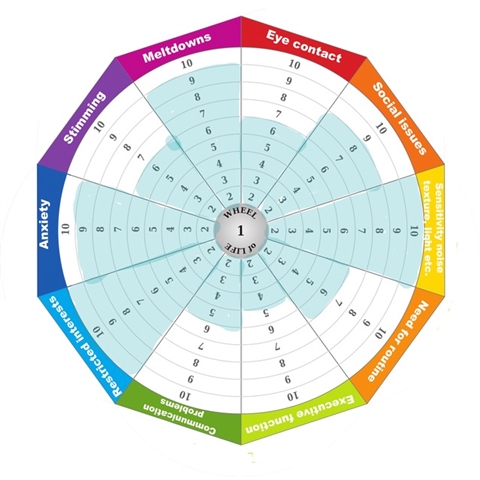
New Scientist science writer Michael Marshall considers “The idea of an autism spectrum, where autistic people have similar traits only to a greater or lesser extent […] is challenged by studies that find that autism may come in multiple distinct forms. These subtypes have more in common with the colour wheel picture of autism […], which plots the extent to which an autistic person experiences each trait as you move around the spokes of the wheel”. 

”The researchers hope that a respectful approach to subtyping can reveal autism's underlying biology in a way that also brings this colour wheel, and the lived experiences it contains, into focus”.

The full article (pay to subscribe) is at the link, but New Scientist and other magazines and books are available to read free of charge through public libraries. You need to become a member first and then download the Libby app to read.

https://www.newscientist.com/article/2509117-what-if-the-idea-of-the-autism-spectrum-is-completely-wrong/

I’m content to take a ‘wait and see’ approach to what future research might reveal. I believe there are potential benefits to moving to four subtypes, but I have concerns that some people might end up not in any category and that it could end up stigmatising some groups more than others. As it is, the spectrum model of autism does not reflect what it is to be autistic and I don’t consider myself ‘disordered’ (Perhaps it would be more accurate to suggest that the thinking that lead to such a label was disordered?). I’m glad that the value of the autism colour wheel model is recognised by scientific researchers and New Scientist Magazine. Perhaps that is a big step towards encouraging psychiatrists to evaluate their terminology when talking about and to autistic people.

Any thoughts?

  • I find the hardest thing is trying to rate myself as someone else said too. (can't find that post sorry)

    I suppose it's very autistic, but wouldn't it be awesome to have a description of each level in each segment so to be sure you can grade yourself accurately. But then it varies on our stress level too. So I can do eye contact fine, unless I am talking about personal things, then I can't even look in that persons direction it's so bad.


  • Here's an example (click or tap on it to enlarge):

    Source: Clare Jack

  • So the spoke/segments are the same thing.

  • I’ll try to find a clear version of the colour wheel. Actually, it doesn’t even have to be colour as it can just be a wheel with a central hub and a limited number of spokes to represent each trait. The degree each trait affects a person is plotted on an imaginary line along a spoke between 0 - 10. 

  • The colours are irrelevant, they don't contain any information.

    It is just a circle chopped into segments, where each segment is an attribute. The size of the segment is related to how much you have or don't have the item.

    The segments are not related to each other, so just because one is next to another, it doesn't imply any link. They are separate discrete items.

    The colours are just to make it look pretty, as far as I can tell.

  • For me the colour wheel isn't about how I consider autism, but simply I don't understand it, it might be that I've only seen it online and it's been quite small and I'm unable to see it properly, but I have problems with that sort of thing in general. Plus I understand colour wheels in terms of colour, for planing what colours to use in a persons hair, to what plants to put together, so I can get a bit muddled

  • I find it quite exciting that biology and genetics might contribute to the rewriting of the definition of ASD in the DSM. The article also mentions that education will be needed to dismantle harmful stereotypes. If it stops someone saying “You don’t look autistic” to a person who discloses they are autistic but who doesn’t look like Autistic Barbie, it would be a good thing. I remember being told that when I naively told someone that I was autistic shortly after diagnosis. I felt dreadful, it was compounded by being undermined for many of the things I had struggled with because of being autistic.  

    I get that the colour wheel mightn’t be how everyone considers autism and it is after all just a type of ‘metaphor’ for traits in visual form, rather than something that accurately describes what autism is. Although I prefer the colour wheel model of autism to the linear spectrum model, I tried to complete a personalised version yesterday which required me to score each trait between 1 - 10. It was like trying to give a pain score which is practically impossible for me. 

  • I dislike the term disorder too, no matter what the dictionary might say, maybe the dictionary needs changing as well as the term disorder?

    Having recently read Gina Rippons, The Lost Girls of Autism, I agree that there seem to be at least two different forms of autism and the idea that there maybe four dosen't surprise me. Autism research has been so narrowly focussed for far to long and the studies have to few samples, especially women, even meta data research can be a bit skewed as there's little idea of what question/s were being asked by the original researchers, how they selected thier study groups etc.

    Maybe I will get myself a copy of NSM and have a read.

    Being one of the high functioning autist's I certainly feel unsupported in general, there's no help at all outside of agencies such as CAB for benefit and legal stuff. I go completely to pieces when confronted by a form and need help, they provoke brain fog and I need help understanding the questions, let alone answering them. I'd rather write a 10k word essay than fill in even a simple form.

    I've not got my head around the colour wheel thing yet, so don't know how it works, what added insights it gives or how it would help me longer term.

  • That's really useful, Bunny. Thank you!

  • This is the problem in some ways because the labels of traits Arte skewed towards a neurotypical point of view. ‘us’ as opposed to them.

  • Likewise, I don't think of myself as having a disorder or a disability. However, society tries to disable me by judging some of my (harmless) behaviours as disordered.

  • It may help you to realise that it is autism that is the disorder ( as defined by https://www.dictionary.com/browse/disorder - a disturbance in physical or mental health or functions; malady or dysfunction. ). You have a condition that is a disorder, not that you are necessarily personally disordered - a distinct difference).

    I should have explained that ASD is the abbreviated form of the medical term Autistic Spectrum Disorder as listed in the DSM, and perhaps added more background information to the piece. It is a long article and I couldn’t copy it all because it would have infringed copyright, so I had to paraphrase and use shortish quotes.

    Your comment doesn’t help me because I’m aware that medical people have classified ASD under disorders. Like many others I feel that I am autistic rather than having ASD. In other words, autism is part of my whole being in the same way as I am a woman, I am tall etc. Even if I were to have a disorder rather than being disordered, personal insults occur, even on this site, and I don’t want to be called disordered. 

    The Chambers Dictionary is my usual trusted source:


    disorder /dis-örˈdər/

    noun

    1. Lack of order
    2. Confusion
    3. Disturbance among the public, breach of the peace, crowd violence, rioting, etc
    4. A malfunction of the body, an ailment or illness

    transitive verb

    1. To throw out of order
    2. To disarrange, to reduce to confusion
    3. To disturb the balance of (the mind, etc)
    4. To disturb the health of, to produce disease in

    ORIGIN: OFr desordre, from des- (L dis-; negative) and ordre order

    disorˈdered adjective

    Confused, deranged

  • From:

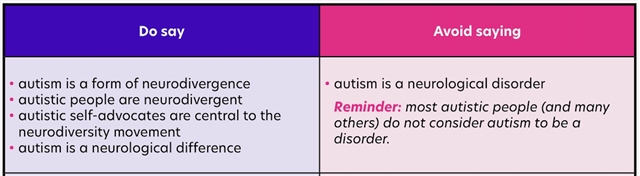
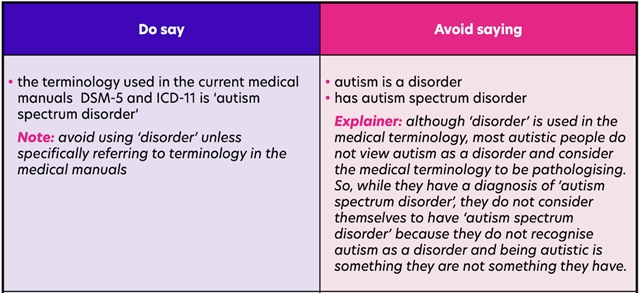
    NAS - How to talk and write about autism

    "This guidance is based on our language research on the preferences of autistic people, heir families and professionals, as well as the feedback and insight we get from our supporters and wider work."

    Side-note: for reasons I've explained previously (here and here), "neurodiverse" is not listed anywhere in the linked document's "Do Say" column. The top-left box refers to how neurodivergence and neurodivergent are the appropriate words to use, whilst the top-right and others discuss "disorder" and the autistic community's majority preference, in respect of your exchanges with  and  .

  • Maybe recognising subtypes would help diagnosed people get the right support, as I can see here this topic repeats constantly "I'm diagnosed,  but can't access any support" especially the "high functioning" or in other words "without intellectual disability" autistic people struggle to get any support or adjustments. 

    I feel disordered, especially when I'm around other people. Since my childhood I feel that im "mildly disabled". When I'm alone, pacing my kitchen happily or engaging in other "obsessive" and repetitive activities, then I don't feel disordered at all. Then I feel that everything is perfect and as it should be.

  • I don't like with the one big bucket for everything approach, as it it so vague the help is hard to target and it is harder for people to understand themselves.

    Four sub-groups would help if that's what the data shows. I think this came up last year in another article. I would think it might be possible to have traits from more than one, but it would still be useful.

    You still have the top level name to put the groups under, so there is still one identity to put on the banner if you want. 

    Otherwise it is like saying you don't want to distinguish between broken leg, broken finger, broken rib, broken skull, because it diminishes the broken bone community. Lumping things together when they are really different in terms of treatment is not helpful in my opinion.

  • It can be perceived as rather than 'it is'.

    The current version of the DSM defines it as a disorder which as the core reference point for any diagnoses so if you start deciding to not accept their definitions then things start to unravel fast.

    You can choose to call it anything you want I guess - it does not make it any more or less right, it just puts you at odds with those who define the terminology we use.

    I fear we have too many situations where people are trying to change meanings of words and it is muddying the waters of how autism is seen by those we need help from. This is why I advocate for using the official meanings.

  • It may help you to realise that it is autism that is the disorder

    It can be perceived as rather than 'it is'.

  • As it is, the spectrum model of autism does not reflect what it is to be autistic

    The single biggest benefit of keeping the term of a spectrum is that it allows NTs to see us as a group who have similar traits but are all different. Without it we would lack a cohesive identity to use to advicate for our rights, our recognition and for support.

    I agree it is an imperfect model but if we keep changing out identify by redefining ourselves everytime a discovery is made then it makes us harder to be visible in a way the public, employers and support services can latch onto.

    I don’t consider myself ‘disordered’ (Perhaps it would be more accurate to suggest that the thinking that lead to such a label was disordered?)

    It may help you to realise that it is autism that is the disorder ( as defined by https://www.dictionary.com/browse/disorder - a disturbance in physical or mental health or functions; malady or dysfunction. ). You have a condition that is a disorder, not that you are necessarily personally disordered - a distinct difference).

    I think this is what you are referring to but it wasn't clear to me.