Is the Idea of the Autism Spectrum Completely Wrong?


New Scientist Magazine’s lead article considers if the idea of autism as a spectrum is completely wrong.

Team member and geneticist Olga Troyanskaya at Princetown University and the Flatiron Institute states, “the researchers were surprised by how strongly the four groups came out of the data. "Every individual is unique, but there do seem to be these replicable groups."

New Scientist discusses the study by Geneticist Natalie Sauerwald and her colleagues at the Flatiron Institute in New York. “They used a dataset from Simons Powering Autism Research, a research study that is led by the autistic community, which included 5392 autistic people—an order of magnitude more than previous studies”. They too found patterns in the combinations of traits that fell into four subgroups. It is unclear how these two studies and other subtype studies fit together.

In the article, Anoushka Pattenden of the National Autistic Society has concerns, "We fear that further categorising of autism is unhelpful and may lead to more stigma or discrimination,"

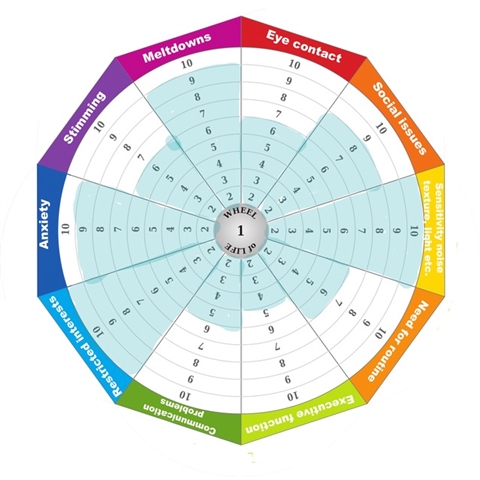
New Scientist science writer Michael Marshall considers “The idea of an autism spectrum, where autistic people have similar traits only to a greater or lesser extent […] is challenged by studies that find that autism may come in multiple distinct forms. These subtypes have more in common with the colour wheel picture of autism […], which plots the extent to which an autistic person experiences each trait as you move around the spokes of the wheel”. 

”The researchers hope that a respectful approach to subtyping can reveal autism's underlying biology in a way that also brings this colour wheel, and the lived experiences it contains, into focus”.

The full article (pay to subscribe) is at the link, but New Scientist and other magazines and books are available to read free of charge through public libraries. You need to become a member first and then download the Libby app to read.

https://www.newscientist.com/article/2509117-what-if-the-idea-of-the-autism-spectrum-is-completely-wrong/

I’m content to take a ‘wait and see’ approach to what future research might reveal. I believe there are potential benefits to moving to four subtypes, but I have concerns that some people might end up not in any category and that it could end up stigmatising some groups more than others. As it is, the spectrum model of autism does not reflect what it is to be autistic and I don’t consider myself ‘disordered’ (Perhaps it would be more accurate to suggest that the thinking that lead to such a label was disordered?). I’m glad that the value of the autism colour wheel model is recognised by scientific researchers and New Scientist Magazine. Perhaps that is a big step towards encouraging psychiatrists to evaluate their terminology when talking about and to autistic people.

Any thoughts?

Parents
  • I dislike the term disorder too, no matter what the dictionary might say, maybe the dictionary needs changing as well as the term disorder?

    Having recently read Gina Rippons, The Lost Girls of Autism, I agree that there seem to be at least two different forms of autism and the idea that there maybe four dosen't surprise me. Autism research has been so narrowly focussed for far to long and the studies have to few samples, especially women, even meta data research can be a bit skewed as there's little idea of what question/s were being asked by the original researchers, how they selected thier study groups etc.

    Maybe I will get myself a copy of NSM and have a read.

    Being one of the high functioning autist's I certainly feel unsupported in general, there's no help at all outside of agencies such as CAB for benefit and legal stuff. I go completely to pieces when confronted by a form and need help, they provoke brain fog and I need help understanding the questions, let alone answering them. I'd rather write a 10k word essay than fill in even a simple form.

    I've not got my head around the colour wheel thing yet, so don't know how it works, what added insights it gives or how it would help me longer term.

  • I find it quite exciting that biology and genetics might contribute to the rewriting of the definition of ASD in the DSM. The article also mentions that education will be needed to dismantle harmful stereotypes. If it stops someone saying “You don’t look autistic” to a person who discloses they are autistic but who doesn’t look like Autistic Barbie, it would be a good thing. I remember being told that when I naively told someone that I was autistic shortly after diagnosis. I felt dreadful, it was compounded by being undermined for many of the things I had struggled with because of being autistic.  

    I get that the colour wheel mightn’t be how everyone considers autism and it is after all just a type of ‘metaphor’ for traits in visual form, rather than something that accurately describes what autism is. Although I prefer the colour wheel model of autism to the linear spectrum model, I tried to complete a personalised version yesterday which required me to score each trait between 1 - 10. It was like trying to give a pain score which is practically impossible for me. 

  • For me the colour wheel isn't about how I consider autism, but simply I don't understand it, it might be that I've only seen it online and it's been quite small and I'm unable to see it properly, but I have problems with that sort of thing in general. Plus I understand colour wheels in terms of colour, for planing what colours to use in a persons hair, to what plants to put together, so I can get a bit muddled

  • I find the hardest thing is trying to rate myself as someone else said too. (can't find that post sorry)

    I suppose it's very autistic, but wouldn't it be awesome to have a description of each level in each segment so to be sure you can grade yourself accurately. But then it varies on our stress level too. So I can do eye contact fine, unless I am talking about personal things, then I can't even look in that persons direction it's so bad.


  • Here's an example (click or tap on it to enlarge):

    Source: Clare Jack

  • So the spoke/segments are the same thing.

Reply Children
No Data