Is the Idea of the Autism Spectrum Completely Wrong?


New Scientist Magazine’s lead article considers if the idea of autism as a spectrum is completely wrong.

Team member and geneticist Olga Troyanskaya at Princetown University and the Flatiron Institute states, “the researchers were surprised by how strongly the four groups came out of the data. "Every individual is unique, but there do seem to be these replicable groups."

New Scientist discusses the study by Geneticist Natalie Sauerwald and her colleagues at the Flatiron Institute in New York. “They used a dataset from Simons Powering Autism Research, a research study that is led by the autistic community, which included 5392 autistic people—an order of magnitude more than previous studies”. They too found patterns in the combinations of traits that fell into four subgroups. It is unclear how these two studies and other subtype studies fit together.

In the article, Anoushka Pattenden of the National Autistic Society has concerns, "We fear that further categorising of autism is unhelpful and may lead to more stigma or discrimination,"

New Scientist science writer Michael Marshall considers “The idea of an autism spectrum, where autistic people have similar traits only to a greater or lesser extent […] is challenged by studies that find that autism may come in multiple distinct forms. These subtypes have more in common with the colour wheel picture of autism […], which plots the extent to which an autistic person experiences each trait as you move around the spokes of the wheel”. 

”The researchers hope that a respectful approach to subtyping can reveal autism's underlying biology in a way that also brings this colour wheel, and the lived experiences it contains, into focus”.

The full article (pay to subscribe) is at the link, but New Scientist and other magazines and books are available to read free of charge through public libraries. You need to become a member first and then download the Libby app to read.

https://www.newscientist.com/article/2509117-what-if-the-idea-of-the-autism-spectrum-is-completely-wrong/

I’m content to take a ‘wait and see’ approach to what future research might reveal. I believe there are potential benefits to moving to four subtypes, but I have concerns that some people might end up not in any category and that it could end up stigmatising some groups more than others. As it is, the spectrum model of autism does not reflect what it is to be autistic and I don’t consider myself ‘disordered’ (Perhaps it would be more accurate to suggest that the thinking that lead to such a label was disordered?). I’m glad that the value of the autism colour wheel model is recognised by scientific researchers and New Scientist Magazine. Perhaps that is a big step towards encouraging psychiatrists to evaluate their terminology when talking about and to autistic people.

Any thoughts?

Parents
  • As it is, the spectrum model of autism does not reflect what it is to be autistic

    The single biggest benefit of keeping the term of a spectrum is that it allows NTs to see us as a group who have similar traits but are all different. Without it we would lack a cohesive identity to use to advicate for our rights, our recognition and for support.

    I agree it is an imperfect model but if we keep changing out identify by redefining ourselves everytime a discovery is made then it makes us harder to be visible in a way the public, employers and support services can latch onto.

    I don’t consider myself ‘disordered’ (Perhaps it would be more accurate to suggest that the thinking that lead to such a label was disordered?)

    It may help you to realise that it is autism that is the disorder ( as defined by https://www.dictionary.com/browse/disorder - a disturbance in physical or mental health or functions; malady or dysfunction. ). You have a condition that is a disorder, not that you are necessarily personally disordered - a distinct difference).

    I think this is what you are referring to but it wasn't clear to me.

  • It may help you to realise that it is autism that is the disorder

    It can be perceived as rather than 'it is'.

  • It can be perceived as rather than 'it is'.

    The current version of the DSM defines it as a disorder which as the core reference point for any diagnoses so if you start deciding to not accept their definitions then things start to unravel fast.

    You can choose to call it anything you want I guess - it does not make it any more or less right, it just puts you at odds with those who define the terminology we use.

    I fear we have too many situations where people are trying to change meanings of words and it is muddying the waters of how autism is seen by those we need help from. This is why I advocate for using the official meanings.

  • That's really useful, Bunny. Thank you!

  • From:

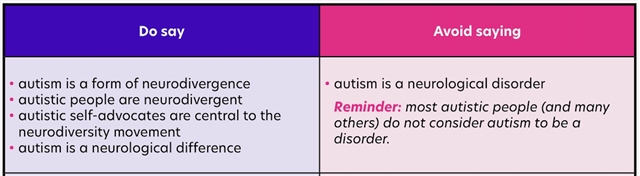
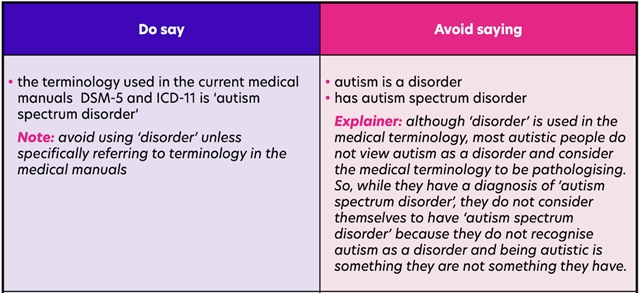
    NAS - How to talk and write about autism

    "This guidance is based on our language research on the preferences of autistic people, heir families and professionals, as well as the feedback and insight we get from our supporters and wider work."

    Side-note: for reasons I've explained previously (here and here), "neurodiverse" is not listed anywhere in the linked document's "Do Say" column. The top-left box refers to how neurodivergence and neurodivergent are the appropriate words to use, whilst the top-right and others discuss "disorder" and the autistic community's majority preference, in respect of your exchanges with  and  .

Reply
  • From:

    NAS - How to talk and write about autism

    "This guidance is based on our language research on the preferences of autistic people, heir families and professionals, as well as the feedback and insight we get from our supporters and wider work."

    Side-note: for reasons I've explained previously (here and here), "neurodiverse" is not listed anywhere in the linked document's "Do Say" column. The top-left box refers to how neurodivergence and neurodivergent are the appropriate words to use, whilst the top-right and others discuss "disorder" and the autistic community's majority preference, in respect of your exchanges with  and  .

Children