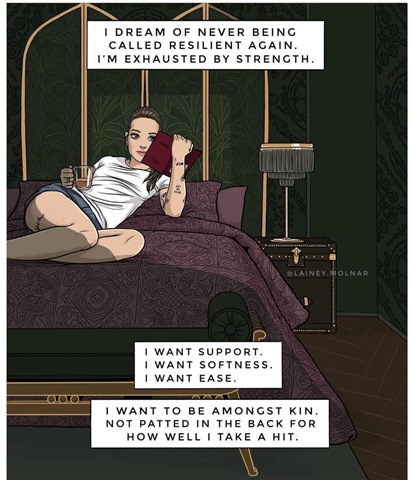
Inner strength

I've been thinking about this a bit.

If you can go for years with no physical contact, limited social interactions, no real friends, no close family, just supporting yourself, working and paying taxes, dealing with issues alone, making no demands on others and adapting to fit in, is this a disability or a sign of inner strength?

I always thought of it as me against the world. The odds are lots to one. To take on the world alone for decades is not easy. I never thought of it as odd till recently, it just seemed my destiny. My attempt at being normal had led to a breakdown.

Being unable to talk about your issues, burying them, unable to ask for help, confused but unsure if anything was wrong, yet carrying on anyway, requires some force of will.

Where does this resolve come from? It seems duty, honour and responsibility, plus fear, shame, guilt and confusion.

To crack occasionally does not seem surprising. The only strange thing is how I went so long.

Rather than feel frustrated at not achieving what I wanted, and not seeking help sooner, I should celebrate the strength required to have got here.

I think this is what others can take. It has not been easy to get to where you now are. Everyone's challenges are different, but they are not easy. It has taken strength and fortitude. To stumble is not weakness. It has made you who you are. You are stronger than you think.

I still wish it could have been easier though.

  • I think uncompetitiveness needs to be recognised in education, the workplace and in wider society.

    Recognition can be advantageous for workplace employers as uncompetitive people may have niche interests that lead to excellence in specific tasks. I imagine you might have made a good researcher in your area of interest? 

  • Being someone who's uncompetitive and dosent' do goals or ambitions, I think being given a performance target would send me straight into a depressive spiral, melt downs and cPTSD.

    When ill the world realsie that not all of us are competitive, goal orrientated and understand performance targets?

  • Family, Society, Workplaces, and sometimes even Healthcare Professionals can demand / entreat of us to pursue "performance" as the approved measure of achievement.

    I am increasingly recognising how harmful this is, and I suspect retirement allows me to make better choices as I seek to be more self-aware and live in an authentic manner. I can’t always identify between what is expected performance and what my authentic needs and desires are.

    learning about and applying priority to each of: resilience, perseverance and progress

    It is interesting that you have identified a method to managing your mental health and autistic needs. It has given me something to consider.

    Thank you for your lovely comments. Your understanding has left me tearful, but in a good therapeutic way. It is a good day today! BlushBouquet

  • I think we can end up to strong for our own good, we get so used to there not being anyone there for us and managing to keep ourselves going because theres no other option that when we really can no longer manage alone everyone seems so shocked.

    But really what other choice was/is there you either cope or go under?

  • That makes me feel like doing something rash like going back to bed with my iPad and talking to nice people like you! 

    The grass needs cut so I’m off to the garden now.

  • Getting an autism diagnosis after all that felt like an award, with worldwide recognition for a great achievement, and my mental health has never been better. 

    A great achievement indeed - particularly given acknowledgement of your earlier grim medication treatment experiences.

    People outside of our community may not fully appreciate quite how grim / broad ranging / long lasting some of the fallout from certain medications can be. 

    All credit due to: every member of the medication survivors.

    We started talking about inner strength and resilience - you have reminded us that perseverance is so very important.

    Family, Society, Workplaces, and sometimes even Healthcare Professionals can demand / entreat of us to pursue "performance" as the approved measure of achievement.

    I disagree with those four bodies. 

    Personally, my; mental health, self-worth, self-advocacy and best Autism support messages all revolve around learning about and applying priority to each of: resilience, perseverance and progress.  Each of those three priorities being set, monitored and appraised by me - and not anyone else.

    Albeit, we all continue to be a work in progress - that is allowed - one of my current hot topics is "boundaries" (to serve me better in all settings).  

    As another older adult, who also only recently achieved their Autism diagnosis, I appreciate your described circumstances. 

    Thank you so much for sharing your lived experience with us here.

    I am heartened to hear your mental health has weathered that earlier maelstrom and emerged in so much better condition.  I don't think I underestimate the effort you must have applied - it is only a shame that there isn't a formally recognised award for that achievement too.

  • Being unable to talk about your issues, burying them, unable to ask for help, confused but unsure if anything was wrong, yet carrying on anyway, requires some force of will.

    Where does this resolve come from?

    The resolve for me comes from the need to survive.

    I grew up in the 70/80s well before diagnoses were available with both parents working and siblings too old to want to spend time with a rather needy younger brother.

    In effect I was on my own most of the time and had to build those defences or suffer.

    By 15 I was lucky in being picked up as a "project boyfriend" by a popular girl in school and was taught some social skills so I didn't embarrass her in public and that gave me a bit of a boost where most autists seem to be left out.

    In uni I was mostly alone as I found it hard being accepted into the groups that formed and found myself alone and isolated away from even family for lengthy periods of time so again had no-one else to turn to.

    Leaving uni and going into a job meant lots of new people, different pressures and lots of new responsibilities but I luckily found a new girlfriend and we formed an alliance of sorts, eventually leading to buying a house together just as the housing market crashed (by around 30%) and the relationship struggled badly when we tried living together.

    Once again alone.

    So each time for me it has been a case of there was no-one else to help so I had to be my own advocate, build my own defences and push myself forward to something better.

    These were my formative years and I can see how they have shaped me to defiant self reliance and dogged self development.

    Talking about my issues only came a few years ago in my 50s when my autistic traits were holding me back from some important things in life but it was liberating.

  • I agree about mental health difficulties and resilience. I have run out of options of effective treatment for enduring depression, yet somehow I am still here, even though I was one of the unlucky ones to have had my autism treated by an anti psychotic drug. 

    In the 1980s, a hospital psychiatrist prescribed an anti psychotic drug which I remained on for over ten years. He told me it was “to change how I think, or change my thinking”. Later, a psychiatrist with more modern ideas told me I should not be on that drug and prescribed an antidepressant. The antipsychotic drug has now been withdrawn from circulation as it was found to be harmful.

    I am still furious about how my autism was treated with an antipsychotic, a ‘treatment’ that harmed my self worth and more. Of course things were different back then and I have since tried lots of different antidepressants, but none have been effective so I don’t take them any more. Getting an autism diagnosis after all that felt like an award, with worldwide recognition for a great achievement, and my mental health has never been better. 

  • Where does this resolve come from? It seems duty, honour and responsibility, plus fear, shame, guilt and confusion

    I know what you mean, and resilience can also be seen in those going through life threatening illnesses or facing human rights abuses in countries where terrorist extremism and wars are taking place. I am thinking particularly of British and Irish people who have undergone years of solitary confinement through no wrong doing, also people who were facing gas chambers in WWII. The Psychiatrist and author Viktor Frankl who survived the Holocaust talks a about that in his book, “Man’s Search for Meaning”.

    I occasionally look back and wonder how I got through some dark or difficult times — school, employment, unemployment, university, years of being misunderstood and not having my autism recognised by me or others, cancer, divorce, bereavement. Resilience is fascinating, but I have no idea what it is that keeps us going, I could suggest a few more things that may contribute to it such as hope and love. Mammals have an innate built in survival instinct, but I don’t know how it works. 

  • This reminds me of a conversation about resilience I had. People with autism are often told they need to build resilience. I think people with mental health difficulties etc can have the same experiences. Yet what we deal with day in day out actually suggests we have a heck of a lot of resilience.