


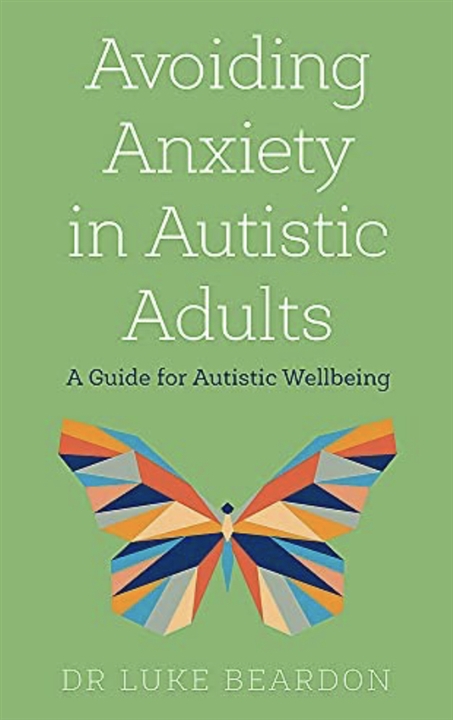
- I have found this book on Amazon, it isn’t released until the 9th.
The reviews look to be very good.
I’m not trying to sell the book or promote it.
It just looks to be worth reading as it covers coping mechanisms which I’m struggling with.

thanks for the review 
The book wasn't bad. I thought it could've gone into more depth on certain parts and I feel some proposals were a bit idealistic but on the whole it's been helpful.
My favourite part was in the section about sensory where he wrote that you can't beat the smell of a "freshly windswept cat".
Just ordered it - I have a very stable life so not too much general anxiety but my wife does have lots of anxiety which gives me anxiety because I am not so good at recognizing when she is distressed or know what to do when she is.
Having only recently discovered I have ASD this will just add to the information and I am sure it will give me some insights into the way my brain works and how to cope with anxiety when it does, inevitably, rear its ugly head.

I think it's useful for us and everyone in officialdom dealing with us.
Nearly finished it now. Totally shifts the paradigm from fixing us to fixing the environment.
I'd like to shove it under the nose of my old headteacher who said it was my fault I was bullied because I wouldn't be like the other children and told my parents they ought to give me a good slap, for sure, but that was 45 years ago. He's probably dead now.
I have read a couple of chapters so far and I am finding it helpful. The only thing I guess is that, as its only the second book I have ever had on autism, I was hoping for more stratagies I could use to help me cope with anxiety. Alot of the book feels like it might be more useful for the people around me than myself.
I am hoping I can get to more stratagies for me as I keep reading.
It did introduce me to the concept of alexithymia which I had never heard of before and makes a lot of sense to me
Going to keep reading and see what happens

I'm glad you've found it helpful. Do you think it would be useful for me, Dawn?
Absolutely! Yes, we all have personal responsibility, but we can't change our wiring to suit everyone else or the system. No one would ask a double amputee to re-sprout legs because there's no lift.
We're already doing whatever we can for ourselves. The system needs to adapt for us in the same way any business should install to ramp for wheel chairs.
That looks like a really interesting book to read. Could be very useful and handy I think.

I do agree with you. I can see both sides of the fence.
Enjoying reading it so far. And much of the emphasis is on changing the environment rather than the person which, after decades of reading self-help books which place the responsibility 100% on the individual, seems to me to be a useful and much needed shift.

That's certainly true. However, I think that here we're talking about excessive, crippling autistic anxiety that can dominate and ruin lives. It's not the nervousness or "butterflies" that many will experience before, say, doing something new or making a speech.
Anxiety is very, very common, of course, and certainly there for a reason (embedded in our evolution and ongoing survival). But autistic anxiety can be off the scale. :(
We certainly can't run or hide from it. However, we may well be more prone to completely shutting down and attempting to do precisely that. There has to be another way and I'm hoping the author will be looking at that.
Just seeing that image gave me anxiety itself. Because its setting you up to think you csn hide from anxiety. Thats not healthy. You can't avoid anxiety, it's part of every day life.
I know I'm being pedantic and you (quite literally) shouldn't judge a book by its cover.
I would still be interested to read it.
Yes, some of it accumulated due to our lack of knowledge and awareness of autism and some due to our own high stress levels and ongoing misguided attempts to rectify things by looking in all the wrong places - therapy that wasn't therapeutic, meds that didn't help, parenting advice that was probably OK for non autistics but which left our kids feeling unheard and traumatised.
Some, however, can attribute to other sources - poorly educated healthcare providers, nursery staff and teachers, plus a lack of empathy, support and understanding that remains widespread in our culture.
Now we need to repair years of damage and we're not even sure this will be possible. How can you help someone who will barely speak, has little to no contact with the outside world and now, after years of trauma, refuses to engage with what they see as the selfsame services and "unhelpful help" that damaged them in the first place?
Here's the thing: the book focuses on anxiety, but in our family we need to cope with the aftermath of decades of it, including intergenerational trauma that spans at least 4 generations of which I'm aware. I'm aware of late uncles who retreated from the world to such an extent that it feels as though their lives weren't really lived. They were invariably blamed for their perceived indequacies. But now that I see this being replicated in the next generation, I'm frankly horrified. It wasn't their fault, it's not our fault, but we desperately need it to end.

I dont know if this helps but I have caused a lot of damage to people before I realised I was autistic. i couldnt regulate my emotions and would always get angry or upset because I didnt understand why I was feeling like this. I didnt know I was autistic either.
I have learnt to forgive myself over time though. Honestly, I cant promise you can undo damage but you have to know it was not your fault and you couldnt help it. You have to forgive yourself. Once you do that its easier for other people to accept and forgive you
Not sure if that helps
Yes, I preordered it because I've found Luke Beardon's other books quite useful. That said, I really need help with the long term consequences of chronic anxiety taking its toll on our younger familiy members for years before we realised that we're actually autistic. So I'm more interested in learning more about how to repair damage and trauma than how to avoid it and am hoping he'll at least touch on this.
For myself, I've spent decades coping with and avoiding it via various strategies so I'm it'd be good if it doesn't just cover the well-worn paths I'm already familiar with.

