13 year old - low mood and losing weight rapidly

My daughter (13) is diagnosed with ADHD and Autism, she has always been a quiet, solitary child but was generally comfortable at home as long as we gave her space and let her come to us. Recently she has become severely withdrawn, deleting WhatsApp so she doesn't have to communicate with friends from school (there hasn't been a fall out or bullying ive checked, her friends are as confused by this as we are) she just lays in her bed all day and only really talks in as short sentences as possible and honestly usually quite rudely. She has also lost a significant amount of weight in the last 3-4 months. She was never a big girl, a women's size 10, but she has started exercising every day, and gets quite upset if we have plans that prevent her exercising. She won't go to bed until she's done her workout video no matter how late it is. I have had to buy her new clothes this week because all of hers are hanging off her, she's gone down at least one dress size as well as a cup size in her bra's. She eats breakfast and a small dinner with us but ive been checking her school account and she seems to only be buying drinks and fruit pots. She claims that she's sharing meals with friends but I don't believe her if I'm honest. If my calculations are right she's eating about 800-1000 calories a day which is way below what she should be eating, however she's not hiding food, or being secretive in other ways so I don't know if were looking at a potential eating disorder or normal teenage girl body issues. 

Im very concerned about her at the moment between the eating and the low mood, her anxiety is high and she has begun wetting the bed again. The school is aware but is, in all honesty, a bit useless. Just doing surface level interventions that in reality help nobody.

Im waiting for a CAMHS appointment but I just wondered if anyone had any advise on getting her help or how best to support her, I'm terrified of saying the wrong thing and making everything worse. 

  • Hi, I am not sure if I can give any advice but I can share my personal experiences. I am autistic and I struggle with a lot of digestive issues and issues around food and I also tend to get stuck in quite rigid routines around lots of things including movement. I think it’s very important than when you seek support for your daughter they are aware that she is autistic and have a good understanding of autism. I have gone through phases where I unintentionally lost a lot of weight and I survived off eating only a handful of foods in the same pattern. It was terrifying and not intentional but I also couldn’t seem to change things. This often coincided with me getting extremely burnt out and overwhelmed and exhausted and I sometimes think that this was my body’s way of telling me I needed a break and that I needed to stop. For me digestive issues complicate things as it makes eating harder and as I am also anxious about triggering digestive issues which makes me more cautious and more likely to stick to familiar foods and routines. I unfortunately got misdiagnosed with an eating disorder eventually (before I knew that I was autistic) and it caused a lot of damage and further issues around food that I hadn’t had before- Thankfully a dietitian eventually realised my diagnosis was not appropriate and she suspected I might be autistic (as my behaviour around food reminded her of other autistic patients), which is how I eventually ended up getting assessed. The NHS also eventually recognised that the eating disorder was a misdiagnosis but the damage was done. It’s very important that medical and mental health professionals understand about autism. There is also evidence that autistic individuals with more typical eating disorders also benefit from tailored treatment and support. 

    It sounds like your daughter is struggling at the moment- how does she feel about school? You mention that she eats when at home but that you suspect that she doesn’t have much at school- do you think this could possibly be as school could be a stressful place or because the food there is not right? I’m not saying this is it but stress can also have a massive impact on appetite so this doesn’t necessarily have to be deliberate restriction of food. 

    Do you think there could be anything else worrying her or stressing her?

    I also don’t know how to best help- it can be a vicious cycle as under-eating also affects mood and low mood affects appetite etc. 

    It sounds like you are doing the right thing by being there for her and being supportive without putting too much pressure on her. When seeking help, I would try to ensure if you can that you can see someone who has a good understanding of autism. If you do end up having to engage with eating disorder services, you could if necessary consider sharing some info on links between autism and eating issues eg. https://peacepathway.org . I also believe the NAS has some good resources that could be useful. 

    Regarding the exercise routine- it could be a way of trying to burn calories but it could also mainly be a way of relieving stress. When I am feeling overwhelmed, I tend to get more rigid in my routines and having something like an exercise routine to do everyday which is going to be the same no matter what unexpected and unpredictable things happen that day, can be very comforting. However it can also become a source of stress in itself as it can be very stressful when you then can’t do it… I do feel trapped by my routines at times as it makes me very inflexible. It does help to know though that all of these behaviours are there for a reason and tend to perform some sort of function. That doesn’t mean they are necessarily healthy or helpful or harmless in longterm but often they are ways to cope. 

    I’m sorry that I can’t be of more help. I hope you find a way forward. 

  • Thank you for this. Yes I will say clear boundaries is definitely what’s needed for her. Positive reinforcement has to be done in the correct way so as not to make the situation worse. It can definitely backfire if done wrong. I’m hoping CAMHS will help with a therapist because I agree, as much as she does still confide in me, a neutral person who isn’t her mum would definitely help.

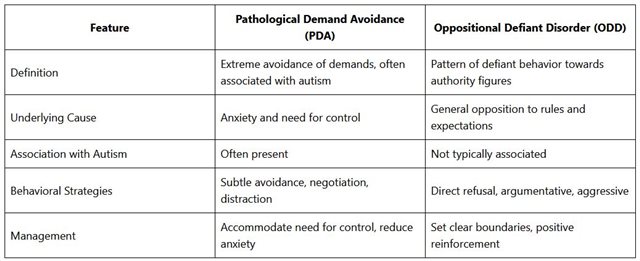
  • ODD is oppositional defiance its similar to PDA.

    I notice the approach for dealing with ODD is quite different to PDA. Taken from the article https://inclusiveteach.com/2025/03/09/pda-vs-odd-key-differences-explained/

    For ODD they suggest "Set clear boundaries, positive reinforcement"

    Does she see a therapist? If so it may be worth asking them to talk about this with her and alert you if there is any action required, so long as it is in line with their ethics on disclosure.

    If she doesn't have one then with ASD, ADHD and ODD as disgnoses then I think having someone she can confide in and who can offer her help to deal with all that is going on during will be of a lot of benefit to her.

    I don't know if the CAMHS or your GP can help with this or whether it would have to be private.

    The teenage years are often a time for the teenagers to pull away from their parents (they are not cool obviously!) so having this safe person to talk through her issues with and practice coping techniques with should help her in the transition to adult life.

    It is never a cheap option of course - I think about £50/hour is the norm and will soon add up.

    I also noticed some advice on strategies for coping with the ODD element:

    https://drroseann.com/deal-with-oppositional-behavior/

    I've not researched this in depth so cannot say if it is good or bad, but it appears to make sense. Just remember any CBT based therapies would need to be adapted for her autism as they do not typically work for us in their native format.

    Good luck

  • Thank you. I appreciate that. ODD is oppositional defiance its similar to PDA.

  • You sound a caring and supportive mum

    What is ODD?

    If it were me, I would reduce demands where possible. 

  • No, no you haven’t spoke out of turn at all. I actually think your scenario is more likely than an Eating disorder tbh. She is diagnosed with ODD and the low mood was there before the eating issues. This is why I’m worried to mention the eating to CAMHS because I don’t want it to overshadow the very obvious anxiety issues that I’m seeing. 

  • Could she be in burnout? For myself, when the outside demands (which includes communicating) all become too much I start restricting my food as it's one thing I can control and the demands of having to eat is just too much. I am autistic with PDA profile. If she ends up under CAMHS and eating disorder services it vitally important they know how autism impacts her with food and eating. It's all too common that they ignore that and try to treat an eating disorder in the only they know how which can cause more harm to an autistic person. It might be worth a GP appointment and getting bloods etc done as it's the speed of weightloss that can cause health problems.

    I hope I haven't spoken out of term, I'm going off my own experiences and from other online groups I'm in. There's a supportive Facebook group Autism and Eating Disorders for both adults and parents.

  • Dear Keelz,

    I am sorry to hear about your daughters current struggles .I understand your concerns and you have done the right thing in reaching out for support. I hope our online community provides a safe space for you to share concerns and hopefully get some good advice. 

    It does sound worrying that your daughter is exercising daily and is limiting calories. As you mentioned that you have been concerned about eating disorders I have linked information to The UK's Eating Disorder Charity - Beat  as well as Eating disorders - I would also recommend talking to your daughters GP or health professionals involved.

    In terms of how you could support your daughter with her mental health I have included some of the NAS guidance on Anxiety  and Depression they have some helpful tips on managing this that I have included below:

    Understand the triggers

    Keep a diary to help identify when you are anxious, and what might make it worse.  

    Monitor and manage your energy levels

    Be aware of your energy levels after social interactions and other events/situations that you may find tiring or difficult.  Recharge by taking time for yourself and doing things you enjoy. 

    Make the environment work 

    Make adaptations to the environment where possible, for example lower unnatural light if too harsh. 
    Try noise-cancelling headphones to reduce sensory overload.  

    Self-soothe

    Use sensory tools and stimming to reduce anxiety levels, if that works for you.

    Relaxation and calming activities

    Try relaxation methods such as meditation, mindfulness, yoga and exercise.  

    Visual schedules

    Visual schedules to help structure the day and reduce uncertainty within your day.

    Use an app

    The following app offers personalised support with anxiety.

    Molehill Mountain – includes: 

    • a system for tracking mood and identifying triggers
    • evidence-based tips on how to self-manage anxiety levels.

    YoungMinds | Mental Health Charity For Children And Young People | YoungMinds - this website has some really helpful information that both you and your daughter could take a look at. I have included a link that takes you straight to their information on How to Talk to Your Child about Mental Health | YoungMinds and Getting support from mental health services | YoungMinds

    Please reach out if you need any further support.

    Warmest wishes,

    Olivia Mod