
Thinking in pictures. Do you?

Is my visual imagination weird compared to yours?

I read a book last year with techniques for overcoming insomnia. One of the exercises was to imagine ten stars shining in the night sky, each representing a worry, and then work through them one-by-one (I forget the details). Anyway, after five decades of existence, I learned something new: I cannot hold a picture of ten stars shining in the night sky in my imagination. In fact, I cannot hold any static image in my imagination. As soon as I try to look at any detail at all, look at one star, say, the image falls apart and all I'm left with is blackness. And I cannot stop myself from trying to look at the details.

The same goes for capturing anything I'm looking at. I can close my eyes now and briefly hold an image of the computer screen in front of me in my mind, but as soon as I try to "look" at any detail, the image disappears to blackness.

Weirdly (I think), what I can do is hold a moving image in my head, spinning it around and looking at it from different angles, resolving more details as I zoom in, becoming more vague as I zoom out, but always staying in motion. For example, I can hold a car engine (ICE) in my head and zoom in and watch individual parts operating and I continue to fly around them, but if I zoom out again it becomes little more than a vague engine block, so the total amount of detail at any zoom level is quite limited. I think this might be because I'm really just creating a series of still images and continuously replacing them as they quickly fade to blackness. I cannot replace one image with another just like it, as I'm always switching perspectives to whatever detail my mind is tracking next.

Does anyone else experience this strange, always-in-motion kind of visual imagination? I'm guessing it's an autistic thing. I kind of like it, but it hasn't helped with my insomnia.

Parents
  • I've always thought in pictures or images maybe a better term, if I have no mental picture for something then I don't understand it. Like Maths and tech, it feels like a big grey wall, featureless, unclimable, I can't see over or around it, I can't break through it either.

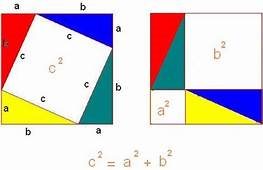
  • There are very visual ways of understanding mathematics. One of the most beautiful ones for me (not the easiest maybe) is the Pythagorean Theorem proof (or "proof" for very demanding readers):

    Observe that we have two same-size squares, but coloured blocks are in a different order. Because re-arranging the coloured rectangles does not change the total white space (we can not create more white space) then one is forced to conclude that c² =  a² + b² which in words is: the white space on the left equals the sum of the whitespace on the right.

    I am omitting details, but that is the essential step. I hope you like it.

    I would be happy to explain this for hours, so feel free to ask any question. If you'd like to give a book a go, I recommend "The Joy of X" which to a large extent is visual as described above.

    Note also that things like Mandalas, and other symmetric objects are mathematical. If you like symmetry, you like mathematics.

Reply
  • There are very visual ways of understanding mathematics. One of the most beautiful ones for me (not the easiest maybe) is the Pythagorean Theorem proof (or "proof" for very demanding readers):

    Observe that we have two same-size squares, but coloured blocks are in a different order. Because re-arranging the coloured rectangles does not change the total white space (we can not create more white space) then one is forced to conclude that c² =  a² + b² which in words is: the white space on the left equals the sum of the whitespace on the right.

    I am omitting details, but that is the essential step. I hope you like it.

    I would be happy to explain this for hours, so feel free to ask any question. If you'd like to give a book a go, I recommend "The Joy of X" which to a large extent is visual as described above.

    Note also that things like Mandalas, and other symmetric objects are mathematical. If you like symmetry, you like mathematics.

Children
No Data