what’s the best place to get a autism diagnosis test? Not everywhere is the same. Is there any better places to go in Scotland as it costs a out of money
what’s the best place to get a autism diagnosis test? Not everywhere is the same. Is there any better places to go in Scotland as it costs a out of money

This isn’t a hard rule, it states where available. Usually children get this or any other NHS assessment (if you don’t retire before you get seen). NHS is based around MDT.
A single experienced consultant psychiatrist (or clinical psychologist) who:
this is sufficient, valid, fits NICE criteria and is 99% of private assessments. Mine was done by a leading psychiatrist in the field at NHS South London and Maudsley which are also home to some of the top consultants in the world, but also sees people privately. It was accepted by my GP and is my medical record. I don’t want people thinking if it’s not MDT led then it’s invalid as that’s not the case. Your comment infers that, at least that’s what I taken from it.

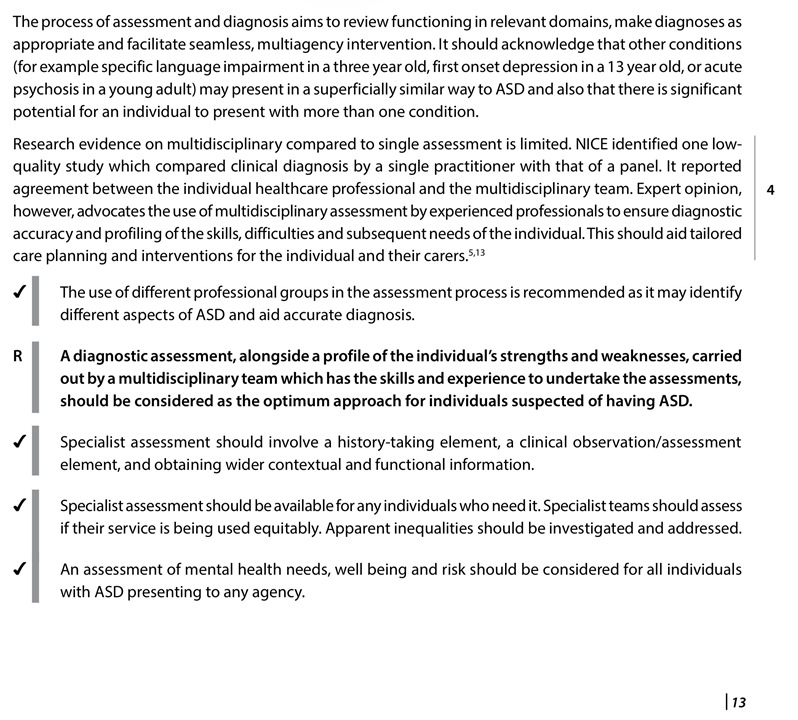
The ‘gold standard’ according to NICE guidelines is for the assessment to be conducted by a multi disciplinary team of appropriate professionals. This is shown in the link you have provided and I have copied the relevant section.
In my area, the GPs accepted private diagnosis only if the assessment was conducted according to these guidelines.
Here is a section of the NICE guidelines from the link you provided:
In order to effectively provide care and support for autistic adults, the local autism multi-agency strategy group should include representation from managers, commissioners and clinicians from adult services, including mental health, learning disability, primary healthcare, social care, housing, educational and employment services, the criminal justice system and the third sector. There should be meaningful representation from autistic people and their families, partners and carers.
In each area a specialist community-based multidisciplinary team for autistic adults (the specialist autism team) should be established. The membership should include:
psychologists with training and experience in working with autistic adults
nurses
occupational therapists
psychiatrists
social workers
speech and language therapists
support staff (for example, staff supporting access to housing, educational and employment services, financial advice, and personal and community safety skills).
The specialist autism team should have a key role in the delivery and coordination of:
specialist diagnostic and assessment services
specialist care and interventions
advice and training to other health and social care professionals on the diagnosis, assessment, care and interventions for autistic adults (as not all may be in the care of a specialist team)
support in accessing, and maintaining contact with, housing, educational and employment services
support to families, partners and carers where appropriate
care and interventions for autistic adults living in specialist residential accommodation
training, support and consultation for staff who care for autistic adults in residential and community settings.
We are all autistic so fully understanding what is meant by the guidelines and what is needed can be import to us. So I hope no one is taking it personally, (it gave me major anxiety all night), especially understanding why some have maybe paid for a bigger assessment with an in person part, but same results at the end of the day really. This is why ideally, it would be better to be able to have it at least through the NHS even if it was paying for a set thing for a set price like the dentist. I hate the privatisation model
I am sorry that you had anxiety all night about this and I agree that it is a sad system when getting a diagnosis can be such a life saver for many people. There is a dreadful amount of inequality from region to region and within regions with regard to autism diagnosis and in other specialisms. From posts here, many people in England have had fast diagnosis through ‘Right to Choose’, although somebody recently mentioned an over one year waiting list for assessment. A year ago, N. Ireland waiting lists in my region were over 4 years long and I think I saw a post stating a region of Scotland has stopped assessments altogether.
there is growing toxicity around getting assessed currently
That is the worrying thing and that causes me anxiety. If society invalidates us more than it does already, where does that leave us? Like many, I am very late diagnosed (60s) and words are inadequate to convey what it did for me. It is an understatement simply to say that since diagnosis, my mental health has never been better.
It given me major anxiety too and lost a whole night of sleep over this. I would encourage you to speak to your GP as I did this morning and the psychiatrist team - I’m told that as long as the criteria used are inline with the recommended assessment criteria than there should be no reason for your medical record not to be updated. This reassured me, however, I do suspect there may be some bureaucracy at play as others have said.

I think you've hit on the main issue, that it will depend on the interpretation of the guidelines and knowledge of your GP.
I haven't spoken to mine to find out if they accepted it or not, I am afraid to. Last time I was there I didn't know anything about autism bar the stereotypes, and I sat there looking at the wall and wringing my hands as I talked, and I think he just thought I was stressed as that was what I was sort of there about. So that makes me think they don't know anything about it, as I can look back and see the signs were all there.
We are all autistic so fully understanding what is meant by the guidelines and what is needed can be import to us. So I hope no one is taking it personally, (it gave me major anxiety all night), especially understanding why some have maybe paid for a bigger assessment with an in person part, but same results at the end of the day really. This is why ideally, it would be better to be able to have it at least through the NHS even if it was paying for a set thing for a set price like the dentist. I hate the privatisation model.
I think it is important to know and get diagnosed if you need it for self understanding, as it could even save your life knowing why you struggle and finding language to talk about it, but there is growing toxicity around getting assessed currently which I think will take it away from people and make it something you only get if you can afford it.
It's a sad system. It all is currently.
I can fully see why you would just self-determine austism and not have to touch the system.
I don’t know if GPs are individually allowed to choose what they will accept, or if it comes from higher up within each individual country.
I wondered that too.
my GP and the NHS Adult Autism Service would accept diagnosis only if undertaken by a multidisciplinary team.
I have had my diagnosis accepted by my GP but then it was a private provider via the NHS.
I am wondering whether the fact that I live in England, you in Northern Ireland and JB33 in Scotland makes the difference with regard to what GPs will accept.
I understand it to be if not MDT led than your diagnosis is not valid? Is that your point?
You misunderstand what I am saying. I have not suggested that your diagnosis was invalid.
My personal opinion is one thing, it isn’t claiming to be anything else. I will explain as best I can. If I wasn’t already diagnosed, I would seek a clinic that offered assessment by a multidisciplinary team. NICE guidelines are based on best evidence, so it makes sense to me to take their advice. Best evidence doesn’t mean that multidisciplinary teams are necessarily always the best way to go about something. Available evidence is weighed in favour of a multidisciplinary team assessment, so it makes sense to me to go down that route.
As I’ve already said in my previous post, my GP and the NHS Adult Autism Service in my area would accept diagnosis only if undertaken by a multidisciplinary team.
glad you finally got your diagnosis too; I absolutely would not doubt it. Mine was a single psychiatrist and he was more than qualified too. What some people dont recognise is that the people that run some of the private assessments are usually NHS consultants too. Mine was online as well, but again, doesn't deter from the validity of the diagnosis as that comes down to the methods and assessments used and that these are inline with NICE guidelines and recommendations (which many are). I would approach your GP, have them key it into your medical record as this will also not be keyed in lightly and will be scrutinised, as it should be, but once it's in, its valid. The doubt I think comes from scam online claims that you can be assessed and seen in 30 minutes kind of thing and that they do not follow the DSM-5/ICD-11 and other rigid guidelines required to make a formal diagnosis.
What some also dont see is that while NHS assessments are often MDT led, lack of resources can mean that the lead clinician owns the diagnosis and is often made by one consultant. If your diagnosis letter outlines the criteria used to diagnose you and your GP / medical system accepts this on your record, then that's all there is to it. Best of luck :)

I understand it to be if not MDT led than your diagnosis is not valid?
Welcome to the forum.
I obviously can't answer for A but I've learned from being on this forum that there is quite a variety in autism diagnosis methods.
Mine was online and via only 2 people - one consultant psychiatrist and one psychologist.
I had lots of forms too.
From reading here, I have at times doubted my own diagnosis as not being thorough enough (especially because it wasn't in person) but I've also read of lots of people who had a single psychiatrist diagnose them and that is sufficient to have the NHS records updated which should be good enough for everyone.
I'm glad you got yours - mine was much later in life.
It makes a huge difference, I've found.
I’m not sure what you’re getting at here? I don’t know how to take this? And I’m struggling to get to the root argument you have and what you’re trying to say (without all the words going around it). I understand it to be if not MDT led than your diagnosis is not valid? Is that your point? I think it is , you just won’t say it. Also, you really like to quote certain parts out of context and somehow draft it as factual and miss the other detail out. This is not helpful.
Regardless - I’m wasting energy now. Let’s agree to disagree. For the benefit of everyone here who may now be concerned about their diagnosis thanks to this forum member, I have asked my psychiatrist to write a summary around this - he will gladly do so and I’ll be posting the response here for clarity.
The section 1.2.5 A details “should” for each of the recommendations you quote above
Indeed.
Yes. Good spot on that Iain, I think it’s because there are some suspect assessments out there and not all are from qualified doctors who specialise in this area with the right credentials.
it is absolutely important people do their research first before paying privately to ensure these are ideally the same clinicians who work in the NHS or are equally as qualified.
The section 1.2.5 A details “should” for each of the recommendations you quote above. If you dig into the language development manual for NICE guidelines, ‘should’ is not mandatory; it’s a recommendation. The whole of the section for ASD you’re referring to, is a “Recommendation”.
If MDT was mandatory (which it’s not), GPs around the country would not be coding autism into people’s NHS record (which is the final stamp). This demonstrates my point and how the NICE guidelines are applied in the real world. You say that your GP surgery only accepts private diagnosis from NICE (specifically you’re getting it being MDT led), it’s not a choice to follow them or not depending on area; GP must follow NICE guidelines or there would be breaches all over the place. Private assessments are routinely accepted all over the country because some of them are from specialist trained consultants - likely the very ones working in NHS. By your logic, how do you explain mine and others being accepted by their GP? Are they somehow ‘not real’ and my GP has made a mistake?
NHS have a single clinician doing the assessments too who may have MDT oversight (most consultants do).
This section describes recommended service organisation and assessment best practice, not a mandatory requirement for diagnostic validity. adult diagnoses by trained clinicians are routinely accepted and coded by the NHS. I’m comfortable leaving it there.

Any GP surgery must accept a diagnosis by a qualified clinician who has followed the correct diagnostic guidance
It looks like NAS does not agree with this:
some people may experience difficulties with having their non-NHS diagnosis accepted by local authority and NHS health services; before deciding to go ahead with a non-NHS diagnosis, it is a good idea to check whether this will be accepted in your area.
I’m surprised to be reading this on a forum like here. Any GP surgery must accept a diagnosis by a qualified clinician who has followed the correct diagnostic guidance
I’m not sure why you are surprised as this forum is for all autistic adults, their families, & others who have an interest in autism. All sorts of people post things here and it people may or may not provide factual information. Sometimes posts conflict. If you are happy with your assessment and your GP has accepted it, that is another thing.
I find it Ill placed as you’re implying people’s diagnosis are not valid unless MDT led, which is not accurate
I did no such thing.
I can only tell you what my GP surgery said, and what the NHS Adult Autism services and two Autism charities in my area said. The advice and guidance section on this website provides information about assessment by a multidisciplinary team. Iain has already provided this very good advice, but with government cut backs to services and political scaremongering over autism diagnosis, I would still suggest assessment by a multidisciplinary team, according to NICE guidelines. (It might decrease the likelihood of a diagnosis potentially being reevaluated and not accepted at at later date)
For this very reason some GPs won't accept some private diagnoses to be added to your medical record so I would check with the GP before paying as it may not get the result you want.
Here is a further section of NICE guidelines:
A comprehensive assessment should:
be undertaken by professionals who are trained and competent
be team-based and draw on a range of professions and skills
where possible involve a family member, partner, carer or other informant or use documentary evidence (such as school reports) of current and past behaviour and early development.
I’m surprised to be reading this on a forum like here. Any GP surgery must accept a diagnosis by a qualified clinician who has followed the correct diagnostic guidance
I’m not sure why you are surprised as this forum is for all autistic adults, their families, & others who have an interest in autism. All sorts of people post things here and it people may or may not provide factual information. Sometimes posts conflict. If you are happy with your assessment and your GP has accepted it, that is another thing.
I find it Ill placed as you’re implying people’s diagnosis are not valid unless MDT led, which is not accurate
I did no such thing.
I can only tell you what my GP surgery said, and what the NHS Adult Autism services and two Autism charities in my area said. The advice and guidance section on this website provides information about assessment by a multidisciplinary team. Iain has already provided this very good advice, but with government cut backs to services and political scaremongering over autism diagnosis, I would still suggest assessment by a multidisciplinary team, according to NICE guidelines. (It might decrease the likelihood of a diagnosis potentially being reevaluated and not accepted at at later date)
For this very reason some GPs won't accept some private diagnoses to be added to your medical record so I would check with the GP before paying as it may not get the result you want.
Here is a further section of NICE guidelines:
A comprehensive assessment should:
be undertaken by professionals who are trained and competent
be team-based and draw on a range of professions and skills
where possible involve a family member, partner, carer or other informant or use documentary evidence (such as school reports) of current and past behaviour and early development.
We are all autistic so fully understanding what is meant by the guidelines and what is needed can be import to us. So I hope no one is taking it personally, (it gave me major anxiety all night), especially understanding why some have maybe paid for a bigger assessment with an in person part, but same results at the end of the day really. This is why ideally, it would be better to be able to have it at least through the NHS even if it was paying for a set thing for a set price like the dentist. I hate the privatisation model
I am sorry that you had anxiety all night about this and I agree that it is a sad system when getting a diagnosis can be such a life saver for many people. There is a dreadful amount of inequality from region to region and within regions with regard to autism diagnosis and in other specialisms. From posts here, many people in England have had fast diagnosis through ‘Right to Choose’, although somebody recently mentioned an over one year waiting list for assessment. A year ago, N. Ireland waiting lists in my region were over 4 years long and I think I saw a post stating a region of Scotland has stopped assessments altogether.
there is growing toxicity around getting assessed currently
That is the worrying thing and that causes me anxiety. If society invalidates us more than it does already, where does that leave us? Like many, I am very late diagnosed (60s) and words are inadequate to convey what it did for me. It is an understatement simply to say that since diagnosis, my mental health has never been better.
It given me major anxiety too and lost a whole night of sleep over this. I would encourage you to speak to your GP as I did this morning and the psychiatrist team - I’m told that as long as the criteria used are inline with the recommended assessment criteria than there should be no reason for your medical record not to be updated. This reassured me, however, I do suspect there may be some bureaucracy at play as others have said.
I think you've hit on the main issue, that it will depend on the interpretation of the guidelines and knowledge of your GP.
I haven't spoken to mine to find out if they accepted it or not, I am afraid to. Last time I was there I didn't know anything about autism bar the stereotypes, and I sat there looking at the wall and wringing my hands as I talked, and I think he just thought I was stressed as that was what I was sort of there about. So that makes me think they don't know anything about it, as I can look back and see the signs were all there.
We are all autistic so fully understanding what is meant by the guidelines and what is needed can be import to us. So I hope no one is taking it personally, (it gave me major anxiety all night), especially understanding why some have maybe paid for a bigger assessment with an in person part, but same results at the end of the day really. This is why ideally, it would be better to be able to have it at least through the NHS even if it was paying for a set thing for a set price like the dentist. I hate the privatisation model.
I think it is important to know and get diagnosed if you need it for self understanding, as it could even save your life knowing why you struggle and finding language to talk about it, but there is growing toxicity around getting assessed currently which I think will take it away from people and make it something you only get if you can afford it.
It's a sad system. It all is currently.
I can fully see why you would just self-determine austism and not have to touch the system.
I don’t know if GPs are individually allowed to choose what they will accept, or if it comes from higher up within each individual country.
I wondered that too.
my GP and the NHS Adult Autism Service would accept diagnosis only if undertaken by a multidisciplinary team.
I have had my diagnosis accepted by my GP but then it was a private provider via the NHS.
I am wondering whether the fact that I live in England, you in Northern Ireland and JB33 in Scotland makes the difference with regard to what GPs will accept.
I understand it to be if not MDT led than your diagnosis is not valid? Is that your point?
You misunderstand what I am saying. I have not suggested that your diagnosis was invalid.
My personal opinion is one thing, it isn’t claiming to be anything else. I will explain as best I can. If I wasn’t already diagnosed, I would seek a clinic that offered assessment by a multidisciplinary team. NICE guidelines are based on best evidence, so it makes sense to me to take their advice. Best evidence doesn’t mean that multidisciplinary teams are necessarily always the best way to go about something. Available evidence is weighed in favour of a multidisciplinary team assessment, so it makes sense to me to go down that route.
As I’ve already said in my previous post, my GP and the NHS Adult Autism Service in my area would accept diagnosis only if undertaken by a multidisciplinary team.
glad you finally got your diagnosis too; I absolutely would not doubt it. Mine was a single psychiatrist and he was more than qualified too. What some people dont recognise is that the people that run some of the private assessments are usually NHS consultants too. Mine was online as well, but again, doesn't deter from the validity of the diagnosis as that comes down to the methods and assessments used and that these are inline with NICE guidelines and recommendations (which many are). I would approach your GP, have them key it into your medical record as this will also not be keyed in lightly and will be scrutinised, as it should be, but once it's in, its valid. The doubt I think comes from scam online claims that you can be assessed and seen in 30 minutes kind of thing and that they do not follow the DSM-5/ICD-11 and other rigid guidelines required to make a formal diagnosis.
What some also dont see is that while NHS assessments are often MDT led, lack of resources can mean that the lead clinician owns the diagnosis and is often made by one consultant. If your diagnosis letter outlines the criteria used to diagnose you and your GP / medical system accepts this on your record, then that's all there is to it. Best of luck :)
I understand it to be if not MDT led than your diagnosis is not valid?
Welcome to the forum.
I obviously can't answer for A but I've learned from being on this forum that there is quite a variety in autism diagnosis methods.
Mine was online and via only 2 people - one consultant psychiatrist and one psychologist.
I had lots of forms too.
From reading here, I have at times doubted my own diagnosis as not being thorough enough (especially because it wasn't in person) but I've also read of lots of people who had a single psychiatrist diagnose them and that is sufficient to have the NHS records updated which should be good enough for everyone.
I'm glad you got yours - mine was much later in life.
It makes a huge difference, I've found.
I’m not sure what you’re getting at here? I don’t know how to take this? And I’m struggling to get to the root argument you have and what you’re trying to say (without all the words going around it). I understand it to be if not MDT led than your diagnosis is not valid? Is that your point? I think it is , you just won’t say it. Also, you really like to quote certain parts out of context and somehow draft it as factual and miss the other detail out. This is not helpful.
Regardless - I’m wasting energy now. Let’s agree to disagree. For the benefit of everyone here who may now be concerned about their diagnosis thanks to this forum member, I have asked my psychiatrist to write a summary around this - he will gladly do so and I’ll be posting the response here for clarity.
The section 1.2.5 A details “should” for each of the recommendations you quote above
Indeed.
The section 1.2.5 A details “should” for each of the recommendations you quote above. If you dig into the language development manual for NICE guidelines, ‘should’ is not mandatory; it’s a recommendation. The whole of the section for ASD you’re referring to, is a “Recommendation”.
If MDT was mandatory (which it’s not), GPs around the country would not be coding autism into people’s NHS record (which is the final stamp). This demonstrates my point and how the NICE guidelines are applied in the real world. You say that your GP surgery only accepts private diagnosis from NICE (specifically you’re getting it being MDT led), it’s not a choice to follow them or not depending on area; GP must follow NICE guidelines or there would be breaches all over the place. Private assessments are routinely accepted all over the country because some of them are from specialist trained consultants - likely the very ones working in NHS. By your logic, how do you explain mine and others being accepted by their GP? Are they somehow ‘not real’ and my GP has made a mistake?
NHS have a single clinician doing the assessments too who may have MDT oversight (most consultants do).
This section describes recommended service organisation and assessment best practice, not a mandatory requirement for diagnostic validity. adult diagnoses by trained clinicians are routinely accepted and coded by the NHS. I’m comfortable leaving it there.