Terminology

Are there any particular aspects of autism related terminology that bother you?

Here are some of mine:

1.

ND -v- autistic

NT -v- allistic

The above terms seem (from reading here) to have become interchangeable but, to my mind, they shouldn't be.

Autism is under the umbrella of neurodiversity but so is Tourettes (for example).

Here is a wheel of ND but I've seen some with more 'conditions' included:
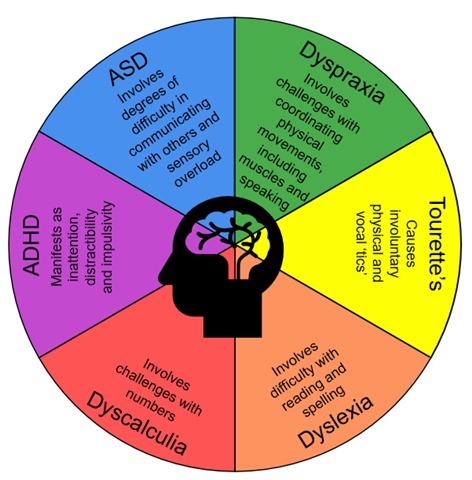
If ND is used instead of 'autistic' (when it's actually autism in particular that is probably the subject) I find it hard to follow the arguments/discussion.

2.

Another is the autism spectrum.

I don't know how it was meant when it was first termed, but my understanding of it isn't that there are ends of it that are less autistic, and more autistic, ie becoming more extreme, but rather than we (autistic people) can be less and more extreme as we dip in and out of the symptoms/characteristics:

Below is a link to an article that I think explains it well:

https://neuroclastic.com/its-a-spectrum-doesnt-mean-what-you-think/

3.

Also, if other people say 'we are all on the spectrum, all a little bit autistic etc' then I think it's important to bear in mind that a diagnosis is only given if the characteristics of autism that we match to are disabling to us.

How do others see the above and also, are there any other terms that you find difficult/confusing?

  • Oh yes! I hate that word! If I described myself as neurospicy I would be putting myself on display. I see all kinds of images that aren’t what the word means—sandpaper, spotted, red, choppy, spiky, jaggy, Zanzibar, unpredictable, unreliable, sexual preference, gritty, ginger, hot. Also, it sends a nasty feeling through my torso.

  • I have had that term used to my communication recently.

    I found it confusing and a little disturbing.

    After further thought about it I concluded that my internalised anxiety and discrimination about doing so led to this.

    I am going to try to ask the person next time what they mean by that and what implications it has about our further communication.

    Thanks for the prompt for me to consider this.

    Also am now considering whether forming a popular music group callled the neuro-spicey boys and girls might have some mileage....

    "I'll tell you what I want ...

    I really, really really want:

    safety, acceptance, a sense of competence and love and peace"

    Hmm not sure it'll make the charts!

  • My personal dislike is being called neurospicy

    Nice to see you here Roy.

    I don't like it either.

    It makes me feel like a curry ie that I am a curry and that I want to eat a curry.

    It feels like it has nothing to do with autism and everything to do with food.

  • I'm more bothered with the terminology being used in normal life.

    For example, I received an email from my letting agent with an online link informing me that 'issues' had been 'raised' that needed to be 'resolved'.  I thought. What the **** are they on about.

    I eventually figured out that they wanted to send an electrician round to do the annual electrical safety check.  

  • My personal dislike is being called neurospicy, it just doesn’t sit right with me. I’ve been called this by a couple of different people and just don’t like it. No real reason, I just find the spicy part makes being say autistic sound fun and entertaining.

  • Calling people names again? (pedant being an offensive term commonly used against autistic people, usually by NT people). 

    It is factually accurate though.

    https://www.dictionary.com/browse/pedantry 

    From slavish attention to rules, details, etc.

    I am being pedantic in pointing out that Bunny was slavishly following the rules she choose to use here in spite of them being against the dictionary definition of the word.

    As for it being an autistic slur - this is not one I am familiar with as being aimed as us unless we are exhibiting the behaviour, in which case it is not a slur but an adjective if true.

    How come I only ever see a contribution from you following being attacked by Bunny where you then attack me for exactly the same thing. This has been the lasy 4 or 5 posts from you in the last year.

    I'm flattered that you only come out to speak to me.

  • With the number of pages you can read in a day this should only take a couple of hours...

    It may help you to understand current terminology.

  • Calling people names again? (pedant being an offensive term commonly used against autistic people, usually by NT people). 

    And, I know this has been explained to you before - you can call yourself an autist all you like but again it may be considered offensive if used by NT people, so best not to label others with it.

  • it certainly helps to understand what neurodiverse means

    From https://www.dictionary.com/browse/neurodiverse

    neurodiverse

    adjective

    1. having or relating to atypical neurological traits and ways of thinking

    Neurodiverse refers to a place, not an individual.

    I think you may need to reconsider this definition in light of what the dictionary says, but what do I know?

    Yours, 

    A neurodiverse individual.

  • I use different terminology depending on the situation. I personally have autism and ADHD and I'm aware that many others also have coexisting conditions. It can be difficult to separate my traits and experiences into autism and ADHD so I will often refer to my nd experiences as this covers both. I also think many autistic traits can also affect people with other conditions that come under the nd umbrella so again I will use nd in these circumstances to be inclusive. If I'm talking about something that I think is definitely to do with autism then I will refer to it as autism.

    My understanding of the autism spectrum is similar to yours that there are no actual ends. I think they first believed it was like this but they now believe it is a circle split into different areas such as sensory issues, communication, social interaction etc. This seems slightly different to the article you posted but I think the general message is the same. People may sit in different places for different traits. For example, may only have some trouble communicating but are significantly affected by sensory stimuli. This is far more realistic to me than the idea that you're either "really autistic" or just "mildly autistic". There is however, a clear difference in the level of support that autistic people can need. Although sadly those seen as needing less support are regularly left to cope rather than given the support that they do need.

    I do not like the statements we're all on the spectrum or all a little bit autistic. It's factually incorrect and takes away from our struggles.

  • Wow - I guess such pedantry could only come from an autist.

    Thank you for pointing out my evil deeds - I must do better, if only my neurodiverse traits didn't include resistance to change Kissing heart

  • It helps to understand the meaning of neurodiverse

    Whilst it certainly helps to understand what neurodiverse means, I’m afraid that you happen to be an example of someone who currently doesn’t, and who (mis)uses it here a lot. 

    If you would be willing to invest some time and effort in learning the terminology, then your posts would be SO much more helpful to people (rather than confusing or misleading) - and they would also help to foster awareness of, and support for, the overall concept of neurodiversity.

    Further down (in a purple font) I have pasted an AI summary, which does a fair job of explaining the terminology. 

    Unfortunately, you routinely misdescribe people who are neurodivergent as instead being “neurodiverse”.   

    Some recent examples:

    • “The uni should have support available for neurodiverse students so do you know if she has registered with them to access these?” (here)

    • “Do you know if one or both of her parents are neurodiverse?” (here)

    • “I think most people are very sensitive to having their mistakes highlighted but neurodiverse people often have their reactions magnfied through a combination of cPTSD and poor emotional regulation.” (here)

    • In your reply above, you also presented a list of neurodivergent conditions as if they explain what neurodiverse means (which they don't).

    Your usage is not what’s intended under the neurodiversity model; instead, it conflicts with it and confuses readers about its core principles. To quote from Judy Singer, who was the first to theorise and publish on the subject:

    "What Neurodiversity is NOT

    Since "Diversity" does not mean "Disability"

    1. Neurodiversity is NOT a synonym for "Neurological Disability". 

    2. Neurodiverse refers to a place, not an individual.

    Some advocates want to insist that an individual can be neurodiverse in themselves, because they have different tendencies. This is also absurd unless they have more than one individual nervous system in their bodies. And also it would be a reversion to the medical model of disability. 

    Neurodiverse:

    - Describes a space, not a person.

    - Is literally an "unreal word" in the same sense as an "unreal number", since every location that has more than one individual in it is "Neurodiverse".

    - Preferably don’t use it. Use Neurodivergent/Distinct/Minority etc."

    I’ve shared these resources before, but will repeat them here:

    Emergent Divergence - Neurodiversity: the Basics

    NAS - Autism and Neurodiversity

    Reflections on Neurodiversity - Judy Singer's Official Definition of Neurodiversity ©

    I do appreciate that there is no shortage of people online (including some researchers and medical professionals) who have also misunderstood and used terminology in ways that doesn't align with the model. But we have a great opportunity, here in this forum, to use neuroaffirming language accurately - including to help others learn and use it, too. This is all to our own benefit, as well as that of others.  

    A brief overview of neurodiversity and key terms (AI-generated):

    Neurodiversity is the concept that the natural variation in how human brains function is a normal and valuable part of human life, much like diversity in gender or ethnicity. It is a biological fact that no two brains are exactly the same. 

    The term challenges the idea of a single "normal" or "typical" brain and frames differences not as deficits or disorders, but as natural variations. 

    Key Terms Explained 

    • Neurodiversity: This is an umbrella term that refers to the diversity of all people's brains globally. The whole of society is neurodiverse, encompassing all neurotypes.
    • Neurodivergent: This term describes an individual whose brain processes information in a way that is different from what is considered "typical" by society's dominant standards.
    • Neurotypical: This describes people whose brain functions and processes information in the way society generally expects. 

    Common Neurodivergent Conditions 

    The term neurodivergent is often used in the context of specific conditions, which are viewed as forms of neurodivergence, or "neurominorities": 

    • Attention Deficit Hyperactivity Disorder (ADHD)
    • Autism Spectrum Condition (ASC)
    • Dyslexia (difficulty with reading)
    • Dyspraxia (difficulty with coordination)
    • Dyscalculia (difficulty with math)
    • Tourette syndrome
    • Sensory processing differences 

    The Neurodiversity Movement 

    Originating in the 1990s and led by autistic self-advocates, the neurodiversity movement is a social justice initiative that aims to increase acceptance and inclusion for all neurodivergent people. It advocates for: 

    • Valuing and respecting all brain types equally.
    • Recognizing that challenges faced by neurodivergent individuals often stem from societal barriers and a lack of support or accommodations, rather than inherent flaws.
    • Promoting a strengths-based approach that highlights unique abilities
  • hehe and segueing into your religious thread (why was that down earlier I wonder?) it's easier for a camel to apss thro' the eye of a needle...!

  • Well I'm going to say something now thats so last decade, one of the reasons I'm very wary of all these studies is because of low sample numbers, huge leaps are made on the back of 50 people in a test group and that can be one of the higher sample sizes. Even if its a metastudy using the results of 50 studies, it's still going to be a low number of individuals actually studied. It makes me seriously wonder at the value of such metastudies as are they asking the right questions of the data they're studying? If they're not asking the right questions and totally different questions were asked in the original studies then how acurate is the data coming out of them and should we be forming policy on the basis of such flawed research? It could be why so many ND's don't recognise themselves, friends and family members in the stuff that comes out of such studies.

    Again a camel has been made by a commitee wanting to make a horse

  • I agree the language and jargon shifts

    Part of the game is to follow the way understanding shifts over time too.  With one research body saying x and another saying y and both of them saying more research is indicated either because the research really didn't come up with any useful answers (OK lets be kind it is a "small step along the way" or because that's a punt at more research funding to keep the researchers in a job maybe!

  • "things seem to change so fast I could read something this week thats outdated by next week."

    oh that's such a last week thing to say!

  • So much stuff is online these days I wouldn't know where to look or to begin looking, in such a fast developing field things seem to change so fast I could read something this week thats outdated by next week.

    I don't find the language used in many of these articles very easy either.

  • There is an ongoing debate as to whether or not Bipolar Disorder fits the neurodiversity framework and websites that I checked didn’t include it. There is not likely to be consensus over the issue as neurodiversity is a social construct, and perhaps there doesn’t need to be as it is up to individuals to choose how they identify. Some arguments for and against its inclusion include:

    For: Differences in brain structure and patterns of cognitive thinking. Some challenges are similar to autism and ADHD.

    Against: The episodic nature, fluctuating moods and high need for clinical management.

    Actually, since reading about the paradigm of neurodiversity, it seems it’s more about fostering positive relationships and inclusivity rather than anything else. I have never described myself as neurodivergent, but perhaps as a late diagnosed retired person, I’ve just never had the need to say it, although I have told a few people I am autistic, not every time with positive results. I find it quite heartening to think that there are more neurodivergent people than autistic people, as that decreases the percentage of ‘non-neurodivergent’ (NT) people.

    https://biologyinsights.com/is-bipolar-disorder-considered-neurodivergent/ 

    I have a friend with bipolar, so I will be interested to find out how she sees herself.