
Terminology

Are there any particular aspects of autism related terminology that bother you?

Here are some of mine:

1.

ND -v- autistic

NT -v- allistic

The above terms seem (from reading here) to have become interchangeable but, to my mind, they shouldn't be.

Autism is under the umbrella of neurodiversity but so is Tourettes (for example).

Here is a wheel of ND but I've seen some with more 'conditions' included:
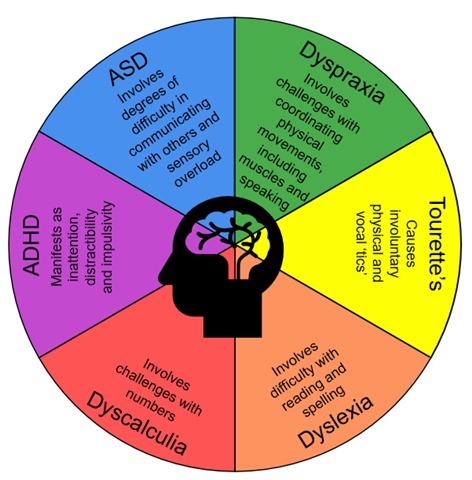
If ND is used instead of 'autistic' (when it's actually autism in particular that is probably the subject) I find it hard to follow the arguments/discussion.

2.

Another is the autism spectrum.

I don't know how it was meant when it was first termed, but my understanding of it isn't that there are ends of it that are less autistic, and more autistic, ie becoming more extreme, but rather than we (autistic people) can be less and more extreme as we dip in and out of the symptoms/characteristics:

Below is a link to an article that I think explains it well:

https://neuroclastic.com/its-a-spectrum-doesnt-mean-what-you-think/

3.

Also, if other people say 'we are all on the spectrum, all a little bit autistic etc' then I think it's important to bear in mind that a diagnosis is only given if the characteristics of autism that we match to are disabling to us.

How do others see the above and also, are there any other terms that you find difficult/confusing?

Parents
  • I use NT and ND because I don't want to exclude anyone and because if I were to describe myself using other terms it woud be an alphabet like it is with LBGTQI+ and woe betide you if you miss someone out.

    I often wonder why so many things are being reclassified as ND, like dyslexia or Bi-Polar, I wonder if this is overstretching neurodiversity? 

    I get annoyed when peope say we're all on the spectrum too, even though I used the term as the title of a recent thread, to me a spectrum has ends and a middle and various points along it, which was why I asked if someone could be profoundly NT?

    I'm not a big fan of these wheel things, I find them confusing and not informative enough. So much has changed since I was diagnosed 13 years ago I can't keep up. Maybe it's a sign of me getting older? 

  • I often wonder why so many things are being reclassified as ND, like dyslexia or Bi-Polar, I wonder if this is overstretching neurodiversity? 

    It helps to understand the meaning of neurodiverse. From https://en.wikipedia.org/wiki/Neurodiversity

    The neurodiversity paradigm is a framework for understanding human brain function that considers the diversity within sensory processing, motor abilities, social comfort, cognition, and focus as neurobiological differences. 

    Neurodivergences include 
    autism, 
    attention deficit hyperactivity disorder (ADHD), 
    bipolar disorder (BD), 
    developmental prosopagnosia, 
    developmental speech disorders, 
    dyslexia, 
    dysgraphia, 
    dyspraxia, 
    dyscalculia, 
    dysnomia, 
    intellectual disability, 
    obsessive–compulsive disorder, 
    schizophrenia, 
    sensory processing disorder (SPD), 
    synesthesia, and 
    Tourette syndrome.

    They do all seem to have similar origins so are logically grouped.

    So much has changed since I was diagnosed 13 years ago I can't keep up. Maybe it's a sign of me getting older? 

    I don't think it is an age thing, more of an effort thing. Before you would have tried to learn and understand but that can be a lot of work to keep abreast of all the developments.

    Do you keep up with the things that fascinate you? You do say you read a great deal so you probably just don't allocate time and energy to keeping up to date on this ND stuff - no judgement, just something that may explain it.

  • So much stuff is online these days I wouldn't know where to look or to begin looking, in such a fast developing field things seem to change so fast I could read something this week thats outdated by next week.

    I don't find the language used in many of these articles very easy either.

  • hehe and segueing into your religious thread (why was that down earlier I wonder?) it's easier for a camel to apss thro' the eye of a needle...!

  • Well I'm going to say something now thats so last decade, one of the reasons I'm very wary of all these studies is because of low sample numbers, huge leaps are made on the back of 50 people in a test group and that can be one of the higher sample sizes. Even if its a metastudy using the results of 50 studies, it's still going to be a low number of individuals actually studied. It makes me seriously wonder at the value of such metastudies as are they asking the right questions of the data they're studying? If they're not asking the right questions and totally different questions were asked in the original studies then how acurate is the data coming out of them and should we be forming policy on the basis of such flawed research? It could be why so many ND's don't recognise themselves, friends and family members in the stuff that comes out of such studies.

    Again a camel has been made by a commitee wanting to make a horse

Reply
  • Well I'm going to say something now thats so last decade, one of the reasons I'm very wary of all these studies is because of low sample numbers, huge leaps are made on the back of 50 people in a test group and that can be one of the higher sample sizes. Even if its a metastudy using the results of 50 studies, it's still going to be a low number of individuals actually studied. It makes me seriously wonder at the value of such metastudies as are they asking the right questions of the data they're studying? If they're not asking the right questions and totally different questions were asked in the original studies then how acurate is the data coming out of them and should we be forming policy on the basis of such flawed research? It could be why so many ND's don't recognise themselves, friends and family members in the stuff that comes out of such studies.

    Again a camel has been made by a commitee wanting to make a horse

Children