Imposter syndrome and Surprised responses

Since being diagnosed as autistic as an adult ( last week) I am suffering with imposter syndrome. I immediately felt relief after the diagnosis and felt a weight had been lifted, so I wanted to tell everyone. However, many people were surprised and have said things like, ' wow, you can't tell,' and 'you're really good at masking.' This just consolidates my fear that I'm a fraud.  I don't know how to respond to it. I haven't been consciously masking. I've just been surviving in the only way I knew how to. I wasn't prepared for the questions that have followed, 'what are your symptoms?' 'what makes you autistic?' I feel like they're asking me what colour underwear I'm wearing!! 

How do people respond to/ deal with this? I feel I'm suddenly off script and I don't have the answers or an explanation. 

  • Thank you, good advice! Yes, the word symptoms did slap my in the face a bit!

  • Hello.

    You could ask them how they know they're not, if they can't tell. That should get them thinking.

    Then put on your blank lost looking  poker face when they are talking.

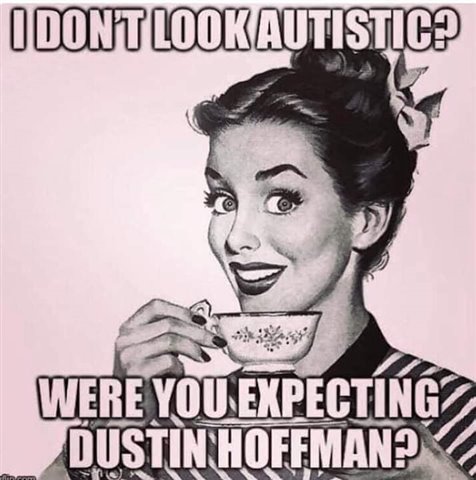
  • “Were you expecting Dustin Hoffman” - does it mean, that someone expects me to look like him, or him to be or look autistic?

  • And on a lighter note - if it's work colleagues saying you "don't look autistic" , you could always print off this meme and stick it on the wall:

  • I think we all feel that when we've been diagnosed as adults, we don't conciously mask, its just something we've learnt to do to make life easier. I think everyone, even neurotypicals mask to an extent, it depends on the situation,  we may have a work self, where we dial down certain aspects of ourselves, the side of ourselves we show to family and maybe the truer self that we share with those who we're emotionally closest too. As I say, its not something wrong as everyone does it to an extent, I think you'd have to be a very boring person not to do it ever, its just that with ASC we don't seem to know when or how to turn it off and be authentically ourselves, we've probably had early experiences that have taught us that our authentic selves are inappropriate in some way, often without any explaination as to why.

    I've had the 'but you seem so normal' remarks from people, part of me wants to shout at them and ask if they expect me to be dribbling, incontinent and brain damaged? the other difficult one is 'we're all on the spectrum somewhere', which is often well meant but hard not to take as dismissive. Sometimes its worth asking what people think an autistic person would/should/ought to be like? That question often stumps them, but it's worth rembering and telling them that ASC is a spectrum and no two people will have the exact same symptoms like they would with something like measles, its more like a cold where you can anything from being a bit bunged up and a scratchy throat, to something that has you in bed for a few days.

  • Hi Merida, welcome to the community. I understand how you feel.

    If people ask what your "symptoms" are, you could try telling them that it's not a disease, it's a condition that means your brain works a little differently to the majority of the population. In reply to "what makes you autistic?" You could give them a list of the things that you struggle with, but you could also tell them what positive traits autistic people have, such as: deep focus  attention to detail, good observational skills, in depth knowledge of topics, creative thinking, resilience, and integrity. 

    I hope you find this forum useful and enjoy chatting with us.

  • When I told my only friend, that my therapist gave me such suspected diagnosis, she said that there is nothing wrong with me. Many of us hear that. Paul Micalleff also talked about his experience with his family after the diagnosis. 
    the truth is that my only friend who knows me for around 18 years knows not much about me. Because I was told earlier in life that my behavior is inaccurate, I started hiding it or modifying while being around people. Including my friend. When I told her some of my secrets, things that I do when I’m alone, it left her speechless, she never approached this topic anymore. She was also shocked to hear about my perception. 
    The person who sees me everyday and often asks “what’s wrong with me” is my husband. And he agreed that I do show these symptoms since he knows me (6 years) and I know about autism 1,5 year. 
    you are not a fraud. I can imagine how it feels. Also in my family there were people who used to tell my mom, that there is  something wrong with me, but she always ignored that saying I’m just me or just a little weirdo. She does not accept the idea of me being possibly autistic, because it’s not severe autism. I’m quite intelligent (not my opinion, it’s what I often hear) and also stupid - that one I hear too, especially in very awkward social situations. 

  • Thank you for this. I am going to keep reading the first line over and over until it's embedded in my brain. I don't know why I didn't prepare for the questions previously, but I will do now.

    I know that sometimes people are surprised or confused about my behaviour or words, so I thought that my being Autistic would explain that to them, but for some reason it doesn't - I think on some level I have to accept that people will always remain confusing to me. 

  • You. Are. Not. A. Fraud.

    Just needed to clarify that. Imposter syndrome sucks (I’ve suffered it both as an Autistic and a musician), but you’ve got a diagnosis that can serve as proof that you really do have it. Not everyone who legitimately has Autism has a diagnosis they can point to.

    Okay now for your question: One way that I deal with people who feed my imposter syndrome is by weeding out who I feel safe telling about my diagnosis. If you know someone understands Autism or you are really close with them, it is a little easier to explain what you have than say a random coworker or acquaintance. For example, I disclosed as Autistic to one of my coworkers at my last job because he first mentioned he has a niece with Autism, and I was able to explain that I have some similar characteristics to her.

    Another idea is to practice. Us Autistic folk are famous for practicing conversations ahead of time, so go for it! Write down what characteristics you think apply to your Autism and practice saying them aloud as if you are trying to explain them to someone else. Think of what questions someone else might ask about those qualities and be ready for that.

    Bottom line: Stave off imposter syndrome with preparation. Be careful who you tell and practice what you’ll tell them.