Lighting

Am I unusual among autistics for preferring very bright and cool white rather than soft, warm yellow lighting? I love bright sunny days and direct sunlight. I often struggle at events for autistic people because I'm fighting the urge to fall asleep in dimly lit rooms with the curtains drawn, which is also an environment I find very depressing. Is there any product that could help me with this? Like sunglasses but in reverse? Something that can make the environment brighter for me but not for everyone else?

  • The average human can perceive approx. 100-150 colours which translates to approx. 1 million hues.
    "Researchers estimate that most humans can see around one million different colours."

    Yes - it seems like the terms 'hue' and 'colour' are often used interchangeably but my understanding is that  the human eye can discern approx. 100 separate 'colours' and that translates into approx. 1 million 'hues' in the same way that RGB (3) and CMYK (4) translates into many more colours.

    I do agree with your point about 'narrow band' lighting - as does the person who started this thread. It's interesting that what is relief for one autistic person is a trigger for another. 

  • Hmmm...

    This is interesting. According to: https://www.pantone.com/uk/en/articles/color-fundamentals/how-do-we-see-colour "Researchers estimate that most humans can see around one million different colours."

    I like clarity on all this as well! So perhaps we'll find some real answers if we keep digging!

    In my experience, narrow bands of light give me headaches. It's a slow burner, but wow I feel different turning off the LEDs and just popping on a halogen lamp.

  • I wouldn't mind hearing your thoughts on this blending of lights situation? 

    The average human can perceive approx. 100-150 colours which translates to approx. 1 million hues. A modern 3 colour RGB LED can produce approx. 16 million hues. That's way more than the average human can perceive any change in. This is (AFAIK) what the Phillips Hue system uses.

    With those kind of figures I don't see how blending 6 LEDs - of any type (even modern print still only uses 4 colours) - built into a table lamp sized package would bring anything that any human could perceive as significantly different or better light and from my short time on that site it looks like some of the critical info that could explain how that might happen is missing in place of marketing terms like 'bottled sunshine'.

    I also think the take-down comparison with the Phillips Hue bulbs is a little bit like criticising a guitar designed for Heavy Metal as not being very good for Jazz - it might be a technically correct observation but I'm not sure it's valid.

    I like the idea of having it programmed to reproduce a real world light cycle - that's a nice idea and a potential improvement on standard SAD lamps - but marketing it as though it might be better or more healthy light is IMHO bordering on snake oil.

    I don't hear you being pedantic. I rather dislike the use of 'Pedantic' against Autists. It suggests a cruelty and most of us are just trying to find clarity

    Thanks. It is all about clarity for me - especially when it's on subjects close to my heart!

  • My circadian rhythm probably is quite natural, but not optimised for modern society. If left to my own devices I go to sleep at dusk and wake up eight hours later. Which is why I've been up since 2:30am today. Unfortunately, this means having no social life from October through to march because the rest of society organises everything in the evenings.

  • I'm not sure I follow. An ability to sense any bandwidth, regardless of width, can be used in analogy in terms of percent. Filtering out a part (or in the case of fluorescents, many frequencies) has an effect. Now, I can understand not everyone has spent time in front of a stereo playing with EQs and filtering sound frequencies or spent time with different types of lighting really thinking about the effect. Many times, I don't think most play enough with sensory elements to sharpen the senses and this is fine.

    So I can understand it's not the best analogy for someone who's not experienced this to a degree. But other than that I'm not sure I follow.

    I don't hear you being pedantic. I rather dislike the use of 'Pedantic' against Autists. It suggests a cruelty and most of us are just trying to find clarity... to which I wouldn't mind hearing your thoughts on this blending of lights situation? 

  • Yes - my bad.

    My suggestion isn't going to help you much in an environment where you can't swap out the light bulbs.

  • Not trying to be pedantic - just trying to do my job as an autistic nerd.

    we all do that now and then. It's compelling

  • Not trying to be pedantic

    This reminds me of a joke my Dad and I have. He saw a pendant light for sale with a typo, labelling it a pedant light, so now any time either of us is too pedantic (we both have this tendency being both on the spectrum) we say "your turn for the pedant light!" Particularly appropriate for this thread, haha!

  • think of a Light Spectrum like a Sound Spectrum

    With respect - this is not a great analogy. 

    The ideal human ear can 'hear' audible sound from approx. 20Hz-20kHz and the average human hearing range is less than that at both top and bottom end.

    The ideal human eye can 'see' visible light from approx. 450 to 750 THz and (AFAIK) the few examples of humans sensing light frequency ranges outside of that have only occurred in lab environments.

    Not to say we aren't affected by frequencies outside the range of our five senses but filtering out frequencies of light humans can't see is not the equivalent of filtering out frequencies of sound humans can hear.

    ...and don't even get me started on statements like: "To recreate the beauty of natural light we actively blend the light of six different color LEDs".

    Not trying to be pedantic - just trying to do my job as an autistic nerd.


  • I don't like sun reflecting from shiny surfaces

    Same! Also hate flashing lights though they don't make me dizzy. But they do draw my attention far too much. And I don't like looking at bright lights so I have to strongly ignore the impulse to look at them! When driving it is hard if the oncoming car has too bright headlights, or in daylight the sun glinting on shiny cars - I would ban shiny cars! Why can't they have matte paint? And some people want to polish them to make them more shiny!

    As for the original question, I like bright light when I need to be awake and see things, though some kinds can be too much, and lower warmer light in the evening to wind down. Anything slightly flickering is bad, especially if it also buzzes or hums when the bulb is failing.

  • Try hunting down an energy efficient halogen or incandescent bulb for one reading lamp in the evening and see if you have your contrast back. Our cones use infrared to see with contrast. I tried to bring this up with my optician but the science is underfunded.

    But why we can't put the math together is beyond me. IR is critical to night vision for a reason. Start here https://www.pnas.org/doi/10.1073/pnas.1410162111

    And it can become a special interest. Haha. (Or it's one of mine!)

  • That blue is what we've known for a long time to interfere with circadian rhythm, which can interfere with your entire body - mess up the clock and everything else suffers. Think of it like the expected doomsday of Y2K. It's not natural for humans to be exposed to it at night and it's actually messing up or ecology as animals and bugs are now confused by the environment. 

  • Here's the Philips Hue btw

    https://www.sunlightinside.com/light-and-health/comparing-philips-hue-natural-light/

    That's a piercing light. I'd even consider wearing sunscreen under that much UV in an office. 

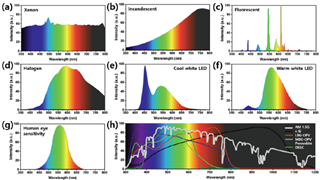
  • The problem is usually the TYPE of lighting. Unnatural lights like LEDs, CFLs and Fluorescents don't mimic the natural spectrum our Star gives off. Fire also mimics sunlight but obviously not as bright. 

    The sun's spectrum and filament/fire has a lot Infrared (IR), which the eyes borrow for Contrast. We've found this by understanding how colourblind individuals have better night vision. 

    Unnatural lighting has far too much of a few points on the light spectrum, too much UV especially, but our eyes borrow from UV light for brilliance. However most unnatural light sources cannot mimic IR light very well, so vision will go a bit blurry.

    to help understand this, think of a Light Spectrum like a Sound Spectrum. If you cut the Low frequencies (similar to getting rid of Infrared) on a song, it doesn't sound pleasant. Then start cutting out other frequencies and it can create a Great Deal of Effort to listen to the song. This is the same kind of effort your brain will be putting in to negotiate unnatural lighting. Which would account for becoming tired. 

    For more info: lightaware.org

  • I could try using my phone more I guess. Perhaps whacking up the brightness and holding it near my eyes while in dimly lit venues.

    I have the cool white bulbs at home, they're brilliant.

  • Oh I don't drive. I can see just fine in low light. I just can't stay awake if it's later than mid afternoon and I'm anywhere dimly lit. Not a lack of sleep as I wake up eight hours after going to bed feeling 100% refreshed and ready to go.

  • Have you considered also changing colours rather than just brightness/temperature?

    I've never felt comfortable under fluorescent or older 'warm' yellowish lighting.

    My workspace uses the Philips Hue bulb range. They're not cheap but you can get LED strips and standard E27 bulb replacements that will do everything from cool, white light at approx. 5000 Kelvins (K) to every other colour and brightness.

    I have a preset on the phone app for working/daytime which is 'white and bright' and a preset for working at nights which is a nice, low blue

    Maybe there's a colour that is bright enough for you that won't make everyone else feel like they're on the sun.


  • Im sensitive to light find it difficult n have 2 squint all the time lol. We have soft lights in the house n that seems to help.

  • I meant night driving glasses, that's what they called in english, but improvement is by removal of light distractions, e.g. glare from street lamps, 

    you would need night vision googles to see in a dark, prices for the cheapest are surprisingly low, only £30, but they don't look like glasses