
Lighting

Am I unusual among autistics for preferring very bright and cool white rather than soft, warm yellow lighting? I love bright sunny days and direct sunlight. I often struggle at events for autistic people because I'm fighting the urge to fall asleep in dimly lit rooms with the curtains drawn, which is also an environment I find very depressing. Is there any product that could help me with this? Like sunglasses but in reverse? Something that can make the environment brighter for me but not for everyone else?

Parents
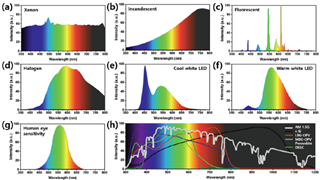
  • The problem is usually the TYPE of lighting. Unnatural lights like LEDs, CFLs and Fluorescents don't mimic the natural spectrum our Star gives off. Fire also mimics sunlight but obviously not as bright. 

    The sun's spectrum and filament/fire has a lot Infrared (IR), which the eyes borrow for Contrast. We've found this by understanding how colourblind individuals have better night vision. 

    Unnatural lighting has far too much of a few points on the light spectrum, too much UV especially, but our eyes borrow from UV light for brilliance. However most unnatural light sources cannot mimic IR light very well, so vision will go a bit blurry.

    to help understand this, think of a Light Spectrum like a Sound Spectrum. If you cut the Low frequencies (similar to getting rid of Infrared) on a song, it doesn't sound pleasant. Then start cutting out other frequencies and it can create a Great Deal of Effort to listen to the song. This is the same kind of effort your brain will be putting in to negotiate unnatural lighting. Which would account for becoming tired. 

    For more info: lightaware.org

  • think of a Light Spectrum like a Sound Spectrum

    With respect - this is not a great analogy. 

    The ideal human ear can 'hear' audible sound from approx. 20Hz-20kHz and the average human hearing range is less than that at both top and bottom end.

    The ideal human eye can 'see' visible light from approx. 450 to 750 THz and (AFAIK) the few examples of humans sensing light frequency ranges outside of that have only occurred in lab environments.

    Not to say we aren't affected by frequencies outside the range of our five senses but filtering out frequencies of light humans can't see is not the equivalent of filtering out frequencies of sound humans can hear.

    ...and don't even get me started on statements like: "To recreate the beauty of natural light we actively blend the light of six different color LEDs".

    Not trying to be pedantic - just trying to do my job as an autistic nerd.


  • I'm not sure I follow. An ability to sense any bandwidth, regardless of width, can be used in analogy in terms of percent. Filtering out a part (or in the case of fluorescents, many frequencies) has an effect. Now, I can understand not everyone has spent time in front of a stereo playing with EQs and filtering sound frequencies or spent time with different types of lighting really thinking about the effect. Many times, I don't think most play enough with sensory elements to sharpen the senses and this is fine.

    So I can understand it's not the best analogy for someone who's not experienced this to a degree. But other than that I'm not sure I follow.

    I don't hear you being pedantic. I rather dislike the use of 'Pedantic' against Autists. It suggests a cruelty and most of us are just trying to find clarity... to which I wouldn't mind hearing your thoughts on this blending of lights situation? 

  • The average human can perceive approx. 100-150 colours which translates to approx. 1 million hues.
    "Researchers estimate that most humans can see around one million different colours."

    Yes - it seems like the terms 'hue' and 'colour' are often used interchangeably but my understanding is that  the human eye can discern approx. 100 separate 'colours' and that translates into approx. 1 million 'hues' in the same way that RGB (3) and CMYK (4) translates into many more colours.

    I do agree with your point about 'narrow band' lighting - as does the person who started this thread. It's interesting that what is relief for one autistic person is a trigger for another. 

  • Hmmm...

    This is interesting. According to: https://www.pantone.com/uk/en/articles/color-fundamentals/how-do-we-see-colour "Researchers estimate that most humans can see around one million different colours."

    I like clarity on all this as well! So perhaps we'll find some real answers if we keep digging!

    In my experience, narrow bands of light give me headaches. It's a slow burner, but wow I feel different turning off the LEDs and just popping on a halogen lamp.

Reply Children
  • The average human can perceive approx. 100-150 colours which translates to approx. 1 million hues.
    "Researchers estimate that most humans can see around one million different colours."

    Yes - it seems like the terms 'hue' and 'colour' are often used interchangeably but my understanding is that  the human eye can discern approx. 100 separate 'colours' and that translates into approx. 1 million 'hues' in the same way that RGB (3) and CMYK (4) translates into many more colours.

    I do agree with your point about 'narrow band' lighting - as does the person who started this thread. It's interesting that what is relief for one autistic person is a trigger for another.