Should autistic people campaign for recognition as a distinct part of humanity rather than be labelled as disabled?

I have stories previously of other groups of people such as Irish gypsies successfully campaigning to be recognised as a distinct subgroup of humanity. Irish gypsies do have a distinct culture (they are wonderful people if you knew them) but they are quite a bit closer to most other people than autistic people are. So rather than be classified as a disability (excluding comorbidity like learning disability, depression etc) should autistic people, who generally have a unique way of approaching life (that is common across most autistic people) campaign for the same thing? In my opinion I don't consider us to have a disability, I think we are really just a very different type of human being with a common identity among all of us who share the so called disability. What are your thoughts?

  • I live rural and  totally  agree ,the difficulties are far more and the exploitation is far worse .

    Its a far more conservative area.

    Unless you have experienced it, you do not really understand.

    I understand asd has a  1 % rate  in the uk in school children .so i would say your statement of 1 in 160 in the population is accurate.

    I think it understates what being autistic is really like when people say nearly everyone is a bit autistic . 

  • You are not disabled until you physically or mentally become unable to deal with life physically or mentally maybe academically.Every human being becomes disabled at some point in their lives but I don't think they are all ever truly able to go through life being themselves unmolded by society. Disabilities are equal opportunity.

  • I've got a few points to make. 

    1. Re being forced down an NT path...I get where you are coming from but this isn't realistic. I've got my life set up as it is and need to partake in "NT" society to pay for the house, bills and shopping. 

    2. Who is to say that they speak on my behalf as an autistic individual? Who gets to decide that the autistic community is a distinct part of humanity? 

    3. Where do you draw the line? Everyone has differences (not just neurological). What makes autism special to distinguish it from other differences?

    4. My friend's son is classed as disabled. If he didn't have that "label" he wouldn't be able to get the help he needs in life.

    Maybe I'm thinking more of the pragmatics. How would this even work without segregating people? I think realistically,  it's that there needs to be more awareness and appreciation of individual differences regardless of neurological status,  or any other status. This would then "allow" people to live a life more naturally suited to them.

  • i am focusing on rural location from experience, there are more autistics in rural locations across the UK then their is in urban areas but little to no support for those in rural location across the UK, Those autistics who live in major towns and cities do not experience a fraction of the challenges that still exist for those who live in villages across the UK.with many of them not having simple opportunities.

    many of these autistic individuals from rural location are stuck living with their aging parents with no means to move to the nearest city. for me the nearest town is over nine miles away with no public transportation and to the nearest city its over forty five miles away with no transportation. access to opportunities are not a simple as those living in towns and cities.      

  • So its toxic for individual with autism to seek support and help after trying to do something themselves  that they cannot achieve or maintained that subsequently puts themselves in crisis or in harm because they way the society has been created. Disability is not a negative thing, it's a label that helps other individuals understand that their is difference that may need extra support or explaining non typical behaviour that a typical person may find inappropriate or negative to think twice before interpreting in negatively typical manor the meaning of a behaviour.     

    we are a distinct part of the human adaptation and development of cross species variants, it has a biological element to it and eventually if the rest of world population let us exist and we will get to a larger population mass of autistic individuals that term disability will eventually fades because large portion of society will be designed for autistic by autistic individuals.

    Currently we autistic are not thriving, many homeless people on the streets have undiagnosed or diagnosed autism or ADHD. Many autistic individuals are not procreating because they understand the world not designed for us and going to lead tho their possible autistic children from suffering incredible hardships.Many of the autistic diagnosed and undiagnosed population across the world are committing suicide because it is disables them from living the way they wish to live.       

  • Yes, i have a diagnosis of Autism and i consider it disabling. Its disabling because for me i can't understand neurotypicals on a basic fundamental level that affect my ability to gain long term employment and disabled my ability to earn the money that will allow me to live the way i choose.

    My point is that individuals like yourself are proactively working against other autistic individuals, congratulations that your autism has manifested in way that doesn't limit your capability but for many individuals who only have autism have to ask for reasonable adaptations in the workplace in order to cope that wouldn't of happened without the understanding of other neurological developmental disorders such as Dyslexia, Dyspraxia, SPD, ADHD and Autism.

    It doesn't benefit only autistic to be put in their subgroup because it limits your voice for understanding and their a very few people with autism who think like you.       

  • No, Because the language and social understanding can be taught someone from a tribe in south american and be understanded in a typical manor. In autism the way of thinking is not down to cultural exposure but a biological difference that disables an individual's ability to understand communication in a typical manor, we can learn how to mimic behaviours, learn how to respond to certain behaviours but will still cannot understand how a neurotypical thinks getting from one idea to another. without understanding how the majority of neurotypical think we struggles to understand interpret their verbal language and non verbal language.people on the autism spectrum do have the capability and that is why we are given a diagnosis.       

  • You seem to be totally fixated with a very tiny group of very autistic people in rural locations -  however, the vast majority of autistic and aspie people were in towns and cities and did just fine until life became too complicated and socially intense in the 80s.  

       There used to be no computers, few telephones, no internet or multiple tv channels.    Gas came from the gas company, electricity from the electric company etc.  Most jobs were for life and came with a proper pension.     All very simple and sensible.

  • I agree with this however majority of those with individuals with autism where in fact working in bottom of the barrel jobs such as livestock, Slaughter and agriculture and where often crippled or harmed in horrific accident before the thirty fifth birthday. Most of the where exploited by their employer paid very little and purposely where made to put their hands in chemicals like fertilizer they new was hazardous and toxic and this continued until 1980.

    Unless you lived in major parts of the cities and thriving towns districts moderately functioning autistics where unemployed, abused by the majority by religious individuals and where left to their own devices and ended up ending their lives.

  • I'm not advocating for segregation. Where are other people getting that from? What I am saying is that I think autistic people are different enough in world view and culture if you like from NT people that it should be recognised a distinct subgroup of humanity we should be facilitated to live our lives how we are built to and not be forced down a NT path and just labelled as disabled.  There doesn't have to be segregation. A NT person "is a" human being and an autistic person "is a " human being. Homosapien is a more complex diverse and beautiful part of the animal kingdom than to just have one set in it.  Are NT people are there is? No there is alot more than that its just not recognised yet. Not segregate but different specialisations of homo sapiens. If that was recognised and facilitated I'm sure the autistic community would be super charged to have an even more productive impact on life in general for everybody. 

  • I think this viewpoint also misses the point that even people who are "neurotypical" have to navigate some situations with difficulties because of variations in personalities, values and beliefs, preferences... the list goes on. 

    I don't think I want to be considered a different type of human. I think the world has enough genocide in its past and present to see the pitfalls of segregation. 

  • If you worked in a group of people just like yourself you wouldn't face the same issues.

    But I don't work in a group of people just like myself - and why would I want to? It is neither realistic nor practical. The real world simply isn't like that. Communities aren't like that. Social groups aren't like that. Plus some of my best workmates are NT's - why would I want to deprive myself of those relationships? Slight smile

    More than that, if I didn't make the effort to understand an NT's perspective the world be even more confusing than it is now. Irrespective of whether or not the world is, or is not "designed" for me (I prefer the idea of the way it has evolved with a whole host of competing ideas which are still in flux) , I still have to function in it - I can make adjustments and change my lifestyle but there will be situations where I am less-able and which will be harder for me. I'm comfortable acknowledging that. There's plenty of work situations I thrive in where the majority of my colleagues don't. 

    Electric shock therapy is still a thing. It's just not the go-to thing because there are other types of interventions - medication, psycho-social which are tried first - and can be effective. Surprisingly, ECT can still be administered, in rare cases, without someone's consent.

    https://www.mind.org.uk/information-support/drugs-and-treatments/electroconvulsive-therapy-ect/consenting-to-ect/

    The basketball analogy doesn't resonate. There are some very short basketball players. Muggsy Bogues is shorter than me and I'd wager he'd still trounce me in a game. Size isn't everything Wink

    Ever meet someone from a different county or background and didn't really "get" them until you understood more about how they thought, why they believe what they do, how their culture has developed. So many "aha" moments have come from me talking with NT work colleagues about how we respond to certain situations differently. To me it's about working out and understanding a different group of people and how to share our outlooks. I'm happy to be an advocate, have that exchange of information, so we can learn from each other but I'm not going to deny I feel less able (or disabled, or less competent) in some situations - because in those situations I am. But I don't let myself be defined by that situation or my reaction to it. I learn how to manage it better in a way which is comfortable for me and work with other people so there's a shared understanding of how we can support each other (although, as I pointed out to one of my senior managers, people and organisations are by their nature chaotic, so at some point I will be let down so I still have to navigate that when it happens). 

    The disabled label I can't get excited about. I can acknowledge that I feel disabled (or less able) in situations which aren't as challenging for a NT but it's a case of using that as an opportunity to learn how to better manage myself (and influence others) in those situations. As I said, I've no problem with someone using the term - as long as they don't use it to put me in a box. 

  • In those circumstances I do feel disabled. It's not an issue of conformity -it's an awareness that I don't have the social awareness and those innate skills that would help me navigate those situations  effectively and I have be a bit more aware and work a little harder.

    If you worked in a group of people just like yourself you wouldn't face the same issues. Its not that you are disabled its that you are operating in a game/a system that is not designed for you or me. You are still looking at the situation from a NT's persons perspective which is also part of the problem.

    Have you ever played a game like basket ball and you weren't good at it because you weren't super tall and instead of saying I'm just not suited to this game you've said oh I'm disabled because I can't play this game that wasn't designed for me well.

    The theory is that, how NT's people look at the world and operate is the only way people should do that and everything every where is setup up for that world view, and if you can't do that your disabled. This is not the case and if people actually did something it could change.

    There are other examples of different types of people where the general consensus was that they were dysfunctional in some way, and needed treatment such as shock therapy, but later the world changed and those people because part of the furniture and have their own identity as a group and are now generally accepted as such and respected and protected. I feel the same thing should happen for the autistic community but I doubt it will ever happen. If we weren't forced to live out our lives like NT's and could live how its best suited for us I think we could thrive even more so than the luckiest autistics do now. 

  • I think it's a little more than work customs - that's just only one dimension of things. Because I don't understand the social drives/interactions of people it places me at a disadvantage in certain settings both in and out of work. Certain people skills don't come naturally to me and there's roles where, to be effective, like it or not, someone has to have a degree of understanding of how to influence, have  general people skills and possess an awareness of how people think and function.  

    The point I was trying to make, and I don't think I did it very well, is that I'm all for a neuro-diversity label (which I think is a lot healthier and inclusive) but there will be those times where I will not be able to function as well as an NT. I'm thinking of specific works circumstances (although there will be others) where the situation has called for a particular approach to resolve the situation - having the technical answer is one thing, influencing people and gaining that "buy in" (and knowing how to do that) is another. A group of people with competing perspectives determining a way forward on a piece of work is an incredibly difficult scenario for me to navigate. They way people become divergent in their thinking, have a messy "groan zone" where all sorts of ideas are being thrown around and then become convergent is incredibly difficult for me. But that's the way reality presents itself. I still have to navigate it regardless.

    In those circumstances I do feel disabled. It's not an issue of conformity -it's an awareness that I don't have the social awareness and those innate skills that would help me navigate those situations  effectively and I have be a bit more aware and work a little harder. Acknowledging there's a fundamental difference between myself and a neuro-typical may well be true, but I still have to learn and apply specific strategies to overcome those "blind spots". I am, in those circumstances, less-able and painfully aware of the challenges that presents.

  • Sounds to me like you are being force to follow the work customs of NT people. This to me just reaffirms my point in a certain specific scenario. Instead of you saying this is how I work and this is how they work and they are fundamentally different because we are fundamentally different types of people, you are looking at it like you  cannot conform to the "normal" status quo and so that means your disabled. It does not. This is a large part of the problem that I am getting at.  

  • I remember a few weeks ago (on this very forum) when I said that I didn't consider myself disabled - just different. Last week for the first time I felt really disadvantaged and - yes - disabled. 

    I'm in work and the way other people work I find absolutely chaotic - I cannot understand how anything gets done or why things are so disorganized. Everything I pick up at the moment is just trash because someone hasn't documented something, someone skipped something, or someone makes a decision when they have no idea about the thing they're deciding about - or they want something before it's ready. It's hard for me to accept that actually - that's the norm. Everywhere.

    Probably the hardest thing is promotion in my organisation.The common experience is that you're dropped in there and expected to figure it out. I can't do that, unless there's a list of things I need to know/do/be aware of I won't cope. Which is the experience I had when I ditched a promotion and then spoke to other people who were having the same type of experience but were able to "hang in there". There's something about ambiguity and uncertainty that absolutely overwhelms me. And I don't mean having to know everything - but where I'm expected to do a role, and the information I need to do that role isn't cascaded, or an overview or just some kind of framework for me to organise it in my head then I'll start to unravel.

    I finally accepted I won't be a leader of a team. The very idea of managing a group of people seems to me like herding cats. I could probably manage a team meeting (agenda, things to go through and discuss) and monthly check-ins (just) but all the other stuff that comes in with managing people - absolutely not. I also struggle to generalise. I need to "see" a job and understand it before I feel able to apply for it - because in many cases what I see in a job description, I've learned, is nothing like what the actual role will be. 

    These problems aren't insurmountable - and there's things I'm doing to find a way forward (more job shadowing for example). Ideally I refer to myself as neurodiverse a lot of the time - and yes, I do see things differently. But there's times when I really do feel disabled. Where that inability to read people, or understand all those unwritten rules that everyone just "gets" and knowing what motivates/influences individuals, and that some people will drive chaos for others and not really give a stuff about it - even though they should - it's like being asked to win at a game when you don't know the rules. When I sit back and watch a group discussion as an observer I can see how the interactions work but to be in and part of it - I'm really struggling.

    Personally I go through stages of acceptance and extreme frustration. Someone said to me today that "I'd have to move out of my comfort zone sometimes" - not understanding that I've been doing that pretty much every day for the last 40 odd years just by having to deal with people. 

    I can't get excited about a disabled moniker - as long as no-one uses it to put me in a box. But if more people recognise the condition and can think of creative ways to support those of us on the spectrum (as I support NT's when I'm coaching them on various work stuff to up-skill them and make their lives easier) than that I can get excited about. 

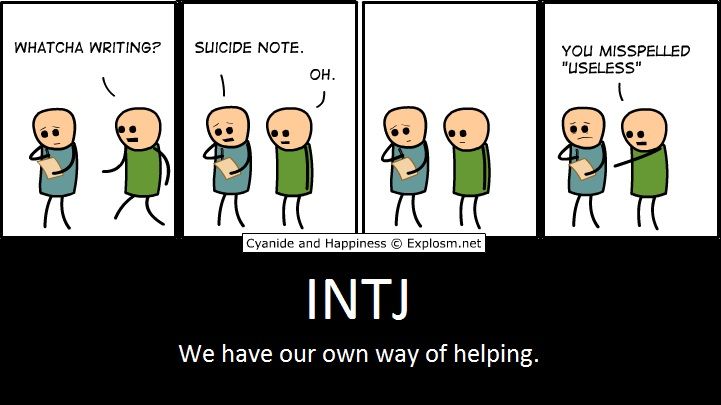
  • Before I was even aware of a Spectrum, I had thought I fit into the Jungian archetype of the INTJ.

    Me too!

  • If you look at 1950s life, aspie men and women would be considered the pillars of society.

    The man goes to his boring job - performs admirably, doesn't create a fuss, maybe a bit of a 'boffin', comes home expects dinner on the table and then spends the evening reading the paper, making models with his son and smoking his pipe.    A jolly good chap.

    The subservient wife cooks and cleans and sends their perfect Jane & Johnny off to school and meekly waits for her very predictable, boring, nerdy husband to come home.   

    Nothing extraordinary, nothing racy - predictable, routine, solid people.

    Then everything became complicated and we couldn't keep up with this new social-biased world.

  • Before I was even aware of a Spectrum, I had thought I fit into the Jungian archetype of the INTJ. That Myers Briggs personality type was my first encounter with being made aware humans have different motives for engaging with the world around Them. It made sense, for the most part. Except that I was still running into problems fitting in, and then not too long ago, it became frowned upon to add these personality types to a CV because the implication of some humans being "superior" to others. Sigh.

    I have researched and read whatever I can find to try and work out how to navigate society even the 48 Laws of Power. Which is a horrendous book and is somewhat this very dark NT 'bible'. But it made me aware that some humans even used an outward appearance of connexion and kindness to dominate others. I now had to rethink how I phrased everything. 

    When it comes to legal matters, I feel an incredible amount of empathy and heartbreak for autistic individuals who are falsely accused and robbed of agency. This issue is worth discussion. 

  • This is a great thread. There is an issue with females being properly diagnosed. NT females are willing to put up with ND males - to some degree. And even society is OK if males don't exert proper social graces. But females?? From my experience it's incredibly difficult to just do my technical 'thing' without being expected to navigate social norms. 

    I started Anti-Oedipus and moved in to A Thousand Plateaus (Deleuze & Guattari) to comprehend WTF is going on. And it's mind blowing. Add other books I've read. Lately I've been trying to work further on my 'agreeableness', which is still a subtle art of manipulation. The redundancy of transmitting and receiving 'orders' as opposed to being in communication. It's wild.

    More thoughts later perhaps...