Can you be diagnosed without "classical" obsessions & routines?

As you can see I'm still chewing over my recent evaluation.

Where my assessor seemed to be digging a lot and struggling to find evidence was in the domain of obsessions and routines.

I do have routines, and I get stressed if anyone threatens them, but how severe is it? I don't know. No meltdowns, but I'm a lot happier if I'm left alone with my original plans - which would generally be go to work & come home at the same time each day, have pretty much the same thing for lunch, and come home to my wife and dogs *only* until the next day. Holidays from work ideally means more time at home for me - no travelling.

I do have obsessions, but they aren't for train numbers or a particular sort of aircraft, or a specific South-African toad or whatever but instead have been pretty intense hobbies that I can achieve a flow state in. They have changed over the years.

I'm worried that the DX I get in about 5 weeks will just say I'm a lonely geek with no friends.

Thoughts?

  • Respect to you that you can leave the right side 'wrong'!

    I have learned that I can only control the things I can control.  The rest of the world has their own crazy, chaotic, mental, ridiculous, WRONG way of doing things.  I can only lead by example and hope they figure it out on their own.

  • Respect to you that you can leave the right side 'wrong'!

    I once re-organised someone else's cutlery drawer 'cos they had three sets of cutlery with different handle colours grouped by colour... to me grouping by knife/fork/spoon made more sense as it was easier to get a 'set' of a single colour that way...

    I also compulsively re-arranged a display of sunglasses so they were ordered by frame and then lens colour

  • There's probably many, many more ways that we do things differently to NTs.

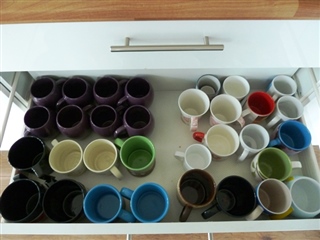
    Here is our cup drawer - guess which side are my cups......

  • Yeah, It's pretty hard when you don't know what's up! I wouldn't say I caused no distress whatsoever to the people around me, they worried more about my intake, if they knew how much I used to drink and take. Not many did. I was very good at hiding it all, very good. That's something I used to feel guilt over, the way I'd found ways to cope, but there was a lot of stuff I hid, or found ways to avoid. I think because I was so closed up about it all that's why it took so long for me to be diagnosed.

    It’s always left me wondering what those 37 years would of been like with a diagnosis, but you can’t live in the what ifs. 

    I had that thought in my head for a quite some time after being diagnosed, but I came to terms with it after a while. There's some experiences and lessons I learned without the diagnosis, that I might not have had if I had been diagnosed. It could have been better, it might have been worse. Like you say it's not worth considering what ifs at this point. I think that my diagnosis came when it needed to, it came when I really needed answers, and that's what made me start to restucture everything. If I'd had it some other time, I might not have been so willing to change.

  • I think it's hard to turn the lens on yourself on this - stuff that seems normal to you might get classed as an obsession by others.

    I'm seeing a psychologist at the moment with a view to a possible diagnosis...

    's list ticked so many boxes for me:

    I fill the dishwasher the 'correct' way. - OMG! My wife gets so mad at me when I re-pack it the 'right' way!!!

    I eat my food in the right order. - packet of M&Ms... sort by colour then consume in ascending order of how many there are

    I wear the same type of clothes every say. - despite my workplace having a casual dress code I wear charcoal trousers and a short-sleeved white shirt & tie every day, except for my self-allowed 'casual Friday'

    I am compelled to do the right thing. - YES!

    I get 'fixated' on things, sometimes for only a short while, and once that goes I'm 'done' with whatever it was

    I think you could replace 'classical' with 'obvious'... I suspect for low-level/high-functioning types (apologies if I'm using the wrong terms) the 'obsessions' probably simply look like 'quirks'

  • That’s what I found that since the diagnosis the coping strategies were easier then before because like you years of counselling that proved to work for a bit but then it was always back to the dark days and self medicating to help, which unlike you did cause distress to others. 

    It’s always left me wondering what those 37 years would of been like with a diagnosis, but you can’t live in the what ifs. 

  • through various means alcohol, drugs,

    I was self-medicating for years, just to block out the sensory stuff. I wasn't so much a problem to people, I functioned better I was under the influence, and was I'd say easier to be around. I was doing damage to my body however, and it all cost money.

    They also become a routine, which most autistic people find comfort in. That's a problem that I think needs looking at more. I've spoken to a few addicts, who had the same experience as me. They loved the routine.

    Since my diagnosis, I've found coping strategies, that have been far simpler than I'd have thought. I just wish I'd known earlier what the problem was. Years of going to shrinks, and my GP, who had little to no experience (by his admission), was the one to send me for an assessment.

  • It's kind of a strange one, but I think you become more aware of things after diagnosis. I found it the case anyway!

    I was pretty much in the dark about a lot of the things that autism encompassed. I knew bits here, and there, but not that much compared to now. I was referred by my GP after he suggested that he'd seen traits, and he got me to take the AQ test. I didn't know much about traits, stimming, or the sensory challenges. I answered the questions, and didn't know how they related to anything too much. I have a few friends with autistic chlidren, and I just knew how to act around them. I'd also had a girlfriend with AS when I was younger, but again I just knew what she liked, didn't like, or had challenges with.

    As with regards of how it all related to me, I didn't have a clue. I chose to not look into it before the test, just in case it influenced the assessment.

    I was told to take a parent, or someone I'd known for a long period of time. So they had some other input to analyse. I took my mom, and my ex of over 10 years. The lady doing the assessment asked my mom about things like if I used to rock or spin around as a child, if I liked to be held, lots of things that I didn't have a clue about. They were both asked about eye contact, if I started a task, or job, did it consume my attention. I was asked about my senses, and I gave them the answers (I knew that something was seriously different there!). Some other questions about relationships, memory, IQ, and interests. I do have a few interests that border on obsessive, but I thought that most people I knew do, so what of it.

    I got my diagnosis, and a list of contacts at the next appoimtment. That's where things really started to make sense. I was told how certain things related to me, and that I should contact someone to find out more.

    I met up with a lady at my local autism charity, and we got talking about it all. Then I started to notice all of the routines I have. I have had bouts of serious OCD at different times in my life, which all tied into my autism, when it was all explained to me. Even my substance problems too, they were part of a routine.

    Sometimes our traits make us form routines, and we don't notice!

    Here are some of the things I've noticed since I've been diagnosed!

    I have a serious sensory problem with having a dry mouth. I have a pint glass full of water around me at all times, or a bottle. If I eat savoury food I drink water, if it's sweet I drink milk. I tend to like mushy food because it doesn't dry my mouth out, if it will I drink after every bite.

    I have only eaten food with the same plate, mug, cup, and cutlery. All of them are black because I can see any residue after they are washed.

    I wear the same colours, they are ones that don't make me feel uncomfortable, or don't distract me because of the sensory problems I have. I also wear a T-shirt with the label cut out under almost everything I wear.

    I wear the same 3 types of shoes, always have, always will. I have serious sensory problems with my feet. If someone touches my feet I can fly off the handle. I can touch them myself, but I still don't like it, so sometimes my toenails are pretty long. 

    Every room in my house is decorated with colours that don't interfere with my head too much.

    I don't keep anything with chlorine in the house, because the smell of things that contain it make me feel what is akin to pain.

    I do far much more in Winter, because the heat is another challenge. I would avoid days out in Summer, mostly.

    I don't like my head being touched by people, so I have either had long hair, or a buzzcut (because I can do it myself) all my life.

    I have to shower every morning, because I feel sick if I don't. It makes me nervous if I don't.

    I can start something, if it falls into something I can obsess over, I can, and will stay awake for days until it is done right, or to my satsfaction. It sometimes makes me hesitate to start something because I know I will drive myself to the edge, if I start to get tunnel vision, or as I now understand it "autistic hyperfocus"!

    And so on, and so on! I could write lots more, but I think you get it. The more you start to understand, the more you will notice. The best advice I can give is, if you are diagnosed, don't get too lost in it all though. You will still be the same old you, but just with more understanding.

    If you are autistic, trust me, from my experience, they will know. I went in blind, and the lady picked up so much stuff that was detailed in my diagnosis it was spooky!

    If you can try not to worry. I know you want answers, and you should get them.

    All the best, and best of luck!

  • Obsessions don’t have to be to the conformed expectations of obsessions and if this was showed at time of diagnosis then they will note it . I wrote a story of my life which I took and I’m not sure if that helped along with my Mums notes. 

    Some obsessions that you might not of thought of - skin picking or fidgeting, obsessive thoughts leading to severe anxiety daily thus leading into depressive thoughts and sucidal attempts, obsessive behaviour to gain a place in society that causes distress to loved ones and to the person with ASD as they do not understand what they are doing (through various means alcohol, drugs, sex), or a preference to certain things  for example and the anxiety this causes is highly distressing (in personal opinion)  

    This then leads onto meltdowns as most of the above certainly caused a lot of distress so meltdowns were common 

  • I finally had my assessment recently, but I forgot to mention obsessions when asked. I did briefly mention a strong interest I have now as an adult (maybe just one sentence). We were mainly talking about my early childhood, but given that as a child, what I was able to do in life was mainly determined by adults (e.g., parents & teachers), I didn't have much freedom of developing routines and obsessions. In later childhood and teenage years, I developed obsessions (?) but I think of them more like hobbies (and they weren't very unusual and I would be fine if for some reason I wasn't able to do those things for a few days), but didn't think to mention it at the time. I don't think it's necessary to have strong "classical" obsessions to get a diagnosis, and I think the ones you mention are actually quite often what many people with ASD experience - trains numbers and aircrafts are just the stereotypical ones.

  • I have had my initial assessment as well and waiting on the letter to see if I want to progress for the full assessment, taking the private route,
    I am the same when it comes to routines, I know I used to get worked up with change of plans as a child, its stressed me out but now it makes me uncomfortable, anxious but not a major meltdown.
    my obsessions a slightly different aswell a particular shows, a particular food, I don't think I have the energy or time to have hobby obsessions or at least am not aware of any I have, although I would say have an addictive personality not sure if that's same as an obsession.- my assessor did say these to are autistic traits.
    I totally understand where you are coming from, That is my fear aswell ,  but hopefully we both get the answers we want,

  • I can definitely relate to this, I didn't know this was a thing

  • Stimming would be mentioned briefly in the report if they recognised it as such but it doesn’t count towards the score for the ADOS. The scored parts that form part of the final score are social interaction and communication 

  • Yes - my wife mentioned in the interview the fact that I can't call into a shop on the way home from work, but instead have to come home, flip the switch in my head that says I'm "home now and free to go out if I want" and then go to the shop - even if I passed it on the way home!

  • Thanks for the replies everyone! Yes I was on the same page as all of you, but I just got the impression that my interviewer was looking for something more classical (if not stereotypical?). 

    You've put my mind at rest a bit............I'm still chewing my knuckles though waiting for the letter!

    On the subject of knuckles this reminds me I'm pretty sure I was also stimming in the interview (rubbing knuckles together, rubbing my forearm almost as if cold etc...........and I know people's reports have identified stimming for far less, but I pretty much expect mine to mention none of it!

  • I have to put the washing up on the draining board in the correct way, when other adults in my house fail to do the same it really bugs me!

  • Obsessions don’t have to be the classic obsessions with trains etc, they can be hobbies or other things. I never used to think that I had meltdowns either but I realised, after discussion on here, that I do, they’re just not as obvious as the classic meltdown. Everyone is different.

  • Are you sure you don't have obsessions and compulsions?

    I fill the dishwasher the 'correct' way.

    I eat my food in the right order.

    I put things in cupboards in the obviously correct way.

    I eat a repetitive diet.

    I wear the same type of clothes every say.

    I am compelled to do the right thing.

    I am compelled to go to any appointments made for me.

    I always arrive very early to avoid being late.

    If you think about it, it's likely you have lots too but you don't always count them.