How to differentiate between ADHD and autism diagnosis

I’m currently going through the diagnosis process with my daughter. Referred when she was 3/4 and now about to turn 7. Had our first appointment yesterday and the assessor says she is most likely ADHD but only has maybe a handful of autistic traits. She autism traits she was asking questions about I feel don’t really relate to girls on the spectrum.
My daughter is exactly the same as me when I was a child except my childhood was filled with a lot less understanding, especially from school. I was seen by psychiatrists since a very young age but my mum thought it was to do with her divorce rather than something else so I didn’t get an autism diagnosis until I was in my 20s. The reason I differ from my daughter at the moment is because I had all those ADHD traits hammered out of me from a young age so I spent the majority of my life in burnout and masking, which I’m trying to undo now.

What I’m struggling with at the moment is how is ADHD and autism differentiated in girls? She has traits where she never uses body language, doesn’t understand social cues, has no idea what other people are feeling or thinking, sensory issues, and thrives on routine. The assessor says even though these traits are there the fact that she’s sociable and wants to play means she doesn’t think she’s autistic, but my understanding is most females with autism are sociable and happy to talk about topics that interest them, and love to go out and do things with others, the problem is it’s just too difficult because of not understanding social cues or getting bored easily due to no interest or difficulty with things like small talk. Also harder to concentrate and need time to recharge social batteries because the constant bombardment of sensory information we need a break from.

So, how do I make sure my daughter gets the correct diagnosis? I might need to write things down for the assessor while I think of them, like the fact she is asking me if my daughters facial expresJoyons match how she’s feeling or if my daughter gets social cues when I have problems with that myself. I have no idea if she’s getting social cues or not Joy but she does talk over people and doesn’t know when she’s supposed to say certain things so that’s why the assessor has gone with her not being able to understand social cues. She also asked if my daughters facial expressions shows concern to people and I said yes, but I understand it from my point of view where showing concern to me is us saying ‘what is wrong with that person’ and then working out how we might be able to help, or to learn from the situation. But, that has come across as not an autistic trait to the assessor because she thinks my daughter is able to show concern but maybe in the way she interprets in, where in a real life situation people would say that isn’t the correct way to show concern.

Sorry for long post. I’m not sure who to discuss this with and I have the habit of over communicating to try and make sure I get my point across correctly. 

  • I have been following the excellent responses to this post and look forward with interest to seeing how   responds to it - ideally it would be lovely to follow what transpires and see a positive outcome..   Maybe this is being nosy, just human interest and/or a desire to know how to respond better in future!  

  • That might be more appropriate, thank you.

    I identified with the traits described in the NAS magazine article and I’m on the list for an ADHD assessment. I’ll watch the video this evening.

  • I second the "writing down things" suggestion.

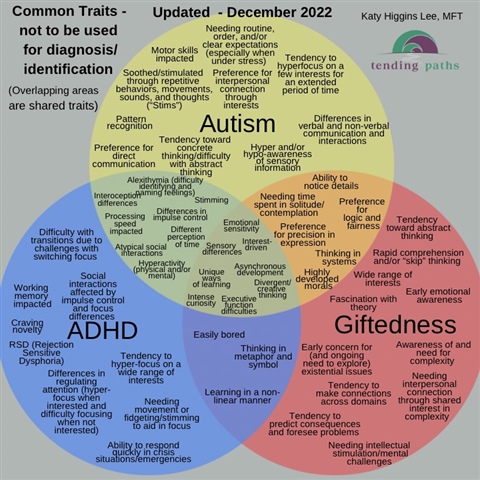
    You could start with some of the traits in the diagram I posted earlier, or just ask ChatGPT (or https://duck.ai) to give you a list of 50 Autistic traits and use those as a starting point. Many will not apply, but it's a good way to get some headings under which you can fill in some of your own observations. Hand that in the next time you see the assessor.

  • This 1 hour 45 minutes video interview with Neurodevelopment Psychiatrist, Dr Khurram Sadiq might be of interest.

    "The subtle differences between ADHD, autism and AuDHD

    The consequences of undiagnosed AuDHD

    How to spot a child with AuDHD

    The AuDHD differences between male and female":

    www.youtube.com/watch

  • I’m going to be repeating what others have already said since you’ve already had such good advice given, but I feel the need to comment because I have a daughter your daughter’s age diagnosed with AuDHD. She was similarly seen as “borderline” Autistic, and her former school practically denied it was possible she was Autistic (instead labelling her as “defiant”). To us, it’s totally obvious she has both Autism and ADHD.

    Writing down things for the assessment is an absolute must! I wish we would have done that both for me and my daughter.

    Hopefully your daughter gets the right diagnosis. Remember, while a correct diagnosis is important, the most important is that you yourself knows what she has.

  • The NAS had an article about AuDHD/Autism and ADHD combined, in their Summer 2025 magazine, but you may need to be a member to read it. It was written by a Neurodevelopment Paychiatrist, Dr Khurram Sadiq, who explains AuDHD is like the blending of two powerful energies — order and anarchy — into one nervous system. The order, routine, sensory seeking and deep focus that some autists need can be interrupted by restlessness, impulsivity, distractibility and need for novelty. Those traits aren’t the same for everybody.

    Dr Sadiq states that he has made the following clinical observations of (non-formal) subtypes in his practice:

    AuDHD with predominant autism.

    AuDHD with predominant ADHD.

    AuDHD with variable expression.

    The article is referring to adults seeking an assessment for potential diagnosis of Autism and ADHD (AuDHD), but it might be worth reading so that you understand how AuDHD might be recognised (in adults), although your daughter is only 7 years old. 

    Dr Sadiq is a Consultant Neurodevelopmental Psychiatrist and Clinical Lead of the Adult ADHD service at Oxleas NHS Foundation Trust and has written a book, “Explaining AuDHD”. (Adult focussed).

    I agree with the comments others have posted and that is why it is important to educate yourself on Autism and ADHD, and observe and note the traits your daughter is exhibiting. It might be a good idea to make a list of your daughters behaviours/traits and cross reference them with legitimate sources from books & article. Then you would have them to hand during meetings with professionals.

    Good luck.

  • Hi and welcome to the community! Wave

    As you suggested, I think it's an excellent idea to write down anything that you think it might be helpful for the assessor to know about (for either condition), and provide it to them. The more information they have, the better (in my opinion).

    Regarding the misunderstanding about whether your daughter "shows concern", I also wouldn't hesitate to send them a written explanation (eg via email) to address that issue and explain your point of view more fully. The same applies in respect of anything else that you think her assessor might have misunderstood.

    You might find the information here particularly helpful in respect of identifying and noting down potential characteristics of autism in your daughter:

    NAS - Signs that a child or adult may be autistic

    NAS - Criteria and tools used in an autism assessment

  • It sounds like your assessor is very outdated with their understanding of autism. There are plenty of autistic kids, boys and girls, that want to play, they just don't always know how to go about it or miss social cues etc. Some autistic kids are overly social and have no boundaries which causes problems because they don't know when to stop. But yes girls often mask and are more likely to be social than boys. Their special interests are also often more "socially acceptable" than boys (for example animals) and therefore don't stand out as much with the rigidity and repetitiveness etc.

    Autism and ADHD together is also further complicated because they mask each other. When I am at work I manage my ADHD very well but my autistic traits really come out because it's peopley and there's sensory things to deal with and change etc. At home my autism settles because I'm in control of my environment and there aren't any people but my ADHD is ridiculous. 

    Again not showing concern is so outdated as an autistic trait. It's long been debunked that autistic people can have empathy. Some people struggle with it yes, others might struggle with how to show it. We might be blunt about it or we might relate it back to ourselves because that's the only way we know how. Some autistic people, particularly girls, actually have hyper empathy and really feel others pain and can get really worried about other people.

    I hate that at this point in life people are still dealing with outdated assessments. I wonder whether you can ask for a second opinion? Or see if you can find information online to really make your point to the assessor.

    https://www.autism.org.uk/advice-and-guidance/topics/identity/autistic-women-and-girls

    https://www.autism.org.uk/advice-and-guidance/professional-practice/autism-and-empathy

    These links might give you a starting point. They are from the NAS themselves and explain a bit about differences in girls and the debunking of the empathy issue. You may be able to find more to back you up online but I know NAS is reputable. 

    My advice with assessments is go through the criteria for each condition (you can find this online) and write down the traits your daughter has for each. Use the information about the differences in girls to help you. This can make it easier to make your point that she does in fact meet the criteria.

    I've already written a lot so I'll leave it there for now but if you'd like me to go into the differences in ADHD and autism traits more particularly from a female perspective then I'm to share my own experiences with you.

  • There's a big overlap of traits between ADHD and Autism. Here is a picture (probably not very scientific) that might help you to visualise things:

    Being sociable and wanting to play are not signs that your daughter is not Autistic. We're not all hermits shut off from the world! If we avoid people, it's more of a learned response to being rejected for being different, rather than a desire to be alone (though some alone-time is nice). It sounds like your assessor might have some outdated ideas about Autism (lack of empathy, etc.) ... or simply that the tests are not showing up anything (as  has suggested is a possibility).

  • the fact that she’s sociable and wants to play means she doesn’t think she’s autistic,

    The assessment procedure is such that it should not be that the assessor does not think your daughter is autistic but that the assessment procedure does not indicate your daughter is autistic.  If it truly is the case that the assessor said "I think" as opposed to the "the tests indicate" (or something similar) then there may be a problem with something called "subjectivity bias".

    To be fair, you, I, and everyone may be subject to this.

    Google AI says on this topic:

    "To overcome subjective bias in psychology, increase self-awareness and acknowledge your own potential biases, then practice reflection to consciously create unbiased thought patterns. Seek diverse perspectives by collaborating with colleagues, reviewing with peers, and deliberately considering alternative interpretations of data. Employ objective methods, such as using standardized assessment tools and phrasing research questions neutrally, to minimize bias in data collection and analysis. "