Explaining autism scientifically to 10 Yr old

Hi

I'm hoping someone can help. Our 10 year old has started calling himself stupid in the last 6 months or so. He loves science and can understand quite complex things. It would be really helpful to have a way to explain autism to him from a scientific angle so thst he could see the reason he struggles with some seemingly straightforward things isn't down to stupidity. We've talked about brains being wired differently but I think he needs some more specific stuff. Hoping this makes sense and someone can point me in the right direction.  Thank you.

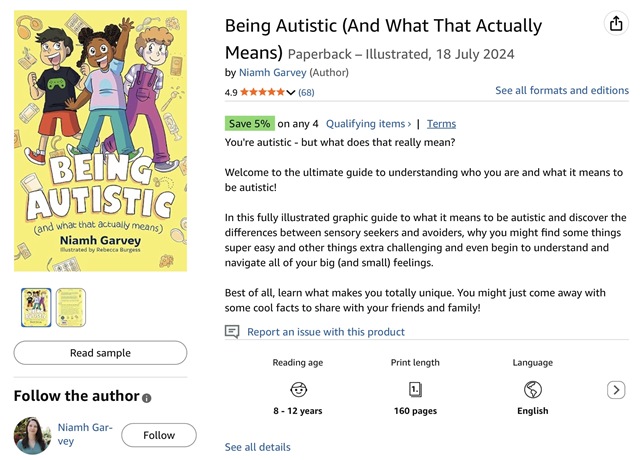
  • Thank you. I wish I’d had something like it too. I bought this book for a young relative months ago, and his mummy says they both really love it. After reading the sample pages, I’m nearly tempted to order it for myself. The analogy between biodiversity and neurodiversity is pitched perfectly. I have all the author’s other books which are aimed at adults. 

  • Good! I hope you both enjoy it.

  • Thank you - this is interesting 

  • Thank you - this is really interesting - I didn't know this.

  • Good suggestion I think  and  Not read it myself however this book also has some very positive reviews from a wide variety of people - wish I'd had it or something like it when I was a kid!  

  • It would be really helpful to have a way to explain autism to him from a scientific angle so thst he could see the reason he struggles with some seemingly straightforward things isn't down to stupidity

    One approach could be to explain that a defining part of autism is that the autistic brain does not go through a key change that neurotypical children go through.

    i'll explain it in the way my psychotherapist explained it to me.

    A childs brain has all its senses supplying information to the brain like an open tap - lots of input to help the child be aware of their environment and learn from it.

    Somewhere around the age of 5 (there is a lot of variability in this), neurotypical peoples brains start to filter the senses so that less information gets through and the brain can focus on the fewer inputs it gets.

    Neurodiverse brains don't develop this filter and we continue being flooded with the senses - everyone a bit different to any other neurodivergent person.

    Neurotypicals now have less load on their brains so they start being able to learn social skills and how to fit in. The poor neurodivergents are learning more and more and always being flooded by their sensory inputs so don't have the time for this new social stuff.

    As time goes on and the knowledge gap grows the neurotypicals start to spot that the neurodivergents act differently the them and their learned pack mentality trains them that different is bad and they often end up bullying the neurodivergents because they believe everyone should "just fit in".

    This often leads the neurodivergents to pull away from social groups and thus the skills grap grows even more.

    However in spite of the social gap, the neurodivergent has an amazing brain that is often able to use its ability to take in so much info to become an expert in its chosen area, or can become great at organising some things in ways that neurotypicals cannot.

    It is a bit of a superpower at times but we often end up damaged from bullying or overload of our senses.

    I think this explains it and there is potential to make use of his abilities as time goes on, but he will need to learn to cope with the overload that comes with it and the fact that learning social skills will be a signiicant concious effort.

  • It might help his self-esteem to point out that some of the greatest minds in science, Isaac Newton, Charles Darwin and Albert Einstein, exhibited many autistic traits.

  • From looking at the neuroanatomy and psychology books that I have it looks like those who have autism tend to have a slightly larger more symmetrical brain than those who do not, also autistic individuals appear to have more shorter interconnections and fewer longer interconnections between the different areas of the brain.

    Regarding the microstructure of the brain what I have found in research papers seems to be contradictory so it appears more research is required.

    The problems with a lot of the research that is carried out on brain structure in autism is that they tend to have a very small sample sizes and as everyone has a slightly different brain structure individual variation can skew any conclusions that are drawn.

  • This book has been written by an autistic author and nurse who is mother to autistic children. It’s informative but pitched at 8 - 12 year olds. It focuses on the positives of being autistic.

    .