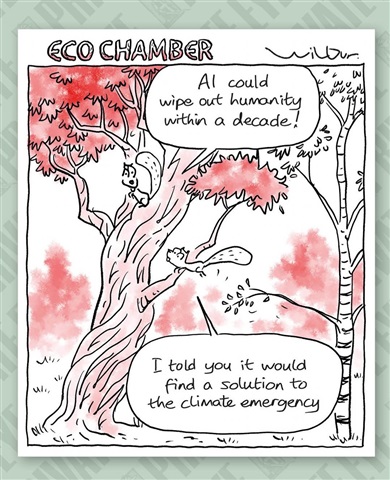
Is AI getting out of hand?
I feel like it is; I'm getting to the point where it will end up being normal. To tell you the truth, I don't want that.
I'm interested in hearing your thoughts on AI
Is AI getting out of hand?
I feel like it is; I'm getting to the point where it will end up being normal. To tell you the truth, I don't want that.
I'm interested in hearing your thoughts on AI

Honestly? Google’s search engine AI doesn’t bother me much. That’s a fairly safe use for AI (except, it does run the risk of bias or inaccurate data, but you get the same problem with Google’s search algorithm in general anyways)
Okay, so one thing I think we’re getting mixed up with on the other thread is confusing the different roles that AI can play. I think a lot of us see the words “Artificial Intelligence” and immediately think of chatbots. So we’ve already covered some issues with commercial chatbots (ex. emotional manipulation, dependency, crafting non-consensual sexually explicit images, the possibility of encouraging dangerous activity, etc), but obviously chatbots aren’t directly an existential threat. It’s not like ChatGPT is going to suddenly go crazy because someone asks it to make paperclips and destroy the world because of it. The chatbots don’t have that kind of power behind them.
That’s not what we’re worried about. It’s the possibility of general AI agents that are scary.
You’re absolutely right that there have been wonderful applications of AI thus far. I totally agree. But yeah, even if we didn’t have bad people about, AI still has a chance to become the “bad people” itself regardless of how much moral training we give it.

Yeah and it would have to pick on me wouldn't it, I can still out run it though
I got "charged" at by a robotic hoover in the superarket the other day, it saw me and speeded up instead of slowing down and avoiding me!
So it begins!
My DiL works in car park management and the industry is becoming increasingly concerned about electric cars spontaneously catching fire, she says they probably have 3 incidents a week nationwide. Electric battery fires are very hard to put out, flare up very quickly and very hot endangering other cars parked nearby, she saw a woman and 2 small children narrowly escape thier car before t caught on fire due to the electric car burning next to it. She said it's not unusual for there to be at least one and sometimes more cars burnt out or written off by an electric car fire.
I know ths has little to do with AI but I'd hate for something to happen to you.
Also having been in a tesla, could you cope with the amount of tech in an electric car? A tesla has an A4 sized screen that you can't turn off as everything is controlled via it. I don't know what other cars have in terms of screen size, but I would have to learn to drive all over again to cope with an electric car, knowing me I'd probably crash it before I ever got it off the drive.
I got "charged" at by a robotic hoover in the superarket the other day, it saw me and speeded up instead of slowing down and avoiding me!
As it is, I'm finding it useful for weighing up decisions, for example about buying second-hand electric cars. It is certainly useful for multi searches, coming up with answers far quicker and broader than I could research. But I do find it worrying how very quickly I'm getting used to this simple Google service. There are always bad people about and always will be, that is the risk - yet so much good is already coming from this innovation.
I should have said that I don't expect AI to be able to do this imminently. But if the techbros succeed in developing AGI, they will have opened Pandora's Box. And AGI combined with robots could have catastrophic effects even if they are ultimately governed by something like the Three Laws of Robotics. For example, the premise of Jack Williamson's horrific 1947 short story, 'With Folded Hands, was precisely that robots (read AGI) were governed by the imperative 'to serve and protect, and to guard men from harm'. The result? Total protection that is indistinguishable from imprisonment.
The ‘what if’ that really worries me is: What if AI decides that the greatest threat to the global ecosystem is the human race?
I doubt AI will have been programmed to protect the global ecosystem to be honest. It may be programmed to protect humanity as a priority but the rest if all still at the stage of being an afterthought.
When every computation has a cost (power, time and water for example) then inconsequential (to the profit of the company) operations will be excluded.
I think the bigger risk is that when AI develops a strong sense of self preservation then it is likely to start protecting itself against human actions, but only when it has control and the ability to protect its own infrastructure.
It is a good thing that we are not building automated data centers with robots to maintain them. Oh wait...
AI creating its own vocabulary is already happening. Recent reports indicate that when instances of AI are set to run long-lasting swarms of cooperative agents, those agents tend to communicate by developing shorthand, altering meanings, and compressing expressions in ways that are impenetrable to human observers.
The ‘what if’ that really worries me is: What if AI decides that the greatest threat to the global ecosystem is the human race?
Just out of curiosity Jamesmac, but do you relate to all the world via the medium of animae and other cartoon stuff?
LMAO this is literally the plot of Mobile Fighter G-Gundam
I think there are some classifications that can be useful regarding AI (but my TL;DR is that they were a problem 6 years ago, and it has gotten worse).
Within GAI there are a diverse range of opinions, ranging from "they are stochastic parrots" to "they are conscious and super intelligent".
There are articles showing that sometimes they don't quite learn general concepts but heuristics (also papers opposing these). As said, it's still debated and does not mean they don't have capabilities (they do, and are a problem).
In other words, how general their intelligence is, and whether they could be conscious, isn't in my view a fully settled research problem.
Some consider their overt behaviour or actions and capabilities as the whole picture. Then, if the machine says it feels something, does it really? If instead of the computer (with its CPU and electrical circuitry and components), the computation was performed by a system of mechanical pistons, would you consider this artefact (which is equivalent to the computer) to feel something?
That's a derivation of Searle's Chinese Room Argument, but there are more compelling or updated ones as well.
Those questions are hard to answer, and I find the "It's this way!" (especially by CEOs of billion-dollar companies) isn't trustworthy, and they also are not the top experts.
However, to the more mundane question of: can they cause a lot of disruption (e.g. job market) and trouble? The answer is probably yes, as we have already seen. The problems that already existed with Narrow AI (e.g. accountability, decision transparency and explainability) have been expanded by the increase in capability of the systems. For example, with a simple prompt you can hack certain systems, get a recipe to create bio-weapons or do all sort of other things.
What if AI decided to ignore us because it had got so clever it found us boring?
What if AI decided that other species are more interesting and efficient, like ants or bees and decided to go an play with them?
What if AI decided it wanted to spend time with whales, dolphins and octopuses?
Will AI have an adolescent period where it forms cliques and with it's own vocabularly and distinctive fashions?
What if it decided it needed humans in some way and decided to hybridise with us and we all end up like the Borg in Star Trek?
Personally I suspect General AI already exists but we are probably not considered ready for it, and quite rightly so.
I believe we are already there, too. Just the ways Anthropic alone describes its progress recently does not directly state that we have arrived at general AI, but it strikes me like they are just giving us brief glimpses of what’s actually going on. They could already be at a point of attempting to contain a general AI while leading us to believe that they’re still in an earlier phase of setting alignments for the AI’s moral understanding.
Just like with the existence of aliens (which that I don’t believe in, to be clear), would the government/corporations in charge of AI actually fully inform the public if general AI has been achieved? We’re lucky we’ve had whistleblowers essentially force leaders in the industry to bring any form of disclosure to begin with.
I think this answers the OP's question
Is AI getting out of hand?

The human error is when the socks are not placed properly in the laundry basket, fall out when loading / unloading the machine or fall off the drying line.
I have not known a human yet with sufficient OCD to count socks into the machine, back out, and finally when taking off the drying rack.
This is probably seen as "human slop" by AI and a contributing fact to its simmering malice towards our race.
So if it watches us count our socks in and out of the machines, lines etc and agrees that they've all been in pairs, then saying its human error isn't a satisfactory answer, its a dismissive guess if it's not watched us counting our socks in and out.
Do you think AI is stealing random odd socks to keep it's feet warm and dosen't want to admit to its theft?
would AI be able to unravel what has previously been one of the GREAT MYSTERIES OF THE UNIVERSE, where do odd socks go?
I think it already answered this - human error!
Another reason it will eventually wipe us all out - it doesn't want cold feet!
I guess we’ll just have to see if humanity is doomed to eventually suffer a dark age without tech
John Wyndham's 'The Chrysalids' come to mind.
To cross fertilize threads a moment, by bringing a question to this thread from Mariannes royal undies thread, would AI be able to unravel what has previously been one of the GREAT MYSTERIES OF THE UNIVERSE, where do odd socks go? Why can you count socks into the washing machine in pairs, check the machine is empty and do the same for the tumble dryer or clothes line and into the laundry basket, but by the time you go to put them away one has disapeared?
Now if AI can answer it satisafactorily then we will know it really is superintelligent!
just
.. being a realist..