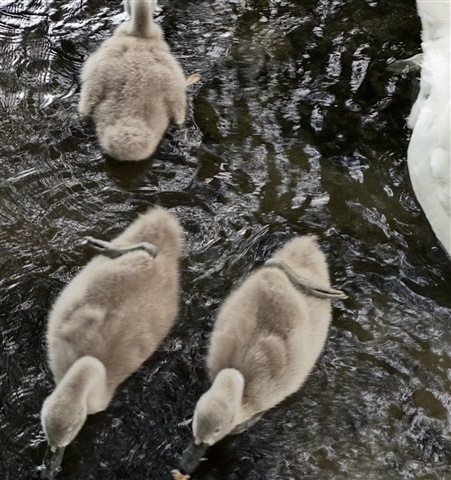
There once was an Ugly Duckling

It's feathers all dirty and brown.. and in so many words the other birds said quack get out of town,

But when spring comes and the "ugly duckling" becomes a swan all of a sudden all the other birds want to be friends.

This childrens song has always upset me, even from a small child, almost reducing me to tears at times. I felt so sorry fo the cygnet who was outcast and rejected for being ugly and brown. As an adult this song still upsets me, I don't just feel sorry for the cygnet but outraged and the implicit racism of being "ugly and brown" rather than beautiful and white as it later becomes. But at the way the other birds stop bullying it and want to be friends, I almost feel this is reflection of so many peoples struggles about being different and how others are encouraged through this song that it's OK to bully others who don't look the same as you or come across the same as you. It's only when the cygnet becomes a beautiful white swan that it's socially acceptable, what does that imply about those of us who are "ugly and brown"? Do we have to become white, do we have to transform ourselves entirely to be acceptable? To me this is a metaphor for not just racism, but for anyone who's different.

  • At the time when the song was popular it was quite common for girls to be married very young and for some of the icons of the day to engage quite legally in what we would term paedophilia by marrying girls as young as 13. Don't forget that a woman was considered "on the shelf", an unmarriageable left over by the time she was 21, today we would consider 21 young to be married, let alone 18 or under, but this was quite common and seen as desireable.

  • This is how I would have liked to have put it into words and the reason is so sad because it’s a truism in lots of ways about human nature, and how people treat each other. 

  • The original Hans Christian Andersson story is really dark, most of the darker bits were removed for the song, but I suggest you read the story and not just listen to the song.

    Racism was very much a thiing in the early to mid Victorian period, along with all sorts of other prejudices.

    I think being a red-brown haired girl at a time when only blondes were considered pretty or beautiful, this song made me feel that I would never be pretty or beautiful.

    You have to remember too that I was quite a small child when all these thoughts were going on, like I said before, it wasn't until some years later that I was able to explain why this song upset me, but this isn't an adult gloss, it's genuinely what I felt at the time and have never stopped feeling.

  • Yes, I was always upset by the line: 

    and in so many words the other birds said quack get out of town,

    Whenever colleagues were unkind [often] that line played over and over in my head. I still feel rejection strongly in old age. Recently, I've made myself a CEWE photobook entitled, 'My Autobiography in Images.'  As well as images of myself and serial friends I've had over the decades, I included images of certificates and testimonials - academic and non academic, also of rented homes I decorated and the many gardens I've made. [The latter are my legacy for future tenants]. I always intended this book just for ME - I have no family or friends. I intend to take it off the shelf regularly to remind myself of my achievements when I lose sight of my identity. TheCatWoman is SO right about not needing to be 'pure' to be a part of the community - part of life. So often we underestimate our value, as part of the human race.

  •  I’ve been feeding some newborn cygnets since they were born in spring. I watched (not literally) for 3 years the parents building a nest 2 years running, either all the eggs were taken by Herons or the babies were killed by foxes. They’ve gone away for the winter. I love how they mirror each other.

    I think the ryhme is about how things get better all of the time. It’s not really possibly to get to the bottom of fairy tails they are manifestations of lots of things. 

  • yeah its one of those stories that seem nice as a child but shows a bit more when you get older, especially if you kinda just stay and dont become a swan, 

    haha did the cassettes line up to make a picture of a swan?

  • Yes this is a sad nursery rhyme. I often think when I go to the park and see a cygnet ‘they are beautiful, not ugly at all!’ I always thought it was just me affected by things like this. 

  • I think your right there, I've never been keen on it, as it always seemed to say that you can only be accepted in society if you make yourself beautiful. Plus I could identify as the cygnet for being bullied and not belonging.

    And I thought the song was annoying as the catchy chorus was 

    'quack, get out of,

    quack, get out of,

    quack, get out of town'. 

    Unfortunately it's now looping round my head! (We had 3 cassette tapes of children's rhymes and songs -they had covers you could line them up in a row and they got together).

  • what you see with the sweet 16 isn't wrong, its just not how everyone sees it, not every guy is looking for a 16 year old and the ones that do are very creepy, but your a woman and you need to be carful of those types in your past and it can be impossible to know what a guy wants unless he shows you, so most people arnt thinking of that but I get why you do.

  • I dont really take it as racism I dont know when the rhyme was originally created but I imagine it was more a metaphor on beauty rather than racism, I guess you could say its about how life is built on luck and you can become a "valuable" member of society, or if you one of the people who never become "beautiful" you can see the shallowness of society that people will change how they see you as a person, not based on your character but on the way they perceive you, I can see why you remember the rhyme its actually quite relevant to people like us.

  • Maybe or maybe it just got called a twit?

  • I've always thought that its mother was a bit scatty and laid an egg in a duck's nest by mistake. I think it would probably need counselling to get over the trauma of its youth before it had the potential to be an advocate for others - perhaps it had some sessions with a wise owl?

  • Most of the nursery rhymes and stories like Brothers Grimm where horrible, I don't know why the Victorians decided to make them childrens stories, they were orignially sotries for adults.

  • Maybe, but I want to ask where the swans were when the cygnet was suffering?  I wasn't happy that the cygnet had to grow into a swan before it found acceptance and nor do I feel it's a song about late bloomers doing well later in life. I want to ask what this swan did in later life did it become an advocate for other bullied birds?

  • How come I interpret these things so differently to others

    I only know what some mean because I remember asking what they meant when I was small.

    I didn't like a lot of the children's stories and nursery rhymes. I thought they were weird or not very nice.

  • I was an autistic child, how was I supposed not to take it literally?

    I think you are referring to Stuart's reply where he said:

    I think this is where you are not supposed to take it too literally.

    I think that being upset by the cygnet being an outcast, and also being pleased that the swan it turns into teaches those pesky ducks a lesson, is both being literal - both seem clear from the lyrics.

    But you can read more into it - as Stuart says, often people who are shunned early in life bloom later. Sometimes those of us who were bullied at school do well at something as adults and get praise from others.

    Also, the swan is found by other swans and taken into their group, so he's no longer an outcast - a bit like us finding this community.

  • I was an autistic child, how was I supposed not to take it literally?

    I always felt the ducklings were being very shallow.

    There are quite a few songs, stories and things that I've interpreted negatively and in a way that others don't, like the song Happy Birthday Sweet 16, I've always found it creepy and then realsied that to me it sounds like a song about waiting for a girl to become 16 and therefore "legal" and theres this old guy perving over her. I'm told I'm wrong about that too. How come I interpret these things so differently to others and have felt uncomfortable with them since childhood when I didn't know what I was uncomfortable about

  • I've always seen it as an uplifting song. The lyrics actually say "There once was an ugly duckling, with feathers all stubby and brown". That's because cygnets do have brown feathers, it's not racism. In comparison to ducklings the cygnet looks less pretty and is shunned by them, but later when he turns into a swan he's admired by everyone. I feel that it's a song about not attacking others for their differences, because later you might feel a bit foolish when they appear better than you.