autism and race - how common is it across the different groups out there

I mentioned here a few weeks ago that I was interested in finding more about the origins of autism as it seems to have a strong genetic component and I wondered if cultures which were more genetically isolated would have different levels of autism.

Well the bad news is that I couldn't find much data at all - the info on the communities I though would be most useful is not available or in a language that is too challenging to translate with accuracy.

The most interesting research info I came across was US based and talked about the differences between ethnic groups for diagnosis.

https://www.cdc.gov/ncbddd/autism/addm-community-report/spotlight-on-racial-ethnic-differences.html

This is a 2018 US report but is well written and quite accessable to read.

Note that the CDC has an alert at the top of the page that Trump is making them change the website so they don't know if the article will remain available.

The key points were a little surprising with whites being the least affected:

For the first time, the ADDM Network data found the percentage of 8-year-old children identified with ASD was higher among Black, Hispanic, and Asian or Pacific Islander (A/PI) children compared with White children.
Black - 2.93%
Hispanic - 3.16%
Asian - 3.34%
White - 2.43%

This is a surprise for me as the vast majority I have come in contact with have been white, certainly far more proportionally than their level of representation in the community.

There could be a lot of factors involved here - maybe my social circles are more exclusive than I though, maybe they have different views on sharing their diagnosis or maybe the higher rates of diagnosis are really only for youngsters who I don't really mix with much outside of my charity work.

Anyway, I just wanted to share the info here in case any were interested. I don't think there are any conclusions to be drawn from it but it does illustrate the genes seem present across all main cultural groups.

  • Yes and the media likes to pick up and distort the facts around people who aren’t neurotypical or who have mental illness. Not everyone checks news source credentials. 

  • No you've not and thak you for telling me the books you've read, I want to read them too, when I've finished my book, I'm still doing the research for that.

    There probably is a genetic component, but I doubt it's just one gene, but areas on multiple genes. I think some psychologist would like to think we arrive as a blank slate to be imprinted on by our upbringing and others think arrive with somethings already there, personally I think it's a bit of a pointless debate, like how many angels can dance on the head of a pin? It's almost certainly a mixture of both nature and nurture, I think some of the newer stuff on psychopaths show us that, some will become awful monsterous killers, others not and the only thing that makes sense is them being brought up in totally different environment, or at least according the the researchers. But then I suspect psychopathy is a spectrum too, so not everyones psychopathy will be the same anyway.

  • I have looked up sub Sahara African genetic diversity now and I remember reading about the genetic admixture on the the BBC News App. It is interesting stuff and I get your point. I still wonder if there is a genetic component to autism as traits like personality are probably at least partially genetic. Aren’t psychologists still arguing over the nature versus debate? I thought I had read somewhere that an autistic person would be more likely to have at least one biological parent or child than a non autistic person and that it has a genetic component? Is it not likely that autism has been inherited through the admixture of one or more types of hominin, in the same way that there is a genetic component to hair colour or eye colour? Are sub Saharan’Africans more or less likely to be autistic than people in other parts of the world?  The idea of autistic people being just as we should be, processing information in different ways, is how I think of myself, even though I can get overwhelmed and struggle in a neurotypical world. So far, I have read Tom Higham’s “The World Before Us: …” and have just started “Human Peoples: on the Genetic Traces of Human Evolution, Migration and Adaptation” by Lluís Quintana-Murci. I am going to read Gina Rippon’s book next so thank you for the recommendation CatWoman. I hope I haven’t ranted too much about something I know next to nothing about, it is just me thinking aloud.


  • If you look at sub-Saharan Africa there is more genetic diversity and more relict DNA from other earlier human species.

    I don't think ASC is confined to one genetic grouping, I think it's a basic human trait.

    Have a look at Gina Rippon's book, The Gendered Brain, to get some idea of how small the samples used in many of these studies really is and the massive conclusions they come to from such a minute sample size.

  • I am sure you have made a thorough job of researching the available statistics Iain. I suspect that at best the figures will give only a hint of the extent of autism, but as you say autism seems to affect varied cultures.  I am not knowledgeable in the field of statistics or autism, but I can’t accept that the figures would have taken into full account the extent of the problem of accurate diagnosis and the variables around criteria, gender, masking, educational background, culture, religion, economic situation, mental health …. etc. Moreover, existing studies seem to be small, or else aren’t accessible to the public. Where I live, parents of school age children are struggling to get their children assessed and some young people in the 18 - 25  age bracket are being referred only now. In this day and age, how have these young people gone through school and been missed or prevented from receiving a diagnosis. I have recently become interested in genomics and have learned that those of us not of African origin have between 1% and 3% genetic material derived from Neanderthals because Sapiens and Neanderthals interbred. The ancestors of today’s Asians interbred with Denisovan’s and those living in Papua New Guinea carry between 3.5% and 5% Denisovan genetic material. The Tibetans’ ability to live in extreme conditions at high altitudes is due to their Denisovan ancestors and the first Europeans were better able to cope with viruses such as the cold, and other pathogens, thanks to Neanderthal DNA. I cannot find any research looking at a possible connection between genetic origins and autism, but it is a fascinating and fast moving subject.

  • I heard from a “therapist” that not having friends is not a problem at all

    Just going off of this, pain is an "illusion". However, it is a very useful illusion and we still very much feel it. Likewise, we can feel psychological (social/emotional) pain just as we can feel physical pain. Loneliness is just as bad for you as smoking is, and smoking is very bad for you.

    I know that's probably not what people want to hear because loneliness I think is something that affects many of us, but it's just something that sprang to mind.

  • I think it’s also due to differences in quality of the system in many countries. In Poland where I grew up people still often don’t believe depression exists. I heard “are you depressed? Go clean the kitchen it will help you, stop creating your problems” cleaning kitchen indeed helped a bit but having my problems ignored and being gaslit only made it worse. In my country even currently if you are not insane, running in streets and being danger to others, they will not help you. An appointment to a psychologist covered by insurance takes around a year wait. Just a consultation. I heard from a “therapist” that not having friends is not a problem at all and the whole time of our conversation she behaved like she had to listen to my nonsense and wasn’t really interested in what I wanted to say. She was polish. This is the quality of mental health professionals in my country and I know of even worse cases. For sure there are good ones too but I wasn’t lucky to meet one. Here in Germany my experience is better so far. 

  • I think how differnt countries define ASC will be a big one, somewhere that values homegnity very highly like many Asian countries might define it very differently to us, they may not even recognise it in their own populations and velieve it's something that only happens to us in the individualistic west? Already we see America having looser diagnostic criterian than us in the UK, probably because you pay for medication there. I wonder how many peope there are in the US who are undiagnosed because of high health care costs?

    I saw a bit of an articly the other day who's title was something like, How the internet made everyone believe they're ASC and ADHD, I think we're about to be on the front lines of the culture wars, with those of us who are "high functioning" being told we're not really ASC/ADHD, because we can string a sentence together or because we 'dont' look like there's anything wrong with us'. I think we are at risk of falling down a woke hole being created by neurotypicals who suffer from diagnosis envy.

  • Definitely an interesting topic. I find that whenever you compare different races for any kind of trait/gene/statistic/etc. you're going to really struggle to find sound research on the topic.

    When you add autism into the mix, it becomes even more of a minefield... how do other countries across the globe define the threshold for what makes some autistic, as opposed to just having some autistic traits? How many autistic people are going about, undiagnosed? Etc. etc. etc.

  • I think a lot of it could be cultural either from fear of seeking help due to distrust of the whole system, in the US it could be because of the cost, there could also be bias on the part of psychologists etc who diagnose ASC and other conditions. Just  think of how long it took "the system" to recognise that ASC wasn't an exclusively male thing or that girls who were diagnosed didn't have some sort of "male brain".

    This is the sort of question that could open up a supermarket aisle full of cans of wroms, theres still a lot of poeple in this country who are in denial about how prevalent ASC is and any other learning difficulty, or see it as a middle class thing to excuse their children being not so good academically or as an excuse for poor parenting. Some groups might see anyone asking about ASC in thier comunity as racists with an agenda beyond pure research, or if they do trust the researcher wil worry what use the research will be put too.

  • I have thought for a long time that it's more common than people think. I feel it's better to only look at child diagnoses, because adults often learn to camouflage autistic traits.

  • Interesting. The OU course I did on autism showed lower rates of diagnosis in many countries outside the UK and US - it was theorized that maybe this was partly due to cultural differences, for example in some cultures lack of eye contact is seen as respectful. 

  • Another interesting set of information about autism in general from the CDC also says:

    https://www.cdc.gov/autism/data-research/index.html

    ASD is nearly 4 times more common among boys than among girls

    ASD is reported to occur in all racial, ethnic, and socioeconomic groups

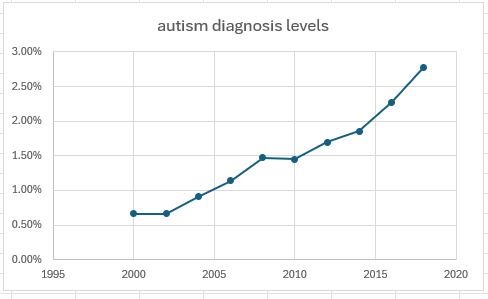
    There is also a table on the page that shows the changing diagnosis rates for autism since 2000 - quite scary.

    I charted these into a graph and it shows no sign of slowing down or plateuing which could indicate, froma purely mathematical point of view, that the trend will continue until a significant slowdown is observed - but that is not in sight yet.

    So there is no indication just yet of how truly common autism is. At present it averages around 2% of the population as adults have a lower diagnosis rate than children. I expect this to increase with time.

    Here is the info on graph format

    Just some geeky stuff I hope is of interest to a few of you out there.