Hi - a worried and stressed mum!

Hi,

We’ve just started to get the ‘ball rolling’ in getting support for our 8 year old daughter who we have always suspected is neurodiverse. Behaviour has been managed at home until she started junior school last September when meltdowns have gone into overdrive and anxiety sky rocketed. She’s now also displaying self harming behaviours. We’ve reached out to our local family team and have qualified for her to receive ELSA  at school. Our problem is that school see nothing. She masks throughout the day and then is exhausted at home. I’ve always felt like our concerns have been dismissed as ‘she’s fine.’ We finally have a meeting with the SENDCO next week and wondered if anyone has any tips for getting them to listen so we can get help for our little girl and for our family!  

thank you Relaxed️ 

  • We had a similar problem. As well as keeping notes of what happens at home, we also noted what had happened at school that day. This showed links between the most difficult experiences at school and behaviour at home in the safe place. If you show the links they can't say it is parenting causing the behaviour at home.

    We also used the notes as part of an EHCP. When we finally got that it did help to get some adjustments at school, although some staff never really understood. 

  • Libby Scott, as an 11-year-old autistic girl, kept a diary and turned it into a fiction book with author Rebecca Westcott. There are now four books in the series. I've read the first two and they were very interesting and informative, as the stories are told from the perspective of a child based on Libby's first-hand experience. If you haven't read them already, I wonder if reading those books with your daughter might help both of you to communicate her needs more easily. Here's a link to the first one, Can You See Me?

  • Hi, 

    My Daughter is 8yrs old too, diagnosed with Autism in May after we paid privately. We have suspected that she was on the spectrum since she was 3, at infant school she was labelled naughty, rude and unable to follow instructions. The one thing I always remained strong with was being her voice and advocating on her behalf. School is tough and sometimes you have to battle to get support in place. My advice would be to go armed with a list of things that would make your Daughter’s time at school better, more social breaks throughout the day, access to a quiet space when she is feeling overwhelmed and overstimulated, remove unnecessary pressures to conform with the uniform and group activities, school plays etc. Good luck

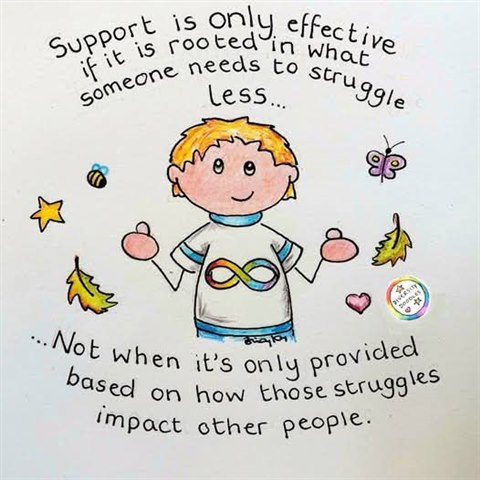
  • I saw this image recently and it hit home with me.

  • Quoting this might help:

    "Camouflaging is one means through which autistic people
    attempt to overcome social challenges within crossneurotype
    social interactions to secure employment and
    education, develop friendships and romantic relationships,
    and even avoid harassment and victimisation  Yet the act of
    camouflaging is cognitively effortful and taxing; prone to
    breakdown under increased social demands and complexity
    and/or psychological distress; and associated with
    increased mental health difficulties."

    From  'Self-reported camouflaging behaviours
    used by autistic adults during everyday
    social interactions'
    Julia Cook , Laura Crane , Laura Hull ,
    Laura Bourne and William Mandy

    Many useful original papers can be found online through searching Google Scholar. A number of books on autistic masking/camouflaging are available also.

  • Keep a note of the precise nature, times and duration of worrying or problematic behaviour at home. This will sound cold, but perhaps recording some of the most troubling behaviour on a smartphone might help give you some incontrovertible evidence. 

    If any one you have contact with has any real knowledge of autism, they will know that intelligent autistic children (and adults)  can and do mask in public. Then the exhaustion and strain of masking can cause a rebound effect in behaviour and visible distress at home.  This is well known and you should not be disbelieved by anyone competent.

    It is also apparent that autistic people can show no obvious outward signs of their autistic natures until their abilities to cope socially are exceeded, which seems to be the case with your daughter's progression to Junior School, where more demands are made of children than at Infant School and classes are often larger and teaching more structured.