
Concern about Merlin's RAP changes for autistic visitors

Hi everyone,

I wanted to start a discussion about Merlin’s (Alton Towers, Chessington, Thorpe Park etc) recent update to the Ride Access Pass (RAP), as I’m worried it may negatively affect many autistic people and others with non-physical disabilities.

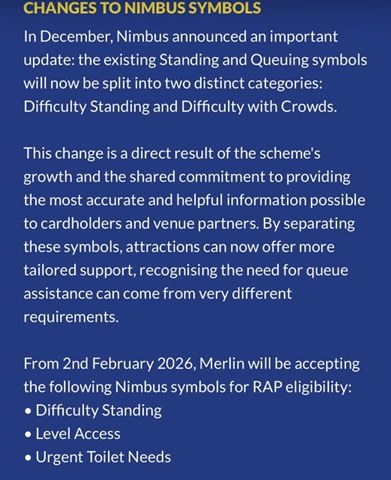
Merlin have announced that from 2nd February 2026, they will only accept the following Nimbus symbols for RAP eligibility:

  • Difficulty Standing

  • Level Access

  • Urgent Toilet Needs

This seems to mean that difficulties related to crowds, sensory overload, and long queues may no longer be considered in the same way.

My 12-year-old sister is autistic and physically able, but she really struggles with busy, crowded queues for long periods of time. RAP has been what made visits to places like Alton Towers manageable and enjoyable for her. Without that support, it’s hard to see how we could continue going.

I completely understand the need for clear criteria, but I’m concerned that this change could unintentionally exclude many neurodivergent visitors who still have very real access needs.

Has anyone else been affected by this or heard more about how it will work in practice?
And does anyone know what the best way is for families to raise concerns or ask Merlin to reconsider support for autistic visitors — for example through feedback channels or disability advocacy groups?

It would be really helpful to hear others’ thoughts and experiences.

Thanks

  • Thank you for sharing this! It's great news.

  • Update worth a read; BBC reports today:

    "Merlin Entertainments has backtracked on its controversial plan to tighten access to its disability queuing system at its theme parks following strong criticism from people with autism, ADHD and anxiety.":

    www.bbc.co.uk/.../cx2gyggxv4no

  • In July 2010 our UK Government took the trouble to produce a 12 page PDF to help service providers to the Public understand the Equality Act 2010.

    "This Disability Quick Start Guide tells you how
    the Equality Act 2010 changes how you have
    to act in order to prevent and address disability
    discrimination and disability-related harassment
    when you provide goods, facilities and services to
    the public, for example as a residential care home,
    community shop or after-school club.These parts of
    the Act will come into effect on 1 October 2010."

    N.B. in the above; "...how you have to act".

    Page 4 of the Guide clearly explains to service providers to the Public; the nature and range of disabilities falling within the scope of the Act, including "...such as Autism":

    https://assets.publishing.service.gov.uk/media/5a79c79940f0b66d161ae174/disability.pdf

    In addition to Sharon Mod's inclusion of the email contact for Merlin Entertainment (in the event that they need to read the above Disability Quick Start Guide document):

    rideaccesspass@merlinentertainments.biz

    ...I do not believe any disabled groups should be accepting of a service provider to the Public disregarding an Act of Parliament, replacing it with terms of their own devising.

    I also believe that our respective MPs ought to represent us in reinforcing this legislative compliance by service providers to the Public too (find my MP):

    https://members.parliament.uk/

  • I hope I have redeemed myself by generally supporting us as an autistic community?

    No personal criticism was intended - I’m sorry if my reply came across that way.

    I understand you meant that it doesn’t affect you personally, in practical terms.

    I also don’t go to theme parks; I was just sharing my different perspective. Slight smile

  • Yes, I realised how my first sentence come across when I looked at it later.

    Perhaps I should have said that I don’t go to theme parks so the entry system doesn’t impact me on a personal level.

    I hope I have redeemed myself by generally supporting us as an autistic community?

  • This doesn’t affect me as I don’t go to theme parks.

    I feel it affects all of us. If this change remains in effect after their review, it will set a high-profile precedent that could easily end up restricting our access to all kinds of other places (both in the UK and abroad) where the card is recognised as proof of someone's needs.

    Merlin have removed a perfectly reasonable adjustment from those who genuinely need it.

  • I just read the BBC article about this. Only ADHD and Anxiety were mentioned in the headline so they are probably already looking at this. ‘Nobody likes waiting’ is almost as offensive as Spectrum generalisation. It may have something to do with their wanting for there to be a paid for fast track system like at Disney World. 

  • Hmm…it does seem fashionable to target those with hidden disabilities.

  • From the article, it sounds like those who are physically disabled have complained about those with hidden disabilities? I'm sure money comes into it too, as Trump has made it fashionable to disregard autism et al., much the way he threw out the Paris agreement and businesses rushed to throw out their green washing policies. 

  • This doesn’t affect me as I don’t go to theme parks. The BBC reports on how the new rules will discriminate against a group of people which include those with autism and ADHD.

    I am wondering if increased queue times are the only issues here or does it cost the theme parks more to manage effective queuing systems for  people with autism and ADHD?  

    I have no idea what the answer is but I wondered if financial greed is somehow coming into this. Whatever the reason, it’s just another example of a society that isn’t geared for autistic people. 

     https://www.bbc.co.uk/news/articles/cx2gwgj4xreo

  • That’s excellent! I’m not a child or a theme park goer, but thank-you NAS (and whichever individuals were involved) for this advocacy!

  • Thank you all for sharing your concerns here.

    The National Autistic Society understand the concerns of autistic people and their families about the changes to the Ride Access Pass. We met with Merlin to raise concerns directly and to hear the plans for the future.  

    We are pleased that Merlin is listening to feedback from autistic people on the changes, and have said they will review the new arrangement after the February half term.  

    We would recommend that anyone with concerns about the changes shares their feedback with Merlin via: rideaccesspass@merlinentertainments.biz

    Sharon Mod

  • Sounds a bit like discrimination. However, how did someone get a RAP and how did they prove eligibility? You could always seek advice from EHRC.

    I am only clued up about employment discrimination and not that in the service sector but they do have a duty. You could always write to them detailing you concerns and asking for a reasonable adjustment due to your autism. Kindly give them a reminder that not all disabilities are visible.

  • I’m genuinely devastated by this change, as I’m no longer eligible for a Ride Access Pass. In my view, I think it’s discrimination against people with invisible disabilities.

    I was diagnosed as autistic and ADHD three years ago. Since then, I’ve worked extremely hard to understand my needs and make my life more accessible. Before my diagnosis, I spent years trying to function as a neurotypical person, which had a serious negative impact on my mental health and led to me becoming very isolated and largely housebound.

    Following my diagnosis, one of my main goals has been to reduce isolation and improve my mental wellbeing by removing barriers where possible. Visiting theme parks has been a huge part of that journey, but only because I was able to use the Ride Access queues.

    Without access to these ride access queues, I simply won’t be able to visit Merlin parks. Long, crowded queues cause overwhelming sensory overload for me… confined spaces, noise, crowds, and the associated anxiety quickly lead to physical exhaustion and shutdowns that can last for days afterwards. This isn’t about “not liking queues”, for autistic people, queuing can be genuinely disabling.

    The Ride Access Pass has never been about free fast-tracking or skipping queues. You still wait, but just waiting outside of an environment that causes harm. I don’t get on more rides than anyone else, and when the normal queues are short (around 20 minutes or less), I use the standard queue without issue. It’s only longer waits that become unmanageable.

    I understand concerns about misuse of the system, but a small number of people abusing it should not result in thousands of disabled people losing access altogether. Removing reasonable adjustments does not solve abuse, it simply excludes those who genuinely rely on them.

    I’m deeply concerned that this change will force many autistic, ADHD, and invisibly disabled people back into isolation. I really hope Merlin listens to the people being disadvantaged by this policy and reconsiders a system that currently places us at a significant and unfair disadvantage.

  • As far as I can tell, they've basically decided that unless you have a physical reason you can't stand in the queue then they won't allow it which rules out any neurodivergent access. 

  • That's a bit confusing? Is it saying that they are splitting physical ability from say autism under the old scheme and then not allowing autism access to the scheme? I can see your concern, as it seems a very confusing and round about way to remove access?

    It does seem like a step backwards is that's the case. Maybe it's worth writing to them asking for clarity?