Digital NHS and AI

Wes Streeting has announced new digital services for NHS England and that the public will have to be educated about it, will that include teaching us how to use a smart phone, afford a smart phone and how to download an app and not give our data to scammers?

I'm glad I live in Wales and don't have to put up with this nonsense..yet and that my GP's don't force people to use the stupid app thing we have that doesn't work.

  • I share your concern  I asked google AI - answer    "Patients can access NHS services without relying on IT by utilising proxy access where a trusted individual manages services on their behalf, or by directly contacting their GP or other healthcare professionals. Proxy access can be formal, requiring setup by the GP, or informal, involving sharing login information. For those needing assistance with online services, support is available through GP surgeries and" (this is the funny bit...) "online resources."     I am reasonably IT literate having started studying it in 1978 and done bits and pieces since.  That said it still can be really frustrating and I am one of those old dogs that takes a while to learn new tricks.  Whatever it is sold as, IT is currently not as user friendly as it might be - especially if the user is under stress, like when unwell for example....  (Doh!!!! it's not rocket science is it...)    But then so can humans can be not as user friendly as they might be too....  Regularly change and innovation is expected to quickly and smoothly replace what has gone before it before all the risks are covered and mitigated.   I think that HM governments have a record on that...

  • It’s good that your surgery is accommodating and I would hope there would always be an alternative for people who don’t want or are unable to use a smartphone due to whatever reason.

    i don’t know if my surgery offers to accommodate people using email, but I know they accept written correspondence, yet that isn’t very practical for some people who aren’t nearby and who don’t smartphones.

  • That's great if you have a smartphone, and I hope it continues for you, but I would not like to see them assume everyone has a smartphone.  I don’t have one and don’t want one.  If I want to use a computer I have this one in the house.  I am seldom anywhere else.

    I do not have any kind of phone as I cannot cope with the unexpected and every call with unknown people is unexpected.  It is making life very difficult.  “AskMyDoctor” which my surgery uses no longer works for me because I haven’t a phone number to give it.  Fortunately the surgery allow me to use email.  I can do email because it is not in “real-time”.

  • Iain, this thread was meant to be about digital stuff in general and a digital NHS in particular, but somehow it seem to have become about me which was not the intention.

    I actually find it quite hard to learn from people on screens and I'd love an Iain in my life who could help me with stuff like this and if you my problems with tech frustrating how do you think I feel? I know you love to help and teach people, but for me this isn't something that can be done remotely.

    When I look at instructions or books like the dummies series, my brain glazes over, mayb the result of trying to assemble to many IKEA flatpacks, lol.

  • I've tried smart phones for dummies and didn't get on with that

    I did wonder whether you might find this one useful. I’ve seen a few ads for it recently:

    Chatsie

  • Apologies for the tiny images. The settings have changed since I last uploaded photographs. 

    Tapping / clicking on them shows larger versions Slight smile

  • She also couldn't get her head around me being ND or having memory problems, she didn't want to talk to me

    The fact she knew nothing about neurodivergence of your specific issues is pretty normal in my experience - it seems unreasonable to expect those who deal with the public to have knowledge of every minority group and the possible niche issues they have.

    I'll be blunt with this next but but it is not intended as an attack. I have offered you help in the past and seen others do the same yet we often receive what feels like a hostile response, that you have had bad experiences before and we will only repeat the mistakes so stop wasting our time.

    I appreciate this may come from a place of experience and past trauma but to lash out at those who do try to help hurts us as much as it frustrates you.

    There can be approaches that work for your particular mix of conditions and I feel that if you can try to find this then it could offer you a lot of benefit. It may be as simple as writing down the steps to do a particular task so your memory is not a factor or trying to be as specific as possible in what you want to achieve when asking for help.

    I've tried smart phones for dummies and didn't get on with that,

    Can you be more specific about what "didn't get on" means? Is it that you don't understand what you are looking at, that you don't remember the instructions on how to use it, that you experience confusion when using it or whatever - knowing where the issue lies allows anyone helping to focus on the area to find solutions that can work for your situation.

    Sometimes admitting to vulnerabilities can be painful but it is really the best way to deal with these sort of challenges.


  • Apologies for the tiny images. The settings have changed since I last uploaded photographs. 

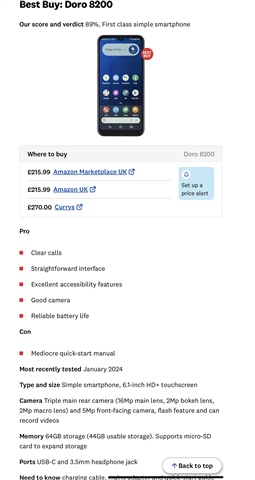
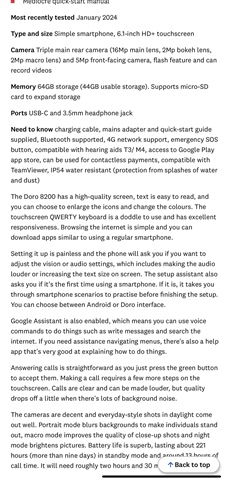
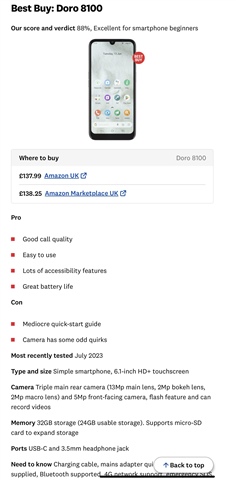
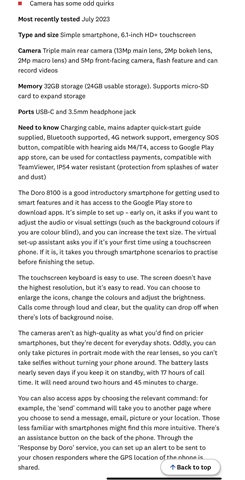
    WHICH Magazine has given the above two simple smartphones the highest reviews for beginner users. They are both DORO phones and are aimed at older users but would be suitable for anyone wanting a simple smartphone.

    WHICH Magazine mentions that Apple iPhones are the most ‘intuitive’ for those beginners who would like a high end smartphone with more features. Intuitive just means that they are easier and more straightforward to use.

    I know you don’t want a smartphone  , but I thought someone else might find this useful, as clearly you are not on your own.

  • How do you operate within a system that dosent' work?

    It sounds lke it has bugs but still works for the vast majority of users.

    There should be a tech support contact for when you have problem as with any other system so it should be a case of getting in touch so they can sort it or advise how you can work around the issue.

  • We had a woman who'd go round libraries teaching smart phone and basic computer skills, I went to see her and she was absolutely useless! I wanted help to buy one as I've no idea where to start, they all seem equally confusing, she started with the usual spiel about Apple or Android, I know one is apple and the other google and thats all I know about the difference, so her solution was to go to a shop and ask their advice, she was totally flumoxed by the idea that these are sales people and thier job is to sell you the most expensive phone in the shop. She also couldn't get her head around me being ND or having memory problems, she didn't want to talk to me, it was like she had a set program that she was going to use regardless of who was sat in front of her. 

    I've tried smart phones for dummies and didn't get on with that, it seemed to thnk everyone wants to be on FB and other social media platforms and obviously can't tell you anything about things like local NHS app's.

    Like I say, I'm glad I live in Wales where there's less of this stuff being foisted on us, maybe it's partly an acknowlegement that Wales is mostly very rural with hills, forests and mountains that don't allow signals to travel very well.

    A lot of this has started since covid, changes that would have taken a decade or more to come along are being hurried along leaving many behind, not just with skills but infrastructure too.

  • In the 1980s, I completed courses on using computers. Back then, we were told that computer literacy would become a key skill  and classified as essential in the same way as reading, writing and arithmetic. 

    I would like to see the government fund or subsidise computer literacy and smartphone courses in libraries, local colleges and schools, to teach adults who for whatever reason have missed out. In my own area, courses such as these have been taking place for years. 

    NHS services online are working very well in my area. I can order prescriptions online or through the app. The app also notifies me of upcoming hospital appointments, and blood results.

  • If it is any consolation, a surgery I used to be registered with (until 2017), took repeat prescription requests on pre-printed forms. Never used to have any problems, but in the year before I left they could never get it right. It often took multiple visits and lots of arguing to get a repeat prescription. 

  • How do you operate within a system that dosent' work? Especially something as fundamental as health and as simple as getting a prescription?

  • So many of these large government contracts run over budget and take so long to create that they're almost redundant by the time of delivery.

    I have worked in the civil service and know project managers in the government and defence sectors. The whole thing is rotten with corruption and the people in charge of overseeing it all (the ministers) are in the pockets of the companies, just like the US government is being managed by the billionaires who fund the president.

    I doubt it will ever really change as this is now systemic and the vested interests are too adaptive to persuade whoever is brought in to oversee them.

    Instead I accept it as being far beyond our control and try to operate within the system.

  • I have broad band at a very fast speed, only it keeps cutting out even with boosters and we have boosters for the boosters! Not everyone has internet so that will be people for whom this isn't a solution.

    One of the things I've noticed with a lot of people, especially older people, is that whilst they may have a smart phone, they don't really know how to use it, they have to have someone else to set things up for them and if there's a problem they're stuck.

    As I said earlier there is also a problem with prescriptions not arriving at the pharmacy when they're meant too even when you give the 5 days notice they want. I don't know if it's a problem with the pharmacy, the GP's surgery or the system itself.

    I think that the use of AI to read scans is good especially as they seem to be better at it than humans, there probably are a lot of things that could be done more efficiently with AI and things like smart watches that can monitor BP and heart rates and then feed the information back to a doctor are great it gives a much better overall picture of how a persons body works. 

    Another concern, is how well any such systems will work, how much they will cost and how long they will take to deliver. So many of these large government contracts run over budget and take so long to create that they're almost redundant by the time of delivery.

  • We still have problems with connesctivity here, black spots or places that only pick up a signal from Ireland. 4G that dosen't have a much signal strength as 3G.

    This fix for this is to get a signal booster that connects to your home broadband connection (it can be supplied by your mobile phone operator) which effectively uses your high speed connection (compared to the mobile network) to give you a mobile phone signal.

    There is some discussion about it being unhealthy to have very close to you for long periods of time so many people relocate it to a part of the room that is away from where you sit or work. I've not seen any proof of these issues but it doesn't do any harm to take this precaution.

    I worry that more and more us will be excluded

    I had an interesting discussion from the manager of the care workers that visit my mother several times a day on this subject. It mirrors what I hear from doctors when they have had a few drinks and have less inhibitions.

    For the very old, very sick and marginalised elements of society who are a major net burdon on the NHS, there is an unspoken policy to let natural selection happen and for them to die. It cannot be anything overt but delaying responses indefinitely, not recommending possible beneficial care and leaving them to basically not want to live - all are common practice.

    Every week I run through all my mothers medical conditions with her and work out the best proactive approach to getting the care so she can call up the GP, doctors, opthamist or whatever specialist is in charge of the issue in question and chase them on the state of play and what they are doing to expedite it.

    By becoming more of a pain to deal with the chasing than offering the solution would be, it becomes quite surprising how much faster issues are cleared up.

    When things like a biopsy take 3 months to come back with a result and it is a cancer, you would find it hard to say this was a reasonable delay, especially when they do their best to advise against treatment. I find it hard to imagine them doing the same with a 30 year old.

  • There are some things used regularly which they don't put on repeat so the app. is no good for that. I queued once to ask for another prescription of mine. I was told I could write it on a piece of paper and put it in the tray. I have now discovered the most successful way is to put my piece of paper in an envelope and post it in the letterbox when they are closed as it says post and prescriptions.

    That would only work though if you can walk there. 

    I note that you can't choose your pharmacy, that's another thing I have noticed that not all surgeries use it as it was designed. The bit that says you can book online then says they don't subscribe to that. 

  • Will the NHS apps need a new phone? I've heard of people being unable to use some services because their phones are too old to take the amount of data.

    Lot's of people struggle with smart phones, not all of us are lucky enough to have an Iain to come and help us.

    At our GP's we have one of those screens to tell them you're there, only it keeps crashing, you think you've done it all and end up sitting there for ages because they think you're a no show.

    We still have problems with connesctivity here, black spots or places that only pick up a signal from Ireland. 4G that dosen't have a much signal strength as 3G.

    I worry that more and more us will be excluded because "the computer says no", or the questions are written in civil service double speak where you think it says one thing but it actually means something quite different.

    The app we have will only allow you to opt for the pharmacy nearest your GP's surgery, which is a bit useless for me as I live on the edge of the catchment area. The pharmacy I use has people from a neighbouring surgery and every time I go in there I see people coming to pick up meds that the pharmacy has no knowlege of. Either how the system works isn't explained to people when they start with repeat prescriptions or the system itself is flawed. It isn't just older people who become confused, but younger digital natives too, so something's going badly wrong, people end up missing meds which are really needed and shouldn't be just stopped. It then take about a week to sort out, this is the second iteration of the app, the first one had to be pulled because it really didn't work.

    Maybe it depends on where you live too, if you live in a city and have friends and family nearby who can help you might be ok, but if you live in a rural area with no friends and family nearby, who is there who's going to help you? If your mobility and dexterity are poor how are you going to get to access any help, will it be another one size fits nobody.

  • I am only in my early 60s and avoid apps. I prefer to phone on my landline and speak to a person. I do use some stuff on the smart phone, but often change something if my finger hovers nearby.

    As for having to log in, at the surgery for example, I often end up talking to it as I try to figure it out.

  • You may also need to ask /how/ people use smartphones. Smartphones work quite well as ordinary telephones - I have an old iPhone which I used as an ordinary phone for a few months last year before it conked out. I never really did figure out how to do anything "smart" on it, and my attempts to download free apps were aborted when it asked for an invoicing address. Still, it worked really well as an ordinary telephone, with good sound quality (despite only using GSM), a loud and clear but un-obnoxious ringer and a reasonable battery life.

    I have also come across plenty of OAPs who quite happily use a smartphone for things like telephone calls, taking/sharing photos, reading news etc. This of course does have its problems as many older people are slower to learn these things and can have problems with dexterity and eye sight. 

    Frequency of use can also be an issue. I've been to NHS hospitals only 3 or 4 times in the last 15 years. I don't know how to use their self service machines or websites or apps... and why would I? The self service tills in Tesco and M&S however... I've been using those practically every week for the last 15 years - and there is always someone there to help if you aren't sure.

    will that include teaching us how to use a smart phone, afford a smart phone and how to download an app and not give our data to scammers?

    I hope so, but I don't think they will be able to replace ordinary 'customer service' entirely. There will always be people who cannot manage a smartphone due to illness (even if temporarily), or who's smartphone broke/got lost/stolen etc etc.