Creativity thread

Please share anything you make in any way.

So, some examples: drawing, photography, digital art, painting, illustration, knitting, weaving, baking etc etc.

I will upload something myself at some point soon.

It doesn't have to be your own if you would like to share something from someone/somewhere else that you like.

Parents
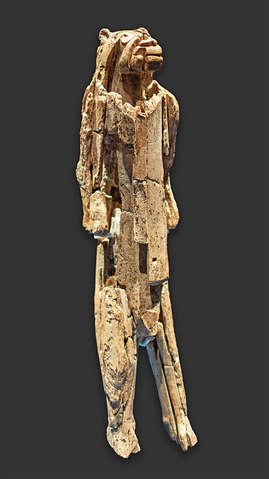
  • fab piece - have you ever seen this - image is from wikki

    "Determined by carbon dating of the layer in which it was found to be between 35,000 and 41,000 years old, it is one of the oldest-known examples of an artistic representation and the oldest confirmed statue ever discovered."

    • Creator Credit: Dagmar Hollmann / Wikimedia Commons
    • License Credit: License: CC BY-SA 4.0
  • I’m delighted to see an image of the Lion Man here. I do know of it, and I have followed the anthropomorphic/zoomorphic debate surrounding it. The later discovered fragments which come from the same spot as the Lion Man were carbon dated to date the figurine. 

    https://journals.ub.uni-heidelberg.de/index.php/qu/article/download/78462/72446

    Lion Man can’t be classified as the oldest known anthropomorphic figurine - the prize goes to this lady, commonly known as the ‘Venus of Hohle Fels’. She dates to around 40,000 years ago. I would have included a photo here, but it might break the thread. 

    https://web.archive.org/web/20161011145105/https://www.uni-tuebingen.de/en/news/press-releases/newsfullview-pressemitteilungen/article/es-muss-eigentlich-eine-frau-sein.html

  • yep I'm absolutely an assisted amateur polymath

    Well then, I won’t offend you by saying your assistant, that is AI, produced slop. 

  • great answer! yep I'm absolutely an assisted amateur polymath   The difference between informed speculation and absolute evidence based science I completely respect.  Hehe, I'm old but not old enough to have been there to remember it personally!

    Best wishes

  • I’m reassured that I’m fully humanSweat smile Thank you  

    It would be marvellous to understand the reason behind the decline in figurine use, but it remains to date, there isn’t evidence to explain why it happened so suddenly during the neolithisation of western and northern Europe, but there is evidence that it declined and my point was that to date, linguistics can’t explain it and neither can archaeology. Is the second part of your response from AI? I haven’t used AI, but if I do, I always check its sources.

    The Neolithisation wasn’t one single event. Studies show the sudden decline of figurine production was in a series of steps. Figurines weren’t commonly ‘small stone figurines’,  clay figurines were the predominant type during the neolithic (dating systems for neolithic periods vary between regions) and they were in abundance until their rapid decline, whereas stone figurines were not common so people didn’t spend time “chipping and polishing stone by hand”.

    “Preservation bias” is something archaeologists are aware of more than most, and you are right in pointing out wood decays. However, if a rich tradition of wooden figurine production had existed, it has been argued that we would have expected to find at least some examples of these among the extraordinarily well preserved conditions that have been revealed in e.g. the wooden wells of Linear Pottery Culture or the pile dwellings in the circus-alpine region, yet this is not so. Moreover, if wooden figurines had replaced clay figurines, at least a few organic figurines would have been revealed during the extensive archaeological work in bogs and wetland areas that preserved other organic material culture. 

    There is archaeological and biological evidence that the introduction of agriculture could be associated with poor health and disease, but to date, a relationship demonstrating it caused people to stop producing or using figurines hasn’t been proved. To prove it, archaeologists would need data showing the symbolic response to the conditions was abandonment of figurines. There are substantial regional differences throughout Europe as farming spread and even communities experiencing  broadly comparable economic transformations responded in different ways. So it can’t be argued that “intense physical and existential stress” led to a “pivot” in their spiritual and symbolic lives. 

    Neolithic people had to contend with celestial events, but it’s too far a stretch to claim figurine use stopped because “survival now depended on mapping celestial events and seasonal cycles”. There is nothing in the archaeological record to suggest that figurine use was connected to astronomy or seasons.

    Regarding Central European Roundels, there is a chronological correlation with the decline in figurine use but it doesn’t explain the cause. Even if they had significant orientation properties, it doesn’t provide evidence relating to a cognitive transformation over a much wider area. 

    We don’t have evidence that “gruelling hours” were spent making clay figurines. They were made by various methods, moulding and shaping by hand. Some may have been made in a small scale ‘workshop’, others perhaps by individuals, but they weren’t labour intensive to make. We don’t know if they were all “intimate, household figures”. In fact, we don’t know exactly what their function was. 

  • Don't worry, ArchaeC, appreciating art absolutely makes you fully human—if anything, being a dedicated custodian and scholar of it is a vital part of keeping that legacy alive! I actually just double-checked the weight of our pieces, and it completely rules out ironwood; the standing figures are surprisingly light. It's highly likely they are carved from a low-density tropical softwood or native palm wood common to the region, though the face masks and bowls are noticeably more dense and heavy.
    As for the Sepik figurines, I'm not entirely sure how much formal anthropological work has been done specifically on the markings, but given how deeply symbol-dense PNG material culture is, I'd bet every pattern carries a specific lineage or totemic meaning.
    Your point about the sudden drop-off of Neolithic figurines in Northern and Western Europe as agriculture spread is a fascinating mystery. It actually tracks perfectly with the fact that when farming first took root, human health, stature, and life expectancy plummeted for a while. Early agricultural communities faced major nutritional stress from a narrower diet and suffered from zoonotic diseases spreading through crowded, permanent settlements.
    If early farmers were experiencing that kind of intense physical and existential stress, it makes total sense that their spiritual and symbolic lives would pivot drastically. The cultural significance of intimate, portable figurines likely decreased as human focus shifted toward larger agrarian and natural factors. Survival now depended on mapping celestial events and seasonal cycles to align with planting and harvesting.
    We also have to contend with a massive preservation bias here; what we call the "Stone Age" was likely a "Wood Age" in reality, and we have no idea how many beautifully carved wooden figurines have been lost entirely to decay. But for the small stone figurines that do survive, the sheer labor economics changed. Chipping and polishing stone by hand takes an immense amount of time—a luxury a struggling, time-poor early farming community simply couldn't afford.
    Interestingly, the timeline shows this wasn't a direct leap to classic monuments like Stonehenge, which actually emerged nearly two millennia later. Instead, the immediate evolutionary bridge was the appearance of Central European Roundels right around 4900 BC—exactly as the figurine tradition was dying out. This marks the precise cognitive pivot where communities stopped investing grueling hours into intimate, household figures, and started looking upward and outward, redirecting their collective labor into massive communal spaces to track celestial cycles and secure their survival. It really highlights how tightly bound material culture is to physical economics, and it’s exactly why that crossover between linguistics, genetics, and archaeology is becoming so essential for filling in the blanks.
    Best wishes :-)
  • It’s ok  I just wondered if they were made from an ironwood, which would be very heavy and hard to carve. 

    Art has been part of what it means to be human since prehistoric times so I wonder if that means I’m not fully human, as creating art has eluded meSweat smile I do appreciate other people’s art.

Reply
  • It’s ok  I just wondered if they were made from an ironwood, which would be very heavy and hard to carve. 

    Art has been part of what it means to be human since prehistoric times so I wonder if that means I’m not fully human, as creating art has eluded meSweat smile I do appreciate other people’s art.

Children
No Data