Job application requiring emotion recognition from AI generated facial expressions

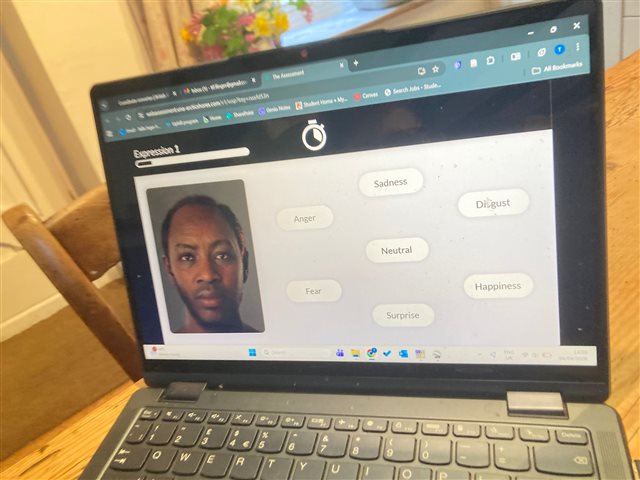
Yes this is after I told them I was autistic (they said they would apply a 'score adjuster' afterwards). Yes it produced the predictable result that I was terrible at it. Here is an example screenshot. 

The job had nothing to do with recognising emotions, it was for a technical role not a people focused one. It just seems ridiculous that they can do this so openly? As I feel like naming and shaming today, this was for a WSP job and the psycometric testing was Arctic Shores. 
 

  • Most jobs do involve dealing with those funny things that walk about on two legs and talk…. in other words people. And an employer has to put lots of them together into a team to produce something people want or are willing to pay for. So it is necessary for the staff to be able to deal with each other. 

    Saying that, I consider the test is discrimination writ large. There is no way the test can "adjust" the score to account for your ability to do something you don’t do. Name and Shame.

  • Most jobs do involve dealing with those funny things that walk about on two legs and talk…. in other words people. And an employer has to put lots of them together into a team to produce something people want or are willing to pay for. So it is necessary for the staff to be able to deal with each other. 

    Saying that, I consider the test is discrimination writ large. There is no way the test can "adjust" the score to account for your ability to do something you don’t do. Name and Shame.

  • Yes, people faces aren't symmetrical. Not in a slightest. Even when they look symmetrical, they're not.

  • Oh that's bad. Like it ever was good, but this is even worse.

  • Overall it looks like a neutral expression, but one eyebrow is raised. Is that enough for 'surprise'? Could the person have uneven eyebrow levels anyway?

    Pointless ambiguity. Companies fall for this sort of psychological claptrap and pay good money for the privilege of finding out nothing of any real use.

  • I'd also be interested to see any evidence they may or may not have. From memory, they just made a generic claim that the facial expressions were exaggerated, as not to disadvantage autistic people

  • It might be good to use this on some existing employees in customer/patient facing roles and if they fail get them some more training! We seem to live in a world where any sort of complaint is seen as aggression which leads to a refusal to engage with you or your complaint. Some people seem to practice passive agression as a way of winding up the customer/patient to the point they lose patience and call out the attitude of the person supposedly helping them. 

    I guess this is going to be another hoop people looking for work are going to have to jump through, like having a driving licence in a role where you don't travel for work purposes, or the old, need a degree  certain amount of experience and be under a certain age, which excludes pretty much everybody.

  • Surely the person in that screenshot is showing different expressions on each side of the face as well? I feel I'm pretty good at recognising emotions on others' faces but that one is tough.

  • I don’t see how that could even be remotely a legitimate way of measuring it - performing a facial expression will 100% not fit with reality - what are they going to do to get an authentic expression? 

  • It's all so preventable and understandable, a real tragedy. Like TheCatWoman says, there should be something you can do, but even if there is, it requires so much mental fortitude that not everyone has, I certainly couldn't cope with it either. 

    I think that's sadly what people like that relay on, that the effort to fight is too much. And sometimes exposing this behaviours requires national tabloid support, which lays you open to more potential hurt. Maybe an anonymous letter to a journalist might get someone interested to do their own investigation into volunteers being treated badly. It's like that story of the kid who M&S fired, he was autistic and volunteered to stack shelves for work experiences, and when his mum asked for some paid work after a few years they let him go. Thankfully due to the coverage he got lots of offers of actual jobs to do what he enjoyed. Managers can act disgracefully till everyone sees them for what they are, only then do they feel any embarrassment and that's mainly for their own reputation than real remorse!

    I hope you are managing to move forward and heal a little, these things take time, especially on top of everything else you dealing with! 

  • I think it a shame that theres not some sort of tribunal one can go to in situations like yours. Many people are encouraged to use any volunteer work in their CV's and to use them as a reference, how could you do this when faced with such hostility?

    I must admit though, I wouldn't want to go back to a place where I had been treated like that I would never feel safe and would be unale to trust them again.

  • Thank you ever so much your words really help me. It was utterly dreadful and a part of the journey which led to a suicide attempt, then incarceration in psychiatric hospital for several weeks. Once I was allowed access to my mobile phone again I rang their head office and tried unsuccessfully to talk to both the national volunteer manager and the CEO, but they so many insurmountable hurdles in the way I gave up fighting. After the pandemic I was diagnosed with C-PTSD and this was one part of the jigsaw

  • That's so sad, especially as a volunteer, it's scary to see people turn on you when they feel completely justified in their behaviours, and the long term damage that can do to a person. I would struggle to get over that.

    As you said, I don't know if it's a lack of understanding or willful ignorance on their part, the outcome is the same for the person being attacked. And for what? For the relatively short time during the pandemic in the greater scale of things, they have lost a wonderfully dedicated volunteer forever. It's their loss but you bear the scars of it.

  • You are absolutely right, I want to say we should campaign to stop this but the pragmatist in me knows that the prejudice against neurodivergent people and many other minorities is utterly embedded and whilst recruiters and employers will say the right things in reality they really dont want us.

    I have personal experience of this. I was volunteering in a big animal charity, won awards appeared in their magazine and was held up as an example of great volunteer attending their national conference. They knew I was autistic but hadn’t a clue what this meant. Then came the pandemic with the sensory nightmare of extensive ppi, I just couldn’t cope with it.I then went from hero to zero virtually overnight. Other NT volunteers were attacking me on the facebook and group and even some paid staff. The volunteer manager basically agreed with the others then made the situation so bad for me that I felt I had no choice but to leave. Were I not a volunteer it would have constituted both bullying in the workplace and constructive dismissal. 

  • So sorry it happened to you too, I would like to see their evidence that it doesn't disadvantage autistic people. What studies have they done that proves the claim it isn't a discrimination tool?

  • It's great you can do it, but autism is a spectrum and some people struggle with this sort of thing even with training. If it becomes widespread, it is a form of needless discrimination when roles aren't customer facing, and actually forces people to disclose during the interview process just to get past the AI filter step, which they still might fail.

  • This is as Martin has said possible discrimination. There are people who has won tribunal cases due to the potential employer applying psychometric tests.

    If you do not get an interview complain. It is not fair and biased against certain autistic people.

  • I agree, but this is categorically not a customer facing role. It's a technical modelling role with limited client interaction. 

  • The job had nothing to do with recognising emotions, it was for a technical role not a people focused one. It just seems ridiculous that they can do this so openly?

    It has become standard practice for many groups who handle recruitment these days - I had employers doing this over 10 years ago but with a bit of research on what they are looking for it is easy to fool the system.

    It is actually quite a useful skill to posess if you have to work with other people as there are all sorts of issues and office politics on the go that benefit from when you can read how people are reacting.

    I looked on it as just another technical skill to learn for the role.

  • I can’t think of one good reason for testing anyone on this!

    Most customer facing roles require you to be able to identify the emotional state of a customer and react to create the desired outcome but adapting to it (eg if they are angry then defuse it, if they are scared then be supportive, if they are confused then try to understand the root of the requirement and help them through the confusion etc.

    It has a lot of use in the working world.

    Management also need it to be able to deal with their reportees, especially where there is any kind of conflict resolution of even bullying going on.