
Terminology

Are there any particular aspects of autism related terminology that bother you?

Here are some of mine:

1.

ND -v- autistic

NT -v- allistic

The above terms seem (from reading here) to have become interchangeable but, to my mind, they shouldn't be.

Autism is under the umbrella of neurodiversity but so is Tourettes (for example).

Here is a wheel of ND but I've seen some with more 'conditions' included:
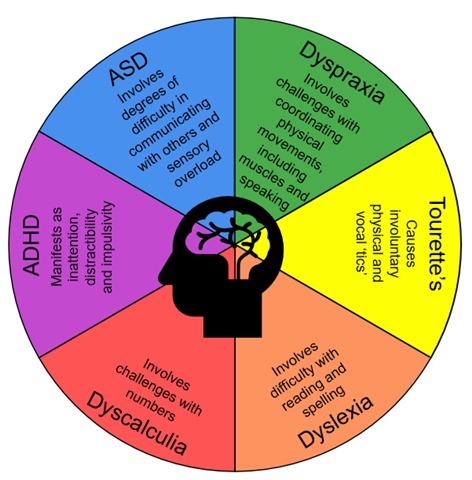
If ND is used instead of 'autistic' (when it's actually autism in particular that is probably the subject) I find it hard to follow the arguments/discussion.

2.

Another is the autism spectrum.

I don't know how it was meant when it was first termed, but my understanding of it isn't that there are ends of it that are less autistic, and more autistic, ie becoming more extreme, but rather than we (autistic people) can be less and more extreme as we dip in and out of the symptoms/characteristics:

Below is a link to an article that I think explains it well:

https://neuroclastic.com/its-a-spectrum-doesnt-mean-what-you-think/

3.

Also, if other people say 'we are all on the spectrum, all a little bit autistic etc' then I think it's important to bear in mind that a diagnosis is only given if the characteristics of autism that we match to are disabling to us.

How do others see the above and also, are there any other terms that you find difficult/confusing?

Parents
  • I have recently read here 'ND spectrum'.

    It isn't.

    It's an autism spectrum.

  • The spectrum concept applies to ND as well but it means something a bit different. From en.wikipedia.org/.../Neurodiversity:

    The neurodiversity paradigm is a framework for understanding human brain function that considers the diversity within sensory processing, motor abilities, social comfort, cognition, and focus as neurobiological differences. This diversity falls on a spectrum of neurocognitive differences

    The terminology is still evolving and is often misunderstood so it is not surprising that some references may be out of date, written by someone who wants to promote a specific agenda or is simply misinformed.

    Even when a word is accepted with a definition there can be groups who want to change the meaning for some agenda. You will see this around the word neurodiverse one this thread and on a few others. All the dictionary sites I check say one thing but they insist it should mean something different. 

    Even the word spectrum can be confusing as many people think of a linear spectrum when autism is more of a circular or even spherical spectrum when you factor in the traits, intensities and impacts.

    I think it best not to get too caught up on absolutes as it seems there is always someone who has a different absolute definition to you and arguing is not going to make you any more (or less) right about a slightly plastic concept.

  • Even when a word is accepted with a definition there can be groups who want to change the meaning for some agenda. You will see this around the word neurodiverse one this thread and on a few others. All the dictionary sites I check say one thing but they insist it should mean something different. 

    You are continuing to misuse “neurodiverse” because you are still fundamentally misunderstanding:

    • the neurodiversity paradigm, from which the word comes, and
    • the nature of modern dictionaries 

    As I explained earlier in this thread, modern dictionaries do not “insist” or claim to prescribe what any word “should mean”. Instead, acting like a mirror, they reflect how people are using words, including when words are used incorrectly by enough people for it to be considered significant usage.

    The dictionary entry that you (misleadingly) only partly quoted in one of your earlier replies, for example, therefore included two definitions: one that is the accurate meaning, and one that is an inaccurate meaning, which reflects widespread misuse (including by you).

    It is the neurodiversity movement, not dictionaries, that defined the intended and correct meaning of “neurodiverse”.

    As Judy Springer explains in her article (per my earlier reply): neurodiverse describes a space, not a person or condition(s).

    The correct usage is reflected in the NAS’s guidance, which includes:

    Neurodiversity includes every single human being.

    It is common for words related to neurodiversity to be misused. For example, people might say ‘Autistic people are neurodiverse’ when they mean ‘Autistic people are neurodivergent’.

    Examples of accurate phrases include:

    Humans are neurodiverse.
    Autistic people are neurodivergent.
    Autism is a form of neurodivergence.

    NAS - Autism and neurodiversity

    You linked above to Wikipedia’s article on neurodiversity. I encourage you to read the full article, which confirms how and why neurodivergent is the right word to use.

    We all benefit from promoting accurate understanding and use of the basic language around our condition, whereas misuse of it fundamentally undermines the neurodiversity paradigm.

Reply
  • Even when a word is accepted with a definition there can be groups who want to change the meaning for some agenda. You will see this around the word neurodiverse one this thread and on a few others. All the dictionary sites I check say one thing but they insist it should mean something different. 

    You are continuing to misuse “neurodiverse” because you are still fundamentally misunderstanding:

    • the neurodiversity paradigm, from which the word comes, and
    • the nature of modern dictionaries 

    As I explained earlier in this thread, modern dictionaries do not “insist” or claim to prescribe what any word “should mean”. Instead, acting like a mirror, they reflect how people are using words, including when words are used incorrectly by enough people for it to be considered significant usage.

    The dictionary entry that you (misleadingly) only partly quoted in one of your earlier replies, for example, therefore included two definitions: one that is the accurate meaning, and one that is an inaccurate meaning, which reflects widespread misuse (including by you).

    It is the neurodiversity movement, not dictionaries, that defined the intended and correct meaning of “neurodiverse”.

    As Judy Springer explains in her article (per my earlier reply): neurodiverse describes a space, not a person or condition(s).

    The correct usage is reflected in the NAS’s guidance, which includes:

    Neurodiversity includes every single human being.

    It is common for words related to neurodiversity to be misused. For example, people might say ‘Autistic people are neurodiverse’ when they mean ‘Autistic people are neurodivergent’.

    Examples of accurate phrases include:

    Humans are neurodiverse.
    Autistic people are neurodivergent.
    Autism is a form of neurodivergence.

    NAS - Autism and neurodiversity

    You linked above to Wikipedia’s article on neurodiversity. I encourage you to read the full article, which confirms how and why neurodivergent is the right word to use.

    We all benefit from promoting accurate understanding and use of the basic language around our condition, whereas misuse of it fundamentally undermines the neurodiversity paradigm.

Children
  • I'm with  and  on this one  - but don't want to be ganging up so perhaps it might help to consider what the terms are most usefully employed to indicate and then work from that?

    I think a point might be to acknowledge that there are many representations of the terminology out there (including the one that haven school uses and dictionaries) however the most useful is to discriminate as 

    Humans are neurodiverse.
    Autistic people are neurodivergent.
    Autism is a form of neurodivergence.

    The key difference is that diversity is about variety within a whole, whereas divergence is about separation or increasing difference between elements. 

    In the context of autism and the broader neurodiversity movement, neurodiversity refers to the natural variation of all human brains, while neurodivergence describes the specific state of an individual whose brain functions in a way that diverges from the "typical" societal norm. 

    I would like to straight out ask you please, do you accept these definitions for autism as you personally identify with it or not?

    If you do then the discussion seems to be settled and we might then all go about clarifying autism to those who misrepresent it in their use of terminology.

    If you don't that is of course up to you :-)

    However... if you do not accept this definition please be prepared to consider that those for whom it is important will continue to provide evidence and reasons for why you might change your mind.

    Also to ultimately ask you why, in the presence of evidence and reasons presented, that you do not?