Terminology

Are there any particular aspects of autism related terminology that bother you?

Here are some of mine:

1.

ND -v- autistic

NT -v- allistic

The above terms seem (from reading here) to have become interchangeable but, to my mind, they shouldn't be.

Autism is under the umbrella of neurodiversity but so is Tourettes (for example).

Here is a wheel of ND but I've seen some with more 'conditions' included:
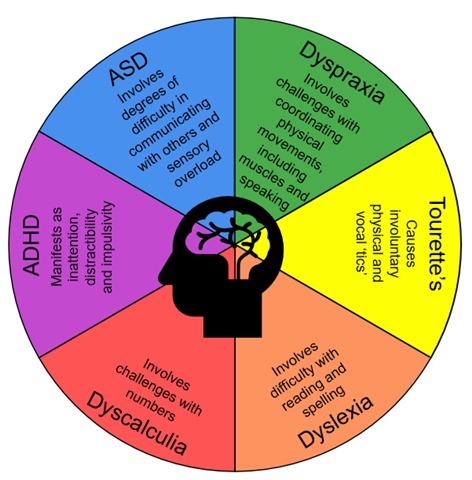
If ND is used instead of 'autistic' (when it's actually autism in particular that is probably the subject) I find it hard to follow the arguments/discussion.

2.

Another is the autism spectrum.

I don't know how it was meant when it was first termed, but my understanding of it isn't that there are ends of it that are less autistic, and more autistic, ie becoming more extreme, but rather than we (autistic people) can be less and more extreme as we dip in and out of the symptoms/characteristics:

Below is a link to an article that I think explains it well:

https://neuroclastic.com/its-a-spectrum-doesnt-mean-what-you-think/

3.

Also, if other people say 'we are all on the spectrum, all a little bit autistic etc' then I think it's important to bear in mind that a diagnosis is only given if the characteristics of autism that we match to are disabling to us.

How do others see the above and also, are there any other terms that you find difficult/confusing?

Parents
  • When people ask questions about NTs (in general) I find that difficult to reply to.

    My understanding of a neurotypical is that they are not neurodivergent ie they aren't autistic, don't have tourettes, ADHD or any of the other 'conditions' listed.

    I don't know how to tell who these people are and I don't know them well if at all so I don't know, for example, if they may have just one condition that's not obvious but still makes them ND.

    For example, bipolar is being recognised now as neurodiverent so presumably people with bipolar aren't NT.  

    How can I tell who, from the general population, doesn't have bipolar so therefore, how can I generalise when asked (especially here) about NTs?

    I much prefer the use of the opposite of each condition eg. autism -v- allistic as it's not a generalisation but a specific term.

  • I don't know how to tell who these people are and I don't know them well if at all so I don't know, for example, if they may have just one condition that's not obvious but still makes them ND.

    I don’t know who these people are either, and I also don’t know what many neurodivergent people (who are autistic with one or more other neurodivergent conditions/or are not autistic) are experiencing. Also, some non-autistic people may have reached the threshold for an autism diagnosis in one area, but not another. We can’t possibly know what they are experiencing. Most of us are limited to our experience of what other people around us tell us, or reading about some aspects of their experience in books or online research papers.We can’t accurately base our knowledge on that.

    I much prefer the use of the opposite of each condition eg. autism -v- allistic as it's not a generalisation but a specific term.

    I prefer to use the specific term too.

  • Also, some non-autistic people may have reached the threshold for an autism diagnosis in one area, but not another. We can’t possibly know what they are experiencing.

    Yes, I don't see it as a 'them and us' situation as there will be lots of shades of grey in between 'NTs' and 'NDs'.

    I simply can't sum up the characteristics of an NT.

Reply
  • Also, some non-autistic people may have reached the threshold for an autism diagnosis in one area, but not another. We can’t possibly know what they are experiencing.

    Yes, I don't see it as a 'them and us' situation as there will be lots of shades of grey in between 'NTs' and 'NDs'.

    I simply can't sum up the characteristics of an NT.

Children
No Data