
Autistic rumination

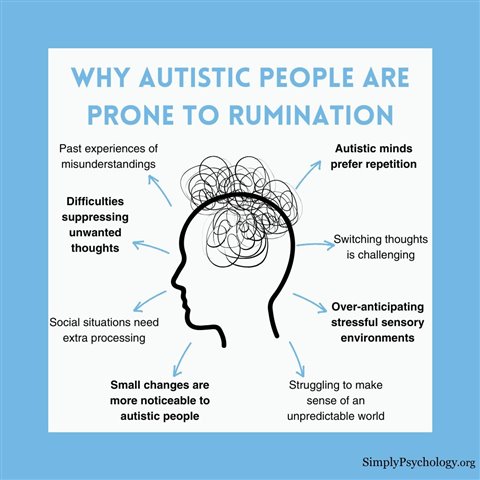
I find it hard to break out of negative repetitive thought processes where I constantly think about past mistakes and why I don't like my life or myself. I came across the concept of autistic rumination which is where an autistic mind is prone to repetitive thinking and can get stuck in this unhappy state. Does anyone else do this or have any tips of getting out of it? 
Parents
  • I do it. It's a feature.

    I asked ChatGPT how to stop rumination. One of these may be helpful.

    Rumination happens when the brain keeps circling the same thoughts, often trying to find a “solution” for something emotional that can’t really be solved logically. It’s the mind’s way of saying, “I don’t feel safe yet.”

    Stopping it isn’t about forcing yourself to “not think” — it’s about changing what the brain is doing when it starts looping.

    Here’s a structured way to approach it:

    brain 1. Recognise and label it

    When you catch yourself re-running a memory or worry, quietly say:

    > “This is rumination, not reflection.”

    Labeling interrupts the automatic loop — it shifts you from being in the thought to observing it.

    Wind blowing face 2. Ground in the present

    Use one of these quick resets:

    5–4–3–2–1 technique: Name 5 things you see, 4 you can touch, 3 you hear, 2 you smell, 1 you taste.

    Breathing anchor: Slow exhale for 6 seconds, inhale for 4 seconds, repeat 3–5 times.

    This tells your nervous system you’re safe right now.

    Gear️ 3. Give your mind a task

    Rumination thrives on idle mental space. Redirect it toward a neutral focus.

    A light puzzle, sudoku, or short article.

    Counting backwards in 7s or 9s.

    Focusing on sounds or textures around you.

    These engage different brain networks — the “task positive” system — that push rumination offline.

    Clock 4. Schedule worry or processing time

    If something genuinely needs thinking through, contain it:

    > “I’ll think about this at 7:30 p.m. for 15 minutes.”

    When the thought arises outside that time, note it down and say, “Not now.”

    You’re training your brain that rumination doesn’t get rewarded.

    Sleeping accommodation 5. Reset physiology

    Rumination often fades when you move your body:

    5–10 minutes of walking, stretching, or light exercise.

    A warm shower — heat helps shift you into a parasympathetic (rest-and-digest) state.

    Speech balloon 6. Shift from “why” to “what now”

    When your thoughts start asking why something happened, consciously reframe to:

    > “What do I need right now?” or “What small thing would help me feel a bit better today?”

    “Why” keeps you stuck in the past; “what now” brings you into action and control.

Reply
  • I do it. It's a feature.

    I asked ChatGPT how to stop rumination. One of these may be helpful.

    Rumination happens when the brain keeps circling the same thoughts, often trying to find a “solution” for something emotional that can’t really be solved logically. It’s the mind’s way of saying, “I don’t feel safe yet.”

    Stopping it isn’t about forcing yourself to “not think” — it’s about changing what the brain is doing when it starts looping.

    Here’s a structured way to approach it:

    brain 1. Recognise and label it

    When you catch yourself re-running a memory or worry, quietly say:

    > “This is rumination, not reflection.”

    Labeling interrupts the automatic loop — it shifts you from being in the thought to observing it.

    Wind blowing face 2. Ground in the present

    Use one of these quick resets:

    5–4–3–2–1 technique: Name 5 things you see, 4 you can touch, 3 you hear, 2 you smell, 1 you taste.

    Breathing anchor: Slow exhale for 6 seconds, inhale for 4 seconds, repeat 3–5 times.

    This tells your nervous system you’re safe right now.

    Gear️ 3. Give your mind a task

    Rumination thrives on idle mental space. Redirect it toward a neutral focus.

    A light puzzle, sudoku, or short article.

    Counting backwards in 7s or 9s.

    Focusing on sounds or textures around you.

    These engage different brain networks — the “task positive” system — that push rumination offline.

    Clock 4. Schedule worry or processing time

    If something genuinely needs thinking through, contain it:

    > “I’ll think about this at 7:30 p.m. for 15 minutes.”

    When the thought arises outside that time, note it down and say, “Not now.”

    You’re training your brain that rumination doesn’t get rewarded.

    Sleeping accommodation 5. Reset physiology

    Rumination often fades when you move your body:

    5–10 minutes of walking, stretching, or light exercise.

    A warm shower — heat helps shift you into a parasympathetic (rest-and-digest) state.

    Speech balloon 6. Shift from “why” to “what now”

    When your thoughts start asking why something happened, consciously reframe to:

    > “What do I need right now?” or “What small thing would help me feel a bit better today?”

    “Why” keeps you stuck in the past; “what now” brings you into action and control.

Children
No Data