
Autistic rumination

I find it hard to break out of negative repetitive thought processes where I constantly think about past mistakes and why I don't like my life or myself. I came across the concept of autistic rumination which is where an autistic mind is prone to repetitive thinking and can get stuck in this unhappy state. Does anyone else do this or have any tips of getting out of it? 
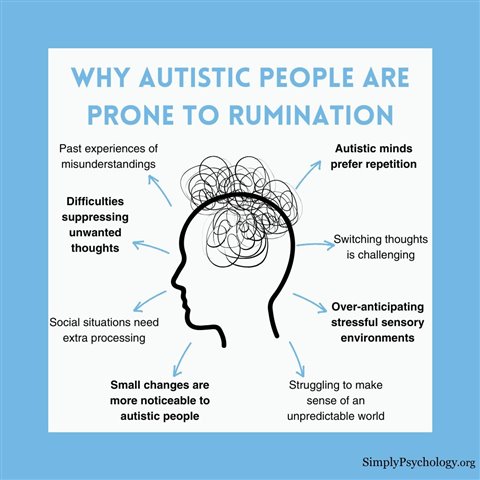
  • I don't know whether it's autism, ADHD or anxiety - something that begins with A seems certain - but I definitely ruminate. My brain doesn't stop, almost ever. Only relief I get from rumination is hyper focus and maybe sleep (although my dreams would suggest I'm still ruminating in my sleep). I am yet to find a solution.

  • I do it. It's a feature.

    I asked ChatGPT how to stop rumination. One of these may be helpful.

    Rumination happens when the brain keeps circling the same thoughts, often trying to find a “solution” for something emotional that can’t really be solved logically. It’s the mind’s way of saying, “I don’t feel safe yet.”

    Stopping it isn’t about forcing yourself to “not think” — it’s about changing what the brain is doing when it starts looping.

    Here’s a structured way to approach it:

    brain 1. Recognise and label it

    When you catch yourself re-running a memory or worry, quietly say:

    > “This is rumination, not reflection.”

    Labeling interrupts the automatic loop — it shifts you from being in the thought to observing it.

    Wind blowing face 2. Ground in the present

    Use one of these quick resets:

    5–4–3–2–1 technique: Name 5 things you see, 4 you can touch, 3 you hear, 2 you smell, 1 you taste.

    Breathing anchor: Slow exhale for 6 seconds, inhale for 4 seconds, repeat 3–5 times.

    This tells your nervous system you’re safe right now.

    Gear️ 3. Give your mind a task

    Rumination thrives on idle mental space. Redirect it toward a neutral focus.

    A light puzzle, sudoku, or short article.

    Counting backwards in 7s or 9s.

    Focusing on sounds or textures around you.

    These engage different brain networks — the “task positive” system — that push rumination offline.

    Clock 4. Schedule worry or processing time

    If something genuinely needs thinking through, contain it:

    > “I’ll think about this at 7:30 p.m. for 15 minutes.”

    When the thought arises outside that time, note it down and say, “Not now.”

    You’re training your brain that rumination doesn’t get rewarded.

    Sleeping accommodation 5. Reset physiology

    Rumination often fades when you move your body:

    5–10 minutes of walking, stretching, or light exercise.

    A warm shower — heat helps shift you into a parasympathetic (rest-and-digest) state.

    Speech balloon 6. Shift from “why” to “what now”

    When your thoughts start asking why something happened, consciously reframe to:

    > “What do I need right now?” or “What small thing would help me feel a bit better today?”

    “Why” keeps you stuck in the past; “what now” brings you into action and control.

  • I can be prone to rumination too, and I find that it's not always easy to stop it. For me, humour and the ability to try to see the funny side to life are a massive help. However, I appreciate that humour is something that some autists can really struggle with.

    Some people find that doing an activity (any activity) can be enough to put an end to their rumination, as it distracts them enough to shift their focus. In my case, this doesn't work. I can be distracted enough for the things I am ruminating about to no longer be at the forefront of my mind, but those thoughts remain at the back of my mind, thus making it impossible to truly switch off from them.

    If I'm in a really dark place in terms of my mental health, and am incapable of seeing the funny side to life, then I just remind myself that the negative thoughts I'm having will eventually pass.

    I don't know if I have done a good job of articulating what I'm trying to say, but I hope that some of what I've said will make sense.

  • Last night I found myself worrying that I had nothing to worry about and wondering if that meant something really bad was going to happen in the near future. I found it really hard to stop as a Greek Chorus, started up telling me that I was wrong and bad and of course something awful would happen. I try and think of this chorus as The Sheep of Baaa-d, and mentally turn around and yell MINT SAUCE at them. I find being ridiculous a big help with things like this. 

  • I have repetitive thoughts,  both positive and negative. Even the positive torture me especially if I can't switch them off for few months. They finally stop but after few months the "old movie" starts again. I have some scenarios that repeat in my head constantly. And yes all this on the picture above- I relate a lot.

  • I recognise this completely. I get stuck in these spirals a lot, and the things that neurotypicals usually suggest, like Cognitive Behavioural Therapy, just don't seem to stick. I find recognising that I'm in such a spiral is one thing, but getting out of it or stopping becoming a habit is another.