Religion and Spirituality

I know this is a contentious issue, but I wnat to talk about it anyway and I hope people can be respectful to the beliefs of others. 

It seems to me that although we in the UK are called a Christian country, we're not, most people don't attend church, many are nominally Christian, church for hatchings, matchings and despatchings, maybe xmas and easter too. Many will attend church to get their children into a high performing church school. Our main bank holidays focus on a Christian festival calendar, Easter, Pentecost, Xmas etc, but I wonder if we should add the holy days of other faiths, like EId, Diwali, the Solticies?

We have so many faiths in this country and many people who don't identify with any particular faith, but are broadly believers in something.

I'd like to see bishops removed from the House of Lords and the Church of England disestablished, in a multifath society I don't see what their place is in the giovernance of the country, I think you either have to have representatives of all faiths or none and seeing as many faiths don't have an episcopal system I don't see how it would work where the representatives come from and which community would they be representing? I think the same is true of the current situation and bishops, there are many Christian sects that do not recognise and episcopal system.  

  • Kemi Badenoch isn't prime Minister, she's Leader of the Opposition, for the time being at least. Do you think she displays Christian values and what are those values on display? Because all I can see is someone who knows the price of everything and the value of nothing.

    Values, are they different from morals? I think we should consider the consequences of our actions. I think we should do as we would be done by. I think we should remember Socrates and use him as a guide, 'The unexamined life is not worth living' and 'The only wisdom is knowing you know nothing'. I think we should examine ourselves and how we live not in some sort of pompous naval gazing, but to make us more genuine and authentic people, I think a lot of the problems of the world could be made a lot better if people's choices where more concious. If we go through life thinking we know everything, then where's the room to learn? By admitting to little or no knowlege then everydays a school day, we can move through the world with less prejudice and self importance.

  • Kemi Badenoch isn’t the prime minister. She doesn’t demonstrate enough compassion to make me vote for her, should an election take place. (I am basing this on her past record with the disastrous Rwanda scheme). Perhaps her Christian values are more about getting votes than putting genuine Christian values into action. 

  • Interesting thoughts, me myself I am a Christan. I am a bit of an outsider in life and know how to make it work for me and so does God.

    Paul had a way with his words that speak to many that was needed. Sometimes if I want something more comforting I may look elsewhere like Timothy. I know the story you recount well.

    I want to cut to something else.

    Kemi the prime minister she said that she doesn't identify as Christian, but holds Christian values which guide her thinking. What values do you think we should take on. I cannot see one as so fair as Christian values. premierchristian.news/.../kemi-badenoch-new-conservative-party-leader-chosen

  • I think a lot of people, when asked just say CofE, or Christian, as a sort of default and CofE is a sort of default for the default. As with so many questionaires results can be skewed depending on the questioner and the questions, for example I was asked in a survey what my religion was and I said that I'm a Pagan, there was no box for that and the questioner was quite hostile and asked me if I'd been christened and what as and instisted that I was CofE.

    *******************************************

    Studying the early medieval period and the Anglo-Saxon Conversion period in particular, I've become aware of just how much controvercy there was, how many different competing Christian beliefs, Pelaganism, Gnosticism, Arianism, who was a heretic and who wasn't. We see a totally different form of worship coming from Ireland, from Columba and Iona to the variety from Rome. Most of Northern Britain was Christianised from Iona, but the standard narrative is still St Augustine and Canterbury, who arrived from Rome with thier version.

    Then there were all the councils throughout the early 1ist millenium that decided what books were going to be in the bible and what versions of those books. St Paul seems to have upgraded at the expense of James bother of Jesus who always insisted that Jesus intended his new revelations to be for the Jewish people not for gentiles. It's easy to forget that St Paul never met Jesus when he was alive, but he said he had a spirtitual encounter with him on the road to Damascus, where he was told to convert everybody, not just Jews. This is the moment Saul became Paul, one of the most important figures in the formation of Christianity as we know it. There's a great deal about Saul/Paul that we don't know, there are lots of conspiracy theories/controvercies about him like was he a Roman government agent, did he deliberately seek to derail Jesus's original message and sideline James, how much of what we currently think of as Christianity is actually Paulanity?

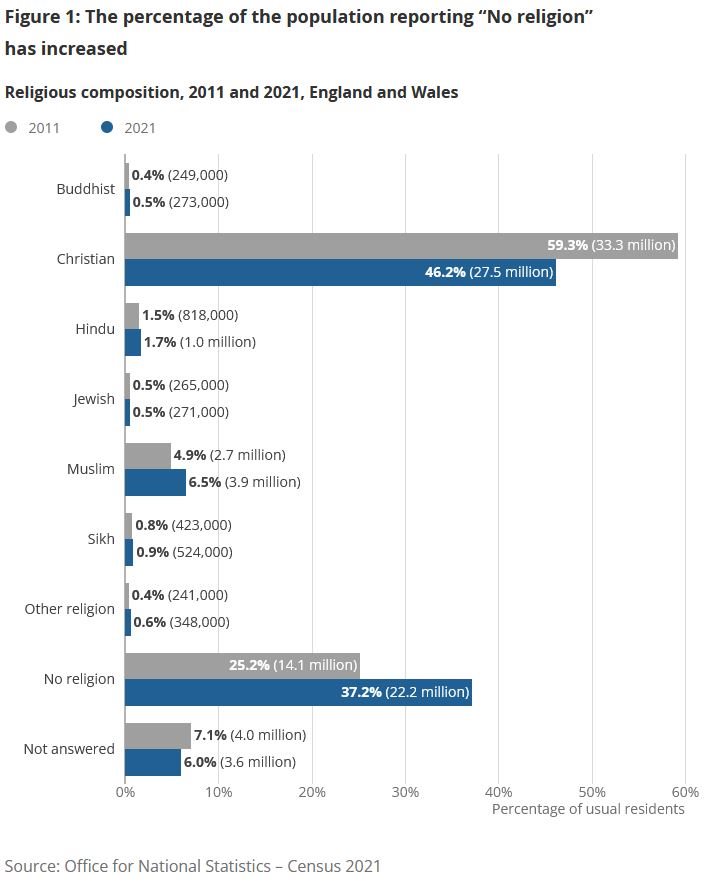
  • Those figures make grim reading for the church - the number of people who are saying they are no not religious has grown by 56% while those identifying as Christian as dropped by 17% - all in just 10 years

    The difference between these stats and the Statistica stats is probably because of the detail of the questions. Statistica asks if you believe in a god while the census asks if you identify with a religion, not whether you believe in it.

    Thinking of how many people are indoctrinated into one religion or another through family or partner this makes a lot more sense.

  • It is from here- The National Statistics 2021 cenus data. 

    • For the first time in a census of England and Wales, less than half of the population (46.2%, 27.5 million people) described themselves as “Christian”, a 13.1 percentage point decrease from 59.3% (33.3 million) in 2011; despite this decrease, “Christian” remained the most common response to the religion question.

      www.ons.gov.uk/.../census2021
  • The last National Statistics figures put Christanity at 46% in 2021 in the country but we had COVID then. 50% = majority usually.

    Can you clarify what the 50% is of what group please?

    The stats from the graph below show only 32% of people believe in any god in the UK. If your figure is 50% of these people then it means it is only 16% of people in the country are christians in a meaningful sense (ie believers rather than ones who just use the label because they were raised that way).

    Tricky things statistics.

  • Christian upbringing for me, from primary school at least. I’m more of a believer in nature now, it covers everything really, nothing unnatural in a natural world, always loved that saying. 

  • Interesting thread. The last National Statistics figures put Christanity at 46% in 2021 in the country but we had COVID then. 50% = majority usually. Some age groups in the church have been in some quiet revival and especially among the 18-24 year old age who are turning back to God. Interesting America is at 62% Christian according to PEW research and UK are often their ally;  I thnk things should stay as they are. Even more secular countries like France are turning to Christanity now and baptisms are up. https://www.catholicnewsagency.com/news/263349/france-sees-record-10384-adult-baptisms-in-2025-45-percent-increase-as-young-catholics-lead-revival

    It will be interesting when the next statistics come out. You haven't mentioned why you want things to change, are there areas of concern. I think the church can do things to help themselves which I wrote here to try and save money and make more diverse services if possible-

    To worship Christmas these days with councils is getting harder and harder. There is meant to a new church that Bishop Gulli talks of. She is a lovely woman.

    https://www.racheltestimony.com/2025/08/my-ideas-on-reducing-church-costs-today.html

    www.racheltestimony.com/.../open-letter-to-catholic-churchs-today.html

  • People changed their understanding in light of changing times, just as faith and understanding is shown to have evolved throughout the Bible. This can be confusing as the Bible is not in chronological order. 

    Christians have varying beliefs, individually and collectively within their denominations and wider Christianity.

    Within Anglican and Catholic Theology, ‘faith seeking understanding’  is a phrase used to explain the idea that theology and revelation is always evolving. God stays the same but people’s understanding develops and grows. So the theology of Scripture is not static. It is not a case of rewriting God’s profile, it’s more about a fuller understanding. 

    Other faiths may take the Bible literally, that God wrote the Bible without human input, but that was never the case in my tradition.

    Incidentally, some Christians substitute God for He, as I have done, as God is Spirit, without gender. 

    The first Christian communities, and the writing of the New Testament, changed ideas of how God revealed Godself in the Old Testament. 

    I am not arguing for a viewpoint here. This is simply a description. 

  • I can only imagine what that might be like. As an agnostic and ex Catholic, your experience is different to mine.

  • People changed.

    But God does not change surely - he has been about forever.

    Or do you mean we changed our interpritation of him? Did we effectively rewrite his profile to be more acceptable?

  • I don't know how someone can call themselves a believer in a kindly god and feel its ok to do some of the stuff I've experienced and heard about.

    I recall the god in the Old Testament being all wrath, brimstone and fire with humanity. Why did he change so much in the New Testament to be so soft?

  • Thats a hard place to be in Prof, I've been around some fundamentalist/strong believers and the guilt tripping is immense, I don't know how someone can call themselves a believer in a kindly god and feel its ok to do some of the stuff I've experienced and heard about.

  • I’m sorry you can’t be yourself. If you don’t believe that’s fine! Im a Christian myself but I respect your views. If these people don’t respect your views then that’s their problem. You can get some nasty people who claim to be Christian, say I went to a couple of schools like that Cry 

  • Wow, that’s really interesting, I never learnt any of this at school but I do think it should be considered to be studied. These events seem to go under the radar and as I said I think Christmas and Easter to most people are more just days of giving and getting presents so that’s why those two dates are very well known but they don’t know the true meaning of those dates. Or the meaning of the Christmas trees and ligbts. But there again we don’t know the date that Jesus sacrificed himself hence Easter is a different date each year. And though Jesus was meant to be born on 25th of December, there are also theories of Jesus not actually being born that date. I do also believe in other Gods and Goddesses as well though and I do think they deserve more attention and so do other religious holidays. 

    As for death, I believe the thing is people are actually more afraid of dying than death itself but I do like to believe that as long as we have been good on earth then we can have an even better life up in heaven smiling face with hearts But that is my personal belief and I am choosing to go down the religious path but there again I also believe that we should have a good life too. I also believe in reincarnation as I’ve said as well. I think what can put people off religion is the fact that people can abuse religion and use it as their excuse to be bullies and wicked so then they can pray to God that they will be forgiven for being bullies and then assume God will forgive them and then this vicious cycle continues but I believe that God will see that as abuse of religion and then go to hell but who am I to say. Hope this hasn’t offended anyone and I hope I haven’t come across as preachy. I respect everyone’s views x

  • What’s weird for me is that I am masking as a Christian just like I’ve been masking my Autism.

    It’s a long story, but I’m an agnostic atheist now in a Christian family in an area flooded with conservative Christians. It sucks that I can’t just be myself and have my own views.

  • I fear being in pain and the indignity of dying, but I'm not afraid of being dead, lots of people are which I find really strange.

    The next life will be different to this one, better that's a matter of interpretation.

    *******************************

    So many Christian festivals were either moved, taken over by Christians or had Pagan ideas attached to them, it's a bit hard to seperate them. Then of course there's the official Roman calendar which everything had to fit into, many people don't realsie that when Constantine officially turned Rome Chrisiian that it was a change of God/s slotted into an already existing beaurocratic calendar. 

    The word Easter come from the Pagan Goddess Eostre, who was Goddess of spring and fertitlity to Anglo-Saxons.

    Candlemass or St Brides/Bridget's day is also a fusion, 2nd of february also known as Imbolc was a festival of returning light, the Goddess Bridget, was sort of melded with and became a saint, I'm not sure anyones really knows how or why?

    Just about every culture has a midwinter festival, xmas has been called so many things, Saturnalia by the Romans, Yule, by the north western Europeans.

  • I find early religions interesting and where they cross over into the Christian bible, but then the Old Testament is a history of the Jews and their God, that seems to have been taken on by Christians. Something else I don't really understand and never really get a satisfactory answer too.

    The Biblical scholar John Barton quotes the Jewish scholar Moshe Goshen-Gottstein, “where Christians see the Bible as a story about God, humanity and salvation, Jews read it as being about God, people and land. The story of Adam and Eve is a minor”. https://time.com/5606942/jewish-christian-bible/

    I can’t speak for Judaism, but my understanding of Christian Biblical theology is that Barton is correct. The Old Testament is an account of the history of Salvation.