Can I clarify whether of not I understand the definition of Theory of Mind? I fear a bit of Dunning-Kruger effect on my part

Calling fellow people with ASD, my curse of TL;DR, a simple question that becomes... this:

I understand that Theory of Mind means: 'the ability to understand that others have their own thoughts, feelings, and beliefs, which may be different from one's own'.

I am autistic and I get that intellectually but I feel like I must be missing something here.

How does theory of mind (ToM) impact relationships?

Assuming people are not bad people with terrible political takes upsets them a lot, is that ToM?

Assuming people have good vocabularies upsets people a lot, is that ToM?

Assuming people will not take a dim view of my subjective interests only to be disappointed then pulling them up for making it obvious I'm upset about their response, this upsets them a lot, is that ToM?

Am I supposed to apologize for giving people the benefit of the doubt? Am I supposed to edit the way I speak, my better takes and enthusiasms to make space for bad takes so people with bad takes don't get offended? Seems like a take on 'trying, reading and being thoughtful on things before committing to a strong opinion/being authentic is bad' and 'using careless heuristic takes based on little but groupthink and deindividuation is good actually' to me.

It's not that I'm invulnerable to making decisions and reflexive responses without thinking first but experience, I'm 47, has shown me the times I regret are the times I DON'T put in the effort BEFORE committing to a POV. While I don't like to upset people if they are wrong, what special angels are never wrong, not me that is for sure. IMO that's a them problem, what I HATE is upsetting people only to find out later they were right and I was wrong because I didn't do the work first.

Why? I hate being talked down to by people who haven't done the work as if I'm wrong and they are right when I KNOW they are wrong and I'm right and I can explain it to them in excruciating detail through 4 different disciplines with quotes, graphs and if you give me time, a laptop and the right resources, and if necessary, Harvard referencing.

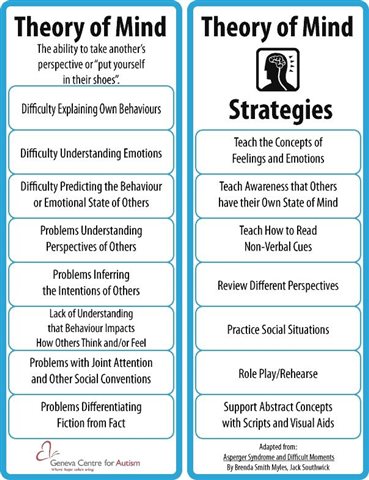
I think I'm OK at these things, I did a counselling theory course back before my diagnosis, but it might be a Dunning-Kruger thing where I just think I get it because I'm not as good at it as I think I am. I still find most people and social situations hard to read when it expands past more than just me plus one other person with a lopsided interaction where I attend to them fully without checking in on my self enough for it to be a satisfying back and forth or I monologue at them trampling them, it is as if I get stuck exclusively on send or exclusively receive.ToM Infographic
Parents
  • I think it is about the ability to see things from someone else's perspective. To have empathy, you need to imagine you are in the same position they are and imagine how they feel, then respond appropriately. It is the ability to predict and understand other people's actions. You have to understand or be able to model their likely position to be able to predict.

    If you cant do this I would imagine you will likely be blunt, insensitive and struggle to make emotional connections.

    Without it you will likely talk based only on your position. You will not understand why if the other person does not agree as you can't see why they would not think the sane. You will then info dump to convince them of your view. If they do not agree, rather than try to have a dialogue and understand why they hold the views they do, you may assume they are just wrong. This can be overbearing, aggressive and unfriendly.

    You need to understand the other person may not have the same info as you, they may not care, they may not think like you, they may be more or less clever than you,, they may have other motives, they may just want to be difficult, etc.  In summary, they are not a copy of you even if you give them the same info you have.

    They may not be as well educated or have read as much and their vocabulary may be different. This does not make their views wrong, it just means they may express it differently to how you expect, or they may not understand you. So you need to reword what you are saying.

    In practice you just have to accept you don't have to win in conversations, or change other people's views, most of the time it doesn't matter, they can be wrong or you may be wrong. If it really does matter then you have to find a way to agree.

    You also have to have self awareness. Imagine someone is talking to you in the same way you are talking to them. Would you be upset at the tone, style or approach? If you would not like to be spoken to that way you can expect they will not react well either.

    It is easy to get upset when someone does something to you, but not be able to see it when you do the same thing. A simple example might be to be upset if someone forgets your birthday, but not think they might feel the same if you forget.

    You can't assume they will like the same things as you. Until you have a discussion you don't know what they like. But you have to accept they are different and may not like your topic.

    You have to be able to take differences without getting too upset or emotional, or taking everything personally. You can disagree and be friends.

    People may talk down to you if they to hink you don't know much or state something that is obviously wrong. The issue is to handle it politely and make sure your are certain if your facts.

  • I think I can do empathy but its a fluency thing. I think I can be set to send well or receive well.  Be a monologuer or an active listener, not seamlessly move between the 2 extremes.    I can be  blunt, insensitive and struggle to make emotional connections but I can also be thoughtful, sensitive and manage connections well with my unused counselling skills... well in the shirt to medium term til I burnout and can't maintain the skills.  

    The counselling HNC really helped me understand myself and others and gave me tools to manage relationships more but counselling is a one sided relationship and it doesn't work in a personal relationships, there are reasons why sessions are 45 mins not hours.  It requires too much and ends in burnout even for allistic counsellors with professional supervision.  

    People can hold opinions that do effect me, us, and I cannot roll with those that do. I wont.  I hear something, unless I really have done the work I try to remind myself to not have a strong opinion to lean in when I don't know and listen but there are a lot of antisocial stuff I will not tolerate like racism, ableism and transphobia etc associated as second order stuff to politics and media personalities like Andrew Tate.

    Respect is baseline stuff and you cannot negotiate on it. There are conversations you cannot shrug about.  I'm not talk about  why my favorite Avenger is Captain America or pizza topping or my love of Nina Simone's song 'Feeling Good' and your has to be yours too, there is a baseline, when they are fundamentally wrong and it had political ramifications based on dehumanising others it is important and after 47 years I have had the 'Oh that is interesting, I have never thought of that before' thing then went and looked it up myself and got the idea I never thought of and in researching it and asking the right people the right questions to think of the right questions to get answers for I had got the idea concrete in my head.  ASD sense of justice, right? 

    People think autistics are lazy, stupid or liars and I will not be disrespected like that, that attitude drives votes and votes take away accommodations and subsistence incomes for all the broken relationships that lead to worklessness not having ToM costs us.  Autistics are humans, we need rent and food too and those attitudes are the first step to terrible political consequences like Charles Lindbergh's baby or the work of eugenicist Johann Friedrich Karl Asperger.

    I'm VERY used to rejection, I hate it, so I try to not be rejective, we all want to been seen but you have to have healthy boundaries too.  I just haven't had to think about it for a while as I barely speak to anyone since my back injury.

    Thanks for the prompt response. I found the reply helpful.  Helped me feel seen I guess. Thanks

  • I'm not quite sure what you are trying to get at.

    All I'd say is to be careful about black and white thinking, especially when it comes to anything political.

    Note the internet can be very polarised, and people stir things up to get clicks. A moderate sensible comment does not get many views. Take it as entertainment . Yes, some people think it is super important, but the majority, the silent moderate majority, ignore all this stuff and just get on with their lives, even if the media and activists want you to think otherwise.

    People repeat things in real life because they think it is clever or can't be bothered to think or research stuff themselves. Avoid the people you disagree with, it is just unnecessary stress.

    Try not to worry too much about things you can't change and focus on things you can.

    And try to appreciate the good things around you, the birds singing, some flowers, a nice view, some tasty food. It keeps things in perspective.

Reply
  • I'm not quite sure what you are trying to get at.

    All I'd say is to be careful about black and white thinking, especially when it comes to anything political.

    Note the internet can be very polarised, and people stir things up to get clicks. A moderate sensible comment does not get many views. Take it as entertainment . Yes, some people think it is super important, but the majority, the silent moderate majority, ignore all this stuff and just get on with their lives, even if the media and activists want you to think otherwise.

    People repeat things in real life because they think it is clever or can't be bothered to think or research stuff themselves. Avoid the people you disagree with, it is just unnecessary stress.

    Try not to worry too much about things you can't change and focus on things you can.

    And try to appreciate the good things around you, the birds singing, some flowers, a nice view, some tasty food. It keeps things in perspective.

Children
No Data