Undiagnosed Autistic Adult, looking for advice

Hey there, I'm new here so I'm not sure where to begin, but hopefully this is the right place. Sweat smile

I'm 99.9% certain I'm undiagnosed autistic. I'm in my late 20s and I've never seeked any help beyond counselling about a year ago, and the things regarding autism were taking a back foot. I'm waiting to hear back from Psych UK after filling in my forms in March, but everything sort of checks out - my partner and I think so, various people in my personal life have had their suspicions/would not be surprised if I were, and I've consistently scored around the high 20s to low 30s on the few times I've done the AQ50 over the past several months.

Looking into it this deeply has been a new experience for me, and it's been quite daunting. I've listened to an episode off the Adult Autism: A Spectrum of Uniqueness Podcast on Spotify, and it was able to put some things I've felt all my life to words. It got me reflecting on how I often have this built up energy that I need to release in some way - at the best of times, it's on my special interests and going really deep into something just for the sake of it, and at the worst of times it can be destructive, like it's lashing out at people in my life and finding it very difficult to hold back for example. I've also always struggled to make new friends, outside of when we all share a special interest, but even then I find it difficult to make deeper connections with them beyond our shared interests.

Throughout my life I never thought my brain was hardwired differently than other people I was around. I always felt a bit left out when I was in school, or felt like an 'other', and that was probably at its worst then. But now I'm starting to come to terms with this notion that it is, and it's gotten me feeling like that again, except it's different this time around and I'm not quite sure how to express it.

In any case, I'm just looking to see if anyone's got any advice/insights about a few things that I experience, as I'm finding it difficult to get professional help at the moment. Anything at all would be appreciated! Grin

  • I'm irritable when I don't get a consistent amount of sleep (usually 8 hours), and I get annoyed when I can't do what I want to do in that moment (reflected earlier on about the built up energy). I want to be able to control this better, as I know that realistically, I won't always be able to do the things I want to do in the very moments that those urges come to me.
  • I tend to mirror the same emotion that I'm being exposed to (e.g. if I'm with someone who's sad, I'm usually sad with them). Not the worst thing in the world, but it gets difficult to supress it if someone's angry at me.
  • I struggle to do mundane tasks that, over time, affect my quality of life - putting off doing things that I don't necessarily want to do, but I know that I have to.
  • I like repetition and routine, and get thrown off or annoyed when something unpredictable happens/is different to what I originally planned.
  • In interpersonal arguments, I often times care more about 'winning' the argument rather than the other party's feelings - more often than not, this is not in a right or wrong kind of argument.
  • I often times interrupt or fully don't listen to people in conversations unless I get what's in my head out, and also steer conversations into topics that I'm interested in (sometimes not fully aware of this in the moment). It makes me feel like I make it that what I want to talk about is more important than what the other person or people want to talk about. edit: I don't want this to be the case.
  • I have a small number of special interests, and by default find it difficult to expand out of them unless I'm nudged to try new things. I want to be able to experience the best of both worlds better, without feeling like I need to be dragged out of my comfort zone.
  • I struggle to articulate, label or communicate my emotions, and find it very difficult to regain control over them when they've taken over me. I've been slightly better at recognising and pointing out when I'm feeling overstimulated, but overall still not something I'm great at.
  • I've never been good at making in-depth long term plans or goals, and as a result I rarely ever keep up with things I've set out to do. I usually go all in on short term things, and I know  that it's not necessarily sustainable in the long run. Possibly related to the point about mundane tasks.
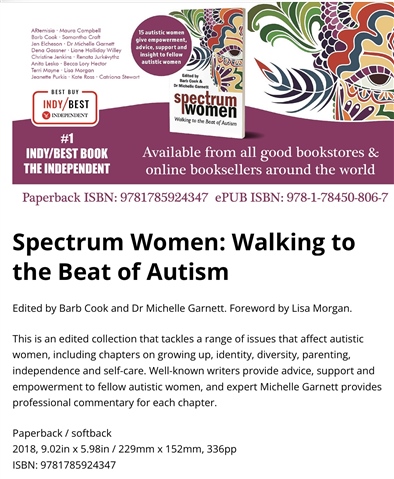
  • Ah right, it mightn’t be the best book for you. Its publishers, Jessica Kingsley Publishers, have some other good books dealing with autism and related issues.

  • Thanks Jalapeno, and no worries at all - I'm more just seeking out if anyone else struggles with the same things and if they have anything that helps them deal with those struggles.

  • Thank you for taking the time to write out all of these points! I think after reading these, a couple of things that come to mind about what I should work on more is planning/scheduling ahead (my partner's suggested the same a bunch of times but I never properly gave it a go, beyond starting/stopping a few times), and being more open to suggestions and ideas of others. I think I'm usually alright with the latter, but maybe subconsciously I'm not Sweat smile

    I'll keep this reply in mind in case anything else pops up. Very much appreciated!

  • Thank you! I'll have a browse for some older posts regarding this stuff. And thank you for the book recommendation - I'm AMAB, identify as he/they, but I'm sure there could be something helpful there, so might give it a look at some point!

  • Hello and welcome to the community.

    I share some of your difficulties and I found useful information on this NAS website and old posts on this forum. Many of the things you describe have been covered. I also searched other autism charities online and read quite a few different books, the most useful for me as a woman in her 60s was the book below. 

  • In reply to your points:

    - I also find it difficult to cope if I don't get enough sleep. I find it's usually when I have things on my mind that I have to do,that it's difficult to get to sleep. I find reading can help, and also a small snack about an hour before getting into bed. I can also be impatient when I can't do things at the moment I want to - I use planning and mindfulness for that - for example, asking others what their plans or ideas are and working out a plan that means we're ready to do things at the same time, or reminding myself it doesn't matter if I can't do something just at a certain time and thinking of something else to do until I can.

    - Mirroring emotions is common in autistic people - it's known as emotional empathy and I also experience it. You could try talking about something else or suggesting an activity to do together that will lift both your spirits.

    - Mundane tasks are boring, and I think everyone puts things off at times, autistic or not. I find that writing a schedule for tasks that need doing, or putting them on my tablet calendar with a reminder, can help.

    - Its common for autistic people to struggle with unexpected change. As in my reply to your first point, I try to use planning (to expect the unexpected, or what I'll do if...) Or mindfulness. And have a rest later to recuperate from the stress.

    - I don't get into arguments much but if I do I try to argue using facts, and if I don't have facts pointing out that what I'm saying is just my point of view. If I have strongly different opinions from others I don't bother seeing them, as I think arguing is mostly a waste of time when I could be doing something fun.

    - Not listening properly, interrupting (or wanting to interrupt and feeling like I'm going to burst) plus steering conversations to my interest is also something I've done most of my life. Now I'm retired I don't speak to many other people, but I still find my mind can be wandering off when I'm supposed to be listening. I'm not sure how to stop this, but I don't think it's a bad thing to talk about your own interests as long as you look out for other people getting bored and ask their opinion or thoughts on stuff.

    - Most people only have a small number of interests. I think Neurotypical people mainly have "typical" ones such as sports, celebrities, cooking, gardening, pets, clothes & beauty. Autistic people tend to have less "typical" interests but if there are typical , such as football, it will be more intense and they will have a wealth of data about football scores, players etc. We can therefore be seen as "experts" in our fields of interest, which I feel is a positive thing. If you want to try something new, perhaps research it first?

    - Difficulty describing and regulating emotions are autistic traits. It's good that you've started to recognise when you are getting over stimulated, so try to keep working at that and plan breaks between potentially demanding activities.I

    - Long term planning: see my ideas re mundane tasks.

  • Hi Dotpoo - obviously we can;t diagnose  / give medical advise on here.  

     I identified with much of what you wrote and recently late diagnosed Mid 50s - so take that as you may be on the right track. 

    I do wonder what it would be like to have diagnosis sooner and it was only when I was near or at burn-out.   I don't usually do pod-casts but will look out for that on Spotify - thanks for the recommendation.

    All the best for your assessment

  • Hi and welcome to the community. I will respond in more detail to your questions later when I have more time.