Different not Broken

I haven’t been on here much the past week so apologies if this has been posted before:

https://annsautism.blogspot.com/2019/05/autistic-people-so-new-research.html?m=1&fbclid=IwAR0EGamhKSl_MBHXtRCrnqLuHKZO7S8NSefVQdMXEr_beIQmyKeDtWQAD94

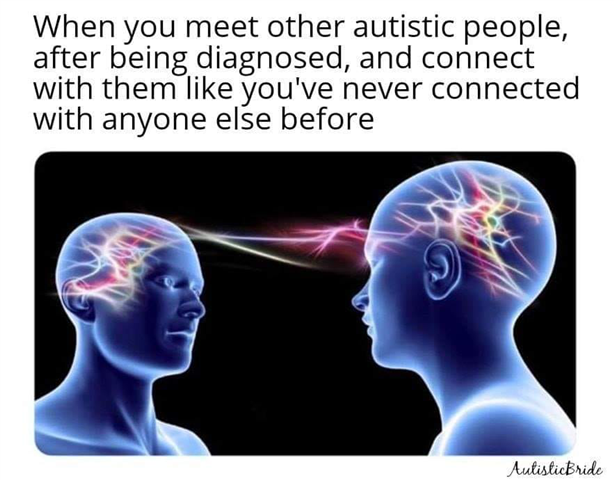
See, we do have effective social communication! It’s just different from that of non-autistic people. This is why it works so well when we are friends with other autistic people!
Don’t get me wrong, I have non-autistic friends and they are lovely people. But this article helps to explain something that I’ve been noticing for some months. That when autistic people are together in a friendship group, they actually appear ‘normal’, because when you’re spending time with and talking with people who’s brains work the same way as yours, it is normal! I get such an enormous sense of validation from speaking with my autistic friends, I finally have social mirrors, it’s not ‘just’ me!

  • both Kitsune and breadpud have left. Kitsune still has her own autistic group on facebook which meets up for real. 

  • It really would be better though.  Imagine if everything was done logically, honestly and carefully?  *heaven*

  • Thank you Blush I’m glad that you also experience the same sense of connection with a possibly autistic friend.

    I’ve read before that some people do believe that we are the next step in human evolution.

  • A heartening read. I have a friend who I communicate very well with. I really feel a same wavelength with. It is very balanced and I'm interested in his life. There's a possibility he's on the spectrum but he's not interesting in pursuing it. I don't pursue friendship because I can be quite about me alot and have difficulty trying to take an interest in other people's lives.

    Recently I was fantasizing that AS people are the next step in human evolution and felt the world would be so so much a better place. 

  • No offence taken! I think perhaps I have a few autistic friends that I am close to where I feel that I am tuned into and on the same wavelength as them. I’m not saying that it will happen with every autistic person because it won’t but what I am saying is that the likelihood of it happening with another autistic person is greater than with another autistic person, simply because our brains are wired the same way.

  • Slightly contradicting this, I don't feel I'm on the same wavelength with an autistic friend of mine. When I talk to her online, everything is fine. However, when I talk to her in person, the conversation is very one-sided and is all about her. But maybe I don't feel on the same wavelength as her because I have (suspected) 'mild' autism, whereas perhaps she is more autistic than me

    I hope this doesn't offend anyone

  • It’s like we have an in built sub conscious radar, since my own diagnosis, one friend has been diagnosed, one has self diagnosed (I’m sure she is though) and there’s a couple more that I’m pretty sure are on the spectrum.

  • I totally ‘get’ what this article is saying. When I’m with my autistic friends, it’s like we’re on the same wavelength. There’s something refreshingly genuine and authentic about friendship between people who can tune into each other a lot better than people without the same neurodiversity.

  • That's impressive how he could not get the same negative reaction from the dogs. He must have understood dog psychology really well from his obsession.

  • My son is now 11, but when he was a lot younger without even trying he would zone in on other children, who I would later find out were autistic.   It was like he had a razor, even when he was non verbal.  I found this interesting.  Also, on two occasions,  dogs that dont like people, did not react to my son who is dog obsessed...shocking their owners

  • Excellent blog post! I agree with and like this part the most:

    Shall we take a moment to shuffle uncomfortably in our seats, reflecting on the endless books, articles,training programmes and materials describe autistic people as deficient in social understanding? All recommending that it's the autistic people who do 100% of the changing?

    Actually, autistic people generally understood each other well.  We always have.  The problem is that the non-autistic people didn't understand us.


    And we didn't understand the non-autistic people.


    So, may I invite researchers, writers and trainers to take a deep breath, and decide to look anew at autistic people?


    What's needed is interpreters and social language experts.  Those who can skill both groups in the 'language' of the other group.  Those who can meet people from the other group and say, "You are wonderfully different.  I would love to learn your natural communication style, as a new language, a new way of interacting.  And I would love to show you our own way of communicating, which is different.  Together, we can learn not to misunderstand one another, and both of us can learn to communicate more effectively with one another.  Together, we can both learn how to be friends, colleagues, and do great things together."

    Can we do that? 

    I think we can.