Some deeper thoughts

I can see quite much disagreement around the spectrum. There are people, who say that autistic people with lower support needs shouldn't be actually diagnosed with autism. There are people, who get angry, that their diagnosis is not being taken seriously anymore. There are people, who get diagnosed just to have the information/ confirmation of their experience. (And its fine) I think, that it's not only about their lives. The more late diagnosed autistic people,  the more insights into the possible future of autistic children. It's always being talked about autistic children,  but very little about adults. I myself found another reason, to go through the process. Half year ago, I also shared that story here, my daughters teacher in nursery approached me and asked me if I would like to share my experience with one family, who's son is probably autistic.  I told her I'm also only probably autistic, it's not sure yet. But I agreed. I described my early development,  which turned out to be very similar to that boy's, my difficulties at school. I prepared that carefully, to not make my story dramatic, but useful instead. The boy got already diagnosed,  I'm awaiting assessment. His mom, who I talked to, expressed her gratitude for sharing my story and lending her a book about autism. So I think that late diagnosed or recognised people are not problematic (as many say) instead, they can help families to prepare and understand their autistic children better. 

When it comes to disagreements around the "what is autism and what's not" I can only say- it's duty of professionals, who work on it, to categorise this or that condition.  For me the most Important thing is having proper diagnosis,  that describes my difficulties correctly. I used to be misdiagnosed multiple times in my life and also mistreated. I think that the spectrum with levels of support needs make a lot if sense, especially because there are many people,  who tick the same list of symptoms,  but their needs change throughout their lives, and autism is a life long condition. 

If anyone has any thoughts about this topic, can share them with me.

Parents
  • I can really empathise with parents of autistic children with very high support needs, the constant battle with authorities and 24 hour care of often a non verbal child must be exhausting. 
    I’ve seen FB groups with parents venting their anger and frustration when they see many people with lesser needs being diagnosed as autistic. Most are able to work and have a near normal life, they must get very frustrated. Some online content creators make autism seem almost fun.

    No level of autism is given in the UK, I don’t know where I would fit in with levels, my childhood was mainly the 1970’s, very little was known about autism, other terms were used and people were institutionalised  often forever. I kept my head down and stayed under the radar. Anything from the norm was seen as bad behaviour and poor parenting.

    The DSM-5 is from the USA, levels are still used, from my understanding insurance providers use them to cost levels of care.

    Level 1 still states, requires support . I don’t know where I would be without my wife, we met at an early age, she makes sure things are paid, insurances get renewed. it became obvious at my assessment that I most probably couldn’t live alone, not because I’m lazy but because I just couldn’t cope, I was quite shocked. Instead of a level of autism, maybe it would be better listing what a persons support needs may be.

    Autism changes throughout a life so much, I’ve had periods when getting out of bed and getting dressed has been a win for that day, the outside world doesn’t see that. Periods of being non verbal, no one sees that either. We are very good at not telling anyone when we are suffering, we sometimes don’t have the language to explain it. Sensory challenges can change as well.

    A diagnosis of autism isn’t given easily, it is a lifelong condition, unfortunately for late diagnosed people, a lot of damage has already been done. By the time most get diagnosed,  they are exhausted and at a very low ebb. I’m nearly a year in from diagnosis, I’m really still scratching the surface of autism.

    Educating the world about adult autism would be a big help and not trying to cure it, it’s still too stigmatised, I said the other day that the world only sees autistic children, I wonder where the think we go to ?

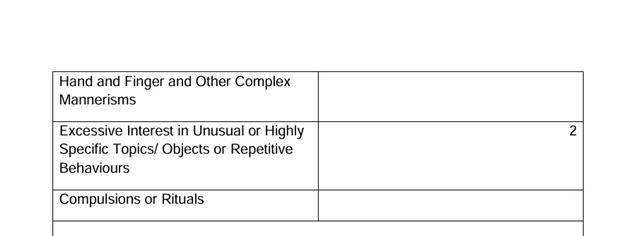
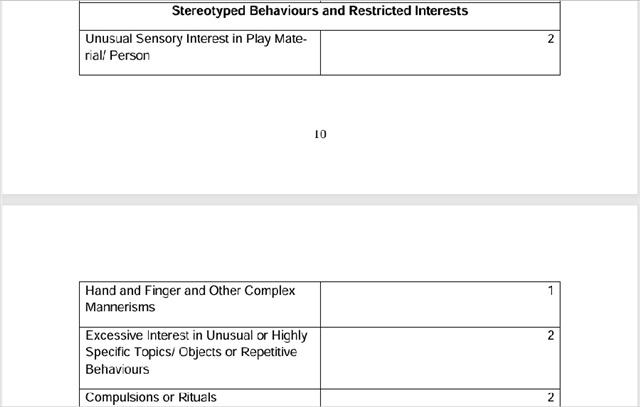
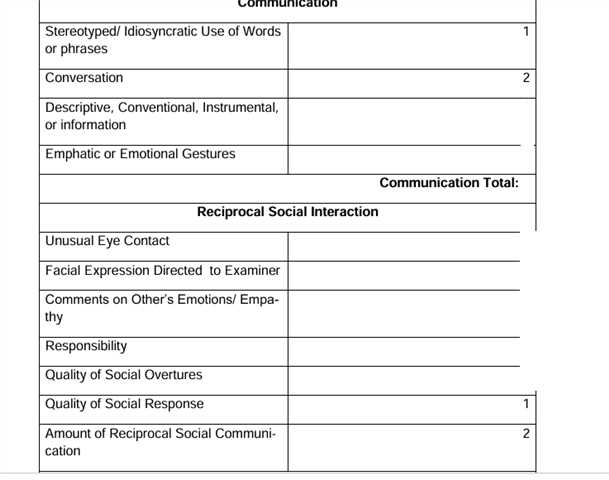
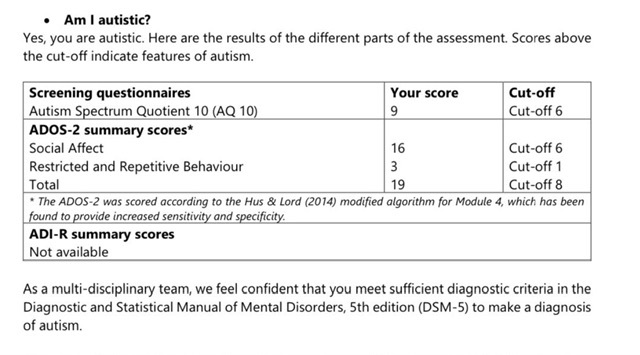
  • My autism ADOS scores with the NHS had individual levels scores for communication, social interaction, repetitive interests and others but no overall level but just a score. I like it this way, in some areas you may be more severe and some others less so. I found it helpful. I did ask overall what level they would say I say I was and they told me to. Being given a level for some allowed me to get OT help for sensory issues being level 2 and above on that. I shown one example, I don't know if yours was the same.

Reply
  • My autism ADOS scores with the NHS had individual levels scores for communication, social interaction, repetitive interests and others but no overall level but just a score. I like it this way, in some areas you may be more severe and some others less so. I found it helpful. I did ask overall what level they would say I say I was and they told me to. Being given a level for some allowed me to get OT help for sensory issues being level 2 and above on that. I shown one example, I don't know if yours was the same.

Children