


When I left school, we were expected to get a job, now everyone seems expected to have a career, why? It's not like everyone stays in the same sector, work morphs and some job types seem to disapear altogether.
When I left school, we were expected to get a job, now everyone seems expected to have a career, why? It's not like everyone stays in the same sector, work morphs and some job types seem to disapear altogether.

the most interesting people have worked in different jobs, they just have much wider life experience.
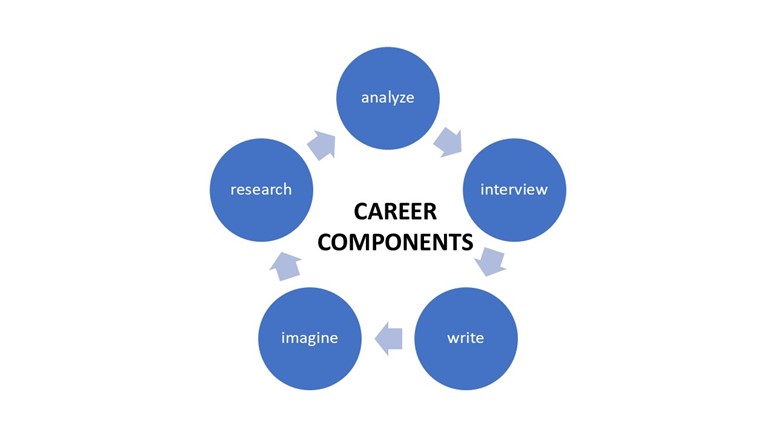
Yes, that's true and very comforting. There've been elements of every job I've had, including cathedral cleaner and security guard, I've really enjoyed; yet parts I hated - Practice Managers & team meetings in the NHS. Perhaps 'career' should not be perceived as focused on one field or role, rather than career advisors helping pupils find elements they might enjoy over a variety of jobs, not necessarily at the same time. I drew this as an example:
I remember when I was a kid there was this song that came out that was someone talking positive things -I've had to look it up, it's "Everybody's Free (To Wear Sunscreen)" released in 1997 by Baz Luhrmann.
There's a line that always struck me
I had a 'career', though going backwards in it now, but I always thought the most interesting people have worked in different jobs, they just have much wider life experience.
When we were younger, me and my husband might sometimes socialise with other people from work and it was always exciting to talk to people's partners who had real life jobs outside the games industry.
I do think there is a difference. Getting a part time job during school/university is unlikely to be a career. A career to me is something you instead to stick at for a long time, usually with aims to progress.
Shades of Educating Rita!
Yes, that was very reflective of how it was. I loved that film and watched it many times.
I never knew this had been widespread until relatively recently. That too was very isolating, as you couldn't talk about it - there were no forums, as you say. I agree about unions. I was delighted when things like women's football came about. It was unimaginable in my early life. Also, women engineers. Can't help being wistful. But at least we are freer now, more constrained by money than anythig else!

Totally that film was true to the lives of many working class women.
there was such a massive feeling that if people "like us" got educated we'd leave the family and wouldn't want to know them anymore as we would of become "posh".
Shades of Educating Rita!
My Dad went mental when I went to uni aged 42, he really didn't see the value in it and it was something completely "other" to him. I would never have been allowed to stay on at school even if it had been an option, there was such a massive feeling that if people "like us" got educated we'd leave the family and wouldn't want to know them anymore as we would of become "posh".
One of the things many people don't realise was just how loaded against women the system was, not just in the attitudes of friends, family and employers, but educationally too. The 11+ passes were skewed so as more boys than girls passed, all to maintain the illusion of male intellectual superiority, so thousands of girls were never allowed to reach their full potential.
I remember all the "you deprived a man of a job" stuff too, what was worse was it fromm people who should have been on "our" side, like trade unions, they totally ignored women until Thatcher reduced the manufacturing base so much that they needed women in order to survive. I'm still distrustful of trade unions to this day because of it, especially the older generation like Len McClusky for example, I know he's retired now as are so many others, but they were quite happy to sacrifice women on the alter of "up the workers", but which they meant men.
I'm still learning about jobs at 51 I never knew existed
Yes, I wish I'd known there were so many private archaeology firms across the country.
If you were working class there was a ceiling that was hard to break through, especially if you were female.
Yes, there was a lot of prejudice. Females were expected to work in offices or marry and have babies. My father was in disbelief when I wanted to be an engineer. I had no encouragement from either parent. When I got a job as storekeeper/buyer in a hospital engineering stores, some of the men said I'd, 'deprived a man of a job.' It took four years to get accepted. I really enjoyed that job as it was so varied, especially when I was accepted as, 'one of the hands.'
I remember a careers advice day at school,
There was one of those at mine. I missed it, and there never was another. No one would put up with this lack now. I'm glad people get more advice and support.
there was a generation who never had a chance
Indeed. It was not only money but you never considered yourself capable as a working class woman to go to Uni. It was a dream place for aristocrats or the super intelligent, so I thought.
for whom going to college for more qualifications was never mentioned, we were factory fodder who then became the "underclass"
Yes, that's how it was! I was shocked when I finally got to Uni and passed MSc age 54. My parents had died by then so I couldn't wave it under their noses.
I was much the same as you Marianne, I bounced from ob to job, although by the time I left school jobs were becoming harder to find and there was quite a bit of unemployment. I wonder if it was a class thing? If you were working class there was a ceiling that was hard to break through, especially if you were female.
I remember a careers advice day at school, it was after we'd made "our" choices for O levels or CSE's, so it was more a case of telling what we weren't going to do rather than what we could do. For many our exam choices weren't ours they were our parents or more likely teachers choces for us. It was expected that we'd leave at 16 and have a job until we married and had children.
For me careers started in the 1980's, they were suddenly something we were all supposed to have as Thatcher destroyed manufacturing and encouraged a service economy. So I think I didn't so much get left behind as never had a chance to start. If jobs are what you do to pay the bills and a career is what you want to do and has progression, the there was a generation who never had a chance. It wasn't the computer said no, it was, the class system that dictates how educated you may become and discriminates against you because of where you come from that said no. I know there were a lot of people who did succeed, but there were a hell of a lot of us who didn't, who were held back, for whom going to college for more qualifications was never mentioned, we were factory fodder who then became the "underclass"
Great question TheCatWoman Whether its job or career if you are lucky enough, 'to do what you love you - will never work a day in your life'. I think a job for me is about doing the social basics, bills etc... a career is progression within a specific job you enjoy, excel at or both.
Because somewhere along the line it became you can do anything you want and progression is a sign of success, aka career, work up the ladder and you have success, or get a uni degree and start higher up.
It's a load of rubbish, always has been
So few end up in jobs they thought they might want to do, I'm still learning about jobs at 51 I never knew existed
It's not so easy to just flip between jobs, industries as it used to be, even minimum wage jobs all day need some kind of qualification or experience
we were expected to get a job
This is a really interesting question. I never knew of 'careers' until a decade ago. From a working class background, 50's and 60's, you simply got a job and 'went to work.' It was easy to leave a job, get an interview and start a new job the following week. I did this for decades [as did many girls] - over time working as a cleaner, 'temp', engineering store-keeper, security guard, library assistant, NHS counsellor, sales assistant selling power tools in a big DIY chain, author, PA. I changed jobs whenever I became bored, neither myself [nor anyone else] recognising I might have pursued a single 'career' rather than a scattergun approach. This lack of linear progress used to bother me until recently. Looking back, I can think of many 'careers' I might have had - archaeologist, librarian, archivist; but I was never confident enough, also lacked support and money to study.
Recently, I've begun to consider these jobs as pearls, all equally valid, strung together as, 'life experience.' Does it matter? Well, from a financial perspective, yes; I might have earned more, leading to a larger pension. From a 'life experience' perspective, no. I met so many interesting, kind people as a security guard and sales assistant, for example. Conversely, many NHS professional colleagues, in a highly stressed/under funded department, were hostile and suspicious. A lot was to do with autism, no doubt: it is hard to plan a career if you have to spend a huge amount of time and energy interpreting irrational people!


