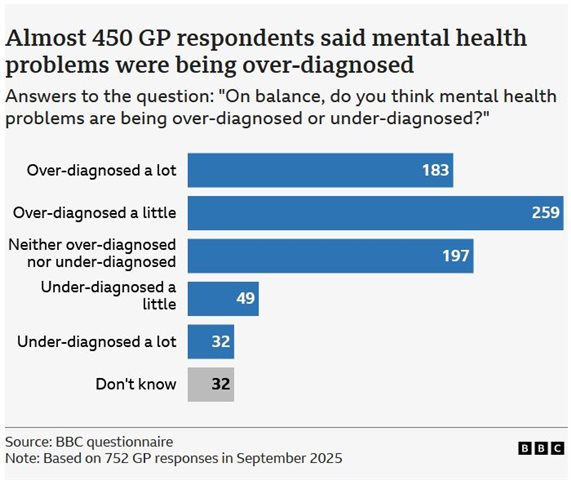
GPs believe that mental health issues are over-diagnosed

The BBC just published an article that says:

'Life being stressful is not an illness' - GPs on mental health over-diagnosis

Of the 752 GPs who took part in our research, 442 said they believed that over-diagnosis is a concern. More said mental health problems were over-diagnosed by a little than over-diagnosed by a lot. 81 GPs who responded felt that mental health problems were under-diagnosed.

https://www.bbc.com/news/articles/cx2pvxdn9v4o

I believe that around 10% of GPs were approached with the questionnaire although only 2% of GPs responded.

I wonder how much of this will influence the governmnets current policy considerations towards neurodivergent people.

<edit> I'm trying an edit to the original post to see if this will clear the error message that is stopping people seeing the replies<>

  • 'Life being stressful is not an illness' - GPs on mental health over-diagnosis

    Yes, I read that. I think it is true. Kids ought to be taught about coping with 'normal' life and also about stress. Everyone ends up stressed, it is not recognised, then things like bullying start [blaming someone else, taking out anger and frustration on a person/animal /destroying something/ getting angry about a 'cause' that normally they would not care about].

     I do wonder about autism being considered 'over diagnosed' as part of this theme of over diagnosis, but nevertheless I think it remains a truism. But GPs will be afraid to tell patients they do not have a mental health problem, because they risk losing their job if someone commits suicide. Suicide is not just to do with mental illness but stressors not dealt with. It is a growing problem that needs far more research.

  • Most of us are mentally ill. Most of us it’s hidden disability. Gps should stop handing out MH medications. It would be cheaper for the government to make stop purchasing psychiatric medications and use the money to make everyone eat healthier fresh food and shutdown social media that allows vast amounts of harm. 

    If visual content was removed. Social smearing activity was removed. Nurturing content was increased. Different countries blocked unless they had a special encryption key to access to speak to family or friends and share good information. Reduction in society social content and overwhelmed with good safe reliable health and fitness and safety and education content. Wipe out all the darkness online and the darkness of how people treat each other. 

    Then we would have a Significant reduction in MH. We would be healthier, Safer, less psychologically abused etc.

    All forms of media including BBC etc are creating content that is harm.

    The government knows that sleep, good nutrition, safety, good hygiene, social friendliness etc all make people lives better. 

    instead they create harm.

  • not to invalidate anyone's experiences but im inclined to agree to some extent.

    I've had life long complex mental health condition and lots of friends with mental health conditions. so, im not an expert except annecdotally.

    I've noticed that a lot of current thinking is to label and treat the symptoms without really considering the cause. its often not helpful and often invalidates the person's experience by suggesting the problem is them. society needs to take a proper look at what the underlying external factors are that affect resiliance and work out how these can be better managed globally to prevent people getting ill.

  • But GPs are not experts in mental health, the clue is is in the name

    Only 10% of GPs were approached and of them overwhelming majority said they thought it was over-diagnosed. Very few thought it under diagnosed. See the graph on the article (may not be visible for mobile phone users I think).

    Statistics can be a bit consusing but I find such visual representations easier to understand.

    GPs are not experts in mental health

    They are out gatekeepers to accessing any NHS support or diagnosis though which is why their opinions are very important. I agree with everything else you say here.

  • If it's only 2% who responded you could question whether it's representative. It could be it was mostly those who had doubts who replied, in which case the other 98% think there is no issue.

    only 10% of GPs were approached and of them overwhelming majority said they thought it was over-diagnosed. Very few thought it under diagnosed. Here are the stats:

    Statistics can be a bit consusing but I find such visual representations easier to understand.

  • If it's only 2% who responded you could question whether it's representative. It could be it was mostly those who had doubts who replied, in which case the other 98% think there is no issue. Or it could be 98% don't know.

    But GPs are not experts in mental health, the clue is is in the name. They are mostly focussed on childhood illnesses and visible physical problems that can be seen in 8 minutes.

    Communication differences (flat affect, understatement) and masking can put some at a disadvantage, particularly since body language and facial expression are a key feature of how they judge.

    But 2 things can be true:

    1. It can be over-diagnised
    2. They can miss people

    I mentioned to both my psychologists that it is interesting that often those that really need help think they don't. Minimisation of your own issues is not uncommon, particularly if you've struggled for a long time and normalised things.

    Also, Doctors who have encountered a few "worried well" or people exaggerating may be less sympathetic to genuine cases.

    It is not something that is easy, since there are few objective tests, which is why it is a specialism. So I have done sympathy.