Angels

Does anyone believe in angels?

What do you believe them to be?

What about nefilim, the half human half angel hybrids that the Great Flood from the bible was supposed to have wiped out?

I find the whole subject fascinating, quite a few cultures have angels in thier religious beliefs, some of them not from an Abrahamic tradition. 

As someone said on another thread, do angels have the equipment to procreate?

Lucifer who was said to have been cast out of heaven by god along with his followers and went to hell and became the devil and demons etc, did hell already exist? Was it vacant when Lucifer took up residence there? A Lucifer figure appears in many religions and myths to, whats-his-face being punnished for giving humans fire and the other one who pushes a rock up a hill everyday only for it to roll back down every night and the one who has his liver pecked out by and eagle on a daily basis, why do we need these transgressive figures who appear to want to aid human development only to be punished by god who seemingly dosen't want us to develope?

There are also lots of myths about Watchers, Grigori and others who are the decendents of the Nephilim and keep watch ove rthe earth and certain individials and maybe bloodlines?

  • I personally believe in angels and God! I also believe they are workers for God who were born in Heaven I guess. I believe in guardian angels but I do believe humans who go to Heaven when the time is right don’t become angels themselves as apparently they are different specials but have human like forms plus the wings! However I’m worried I’ll be viewed negatively as I am left handed and I believe Lucifer is as well 

  • Are you meaning angels were white skinned? I see other posts are interpreting yours as meaning that. Your post made me think of white stone statues outside churches.

    Yes, many images of Jesus showed him with white skin, blue eyes and blonde hair. Nowadays thank goodness, we have more images of a black Jesus, Joseph and Mary. 

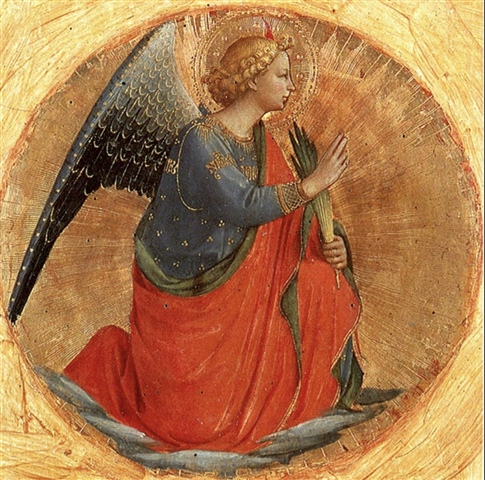
  • There are some statues of angels in white outside churches in Ireland, Britain and Europe, but many more images of angels are portrayed in (originally) strong, bright colours such as red and gold within church buildings, in paintings in art galleries, museums and grand historic homes. 


    Fra Angelico c.1437 From a triptych of the Annunciation Perugia

  • I don’t believe in angels, but I am interested in how beliefs, images and ideas about them have been formed through religion, written texts and art.

    In the Old Testament of the Christian Bible, the Hebrew word for ‘angel’ appears over 200 times and the Aramaic word for ‘angel’ appears twice. 

    I can’t find any evidence in the Bible suggesting that angels procreate. 

    When I was a child I thought angels were girls in gold and silver glittery dresses. It was a shock to discover they were neither male nor female, yet often referred to as “he”. They did appear under the guise of two human men in the Bible. 

    I have copied this extract of how some Biblical theologians understand angels.

    When the Old Testament was being composed, neighboring nations already had literary and artistic conceptions of spiritual beings with wings, known as cherubs or sphinxes. Winged Assyrian statues with the head of the king and the body of a lion or bull were used to guard entrances to important secular or sacred buildings (e.g., temples and their gardens) and to proclaim the king’s divine status among the council of the gods. This probably explains the statement about the king of Tyre in Ezek 28:14a, “You were anointed as a guardian cherub [כְּרוּב‎ (keruv)]” (NIV).

    The Renaissance depictions of angels are more like the cherubim of the Old Testament; the kāribu was an intercessory priest or a guardian spirit often sculpted as a mythical gatekeeper (HALOT 497). Like the Old Testament, messengers are sent from God, the gods, or human heads of state. Being commissioned by a god does not necessitate a spiritual being, unless the context suggests this specifically:

    • A Phoenician text from the third century bc mentions a messenger of one of the deities, who served as this god’s representative.

    • The Keret legend from Ugarit (also the Phoenician region; 1500–1200 bc) adds a suffixed -m to ml’k to indicate duality, the sending of a pair of messengers.

    • Aramaic literature from the eighth century bc describes the “messenger” as an ambassador-like negotiator between kings (TDOT, s.v. “מַלְאָךְ‎, mal'akh”).

    The English translation “Angel” in the New Testament is always a rendering of ἄγγελος (angelos); this is not a true translation—it merely anglicizes the Greek letters into English. This same Greek word is used to translate “messenger” (מַלְאָךְ‎, mal'akh) in the Old Testament. A human or heavenly messenger in the Greek Bible is ἄγγελος (angelos), whereas we (in English) distinguish “angel” and “messenger.” New Testament uses of ἄγγελος (angelos) are:

    • “[Human] messenger, envoy, one who is sent.”

    • “Heavenly spirits” of whom some are “guardian [messengers]” (Thayer, Greek-English Lexicon, 5).

    New Testament “messengers” (good or obedient angels) are called:

    • The angel

    • His angels

    • The Angel of the Lord

    • Angel of God

    • Angel of the church

    • Holy angels

    • An archangel

    • My angel

    • Elect angels

    The good angels are sometimes further described as “mighty,” “in heaven,” “from heaven,” or “from the temple in Heaven.” New Testament messengers may be sinful or obedient. Three times, “his angels” is used in conjunction with the Adversary (or Satan; called the ancient Serpent Rev 12:7–9 or the Devil). Bad or sinful “messengers” are:

    • An angel of light (Satan)

    • Angels that sinned

    • Angels that left positions of authority

    • Angel of the Abyss

    Sometimes “messenger” is neither “angel” or human but an illness. Satan has “messengers” (Rev 12:9; 2 Cor 12:7) but is never named directly as an Old Testament or New Testament “angel.”

    Marlowe, W. C. (2016). Angel. In J. D. Barry, D. Bomar, D. R. Brown, R. Klippenstein, D. Mangum, C. Sinclair Wolcott, L. Wentz, E. Ritzema, & W. Widder (Eds.), The Lexham Bible Dictionary. Lexham Press.

    For me, the Nephilim are much more interesting than angels. According to Francesca Stavrakopoulou, in the Old Testament Book of Genesis, they seem to have come about when the sons of God (minor deities thought to be a remnant of a text related to the source of a Mesopotamian myth) are unable to resist the allure of the daughters of humans so they have sexual intercourse with them. The girls give birth to the Nephilim who are semi-human/semi-divine beings, but are portrayed elsewhere in the Bible as ferocious giants. Stavrakopoulou argues that this account is a version of a longer form called “The Book of Watchers”, in which the Watchers descend from heaven to have sexual intercourse with the women, but they spoil their holiness because the women are human rather than divine beings. However, the women find it enlightening because the watchers give them divine secrets so they can harness the power of the cosmos and they can make and wear their own magical jewellery. The Nephillim born to the women go around devouring humans, but the archangels (senior angels) Michael, Sariel, Raphael and Gabriel ask God to intervene, so God floods the earth in order to obliterate corrupted life forms. Stavrakopoulou, F. (2022) God an Anatomy. London:Picador. 


  • Examples of Christian Ethiopian Art (15th century CE onwards) including angels.

    https://smarthistory.org/christian-ethiopian-art/

    I highlight: the Archangels Michael and Gabriel, late 17th century (Early Gondarine).

  • If you look at painting in places like the Hagia Sofia all the people are brown skinned with dark eyes and hair.

  • Mostly because they were painted by white people, I guess.

    That seems the prevailing opinion. Whitewashing the history of the church.

    I suspect if they could make a decent comic book adaptation of the bible and make the characters of a race to suit the specific audience it is aimed at (ie multiple versions) then it would have a lot more people reading it.

    I have to say, it is one of the hardest books to get into that I have tried.

  • Even God and angels are almost always white. Odd that.

    Mostly because they were painted by white people, I guess.

  • angels have changed a lot over the centuries

    Its odd that almost all the saints, angels and other historical figures are prodominantly portrayed in religious iconography as white.

    Jesus and the people around him were all middle eastern and quite a few historical saints were African but stil end up as white in iconography.

    Even God and angels are almost always white. Odd that.

  • I'm interested in them from an historical perspective, angels have changed a lot over the centuries, the Victorians made them all dressed in white and of course blond haired, but many early representations show them as hainv multicoloured wings.

    I'm also interested in the different types of angels, churubin, why are they alsways depicted as chubby baby angels, seraphim etc what do they do?

  • I’ve been to spiritualist church’s before, they are not of a set religion as such but it’s closely linked to Christianity usually. I cannot say how they know the information they know but some of the mediums are particularly good at picking out information they couldn’t possibly know. It might be names, descriptions of people that have passed or even a current problem you may be facing. If this is not proof of a higher power then it’s some very clever psychological technique to be able to read so much about someone without meeting them before. 

  • No, I don't believe in them but I find stories about them interesting. I enjoyed the TV series Lucifer.