Neanderthal Fingerprint

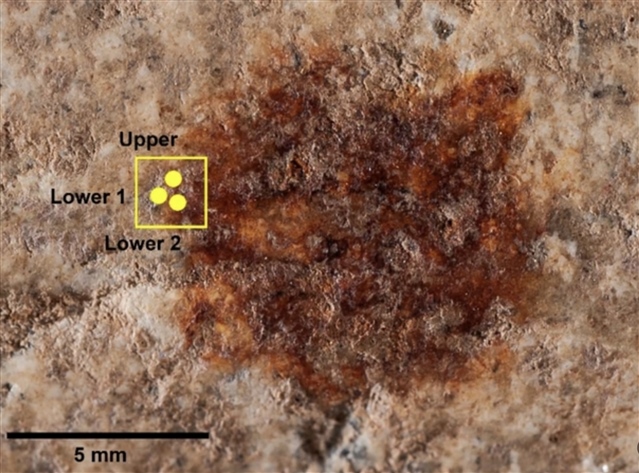
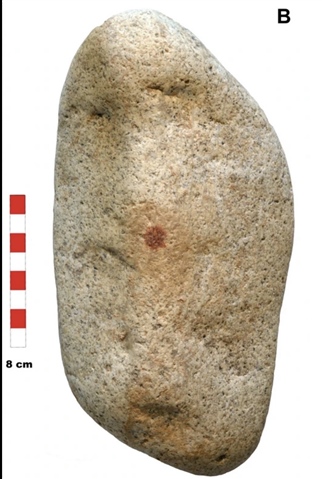
A Neanderthal fingerprint has been discovered on a pebble from Segovia, Spain. Dating to around 43,000 years ago, the dot of pigment was applied by a finger tip and it may be indicative of symbolic behaviour, ie, portable art, rather than accidental. 

‘Pebble figurines’ of the Neolithic are well known in the Levant and other parts of the world. They are commonly incised by Homo Sapiens, but traces of pigment, if used, do not remain.

Could this Neanderthal pebble be a ‘Pebble Figurine’?
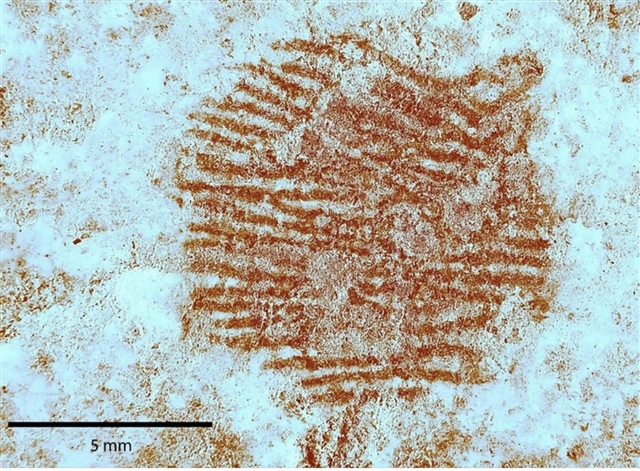
            

More than a fingerprint on a pebble: A pigment‑marked object from San Lázaro rock‑shelter in the context of Neanderthal symbolic behavior

David Álvarez‑Alonso1

M. de Andrés‑Herrero1

M. C. Sastre Barrio4 

M. Á. Maté‑González5

Andrés Díez‑Herrero2

S. Miralles‑Mosquera3

E. Nieva Gómez4 · M. R. Díaz Delgado4 · E. Ruiz Mediavilla4

Received: 11 March 2024 / Accepted: 5 May 2025

© The Author(s) 2025

https://link.springer.com/content/pdf/10.1007/s12520-025-02243-1.pdf

Parents
  • It is impossible to confidently impute intentionality on something so ambiguous. Modern peoples use ochre mixed with fat or oil as body decoration, hair decoration or as a sun-block. Neanderthals could have used it for the same purposes and the fingerprint be entirely incidental.

  • The pebble was carried intentionally from the river bed to the rock shelter so we know that it served a purpose, albeit likely different to the other pebbles that were incised and of a different size. The authors of the article argue that the pigment was applied intentionally. I agree that the evidence suggests this is so, but without more stylised or incised facial features, we can’t interpret it definitively as a ‘pebble figurine’, although that hypothesis can’t be ruled out either.

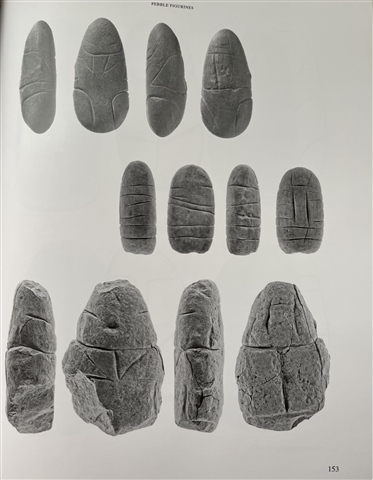
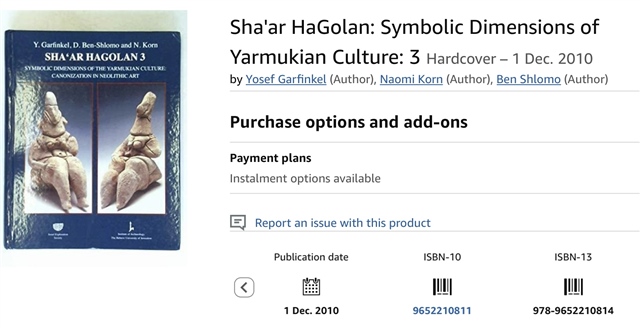
    Here are some incised pebbles in the Museum of Yarmukian Culture at the Neolithic site of Sh’ar Hagolan. They have been interpreted as ‘pebble figurines’. Around one hundred of these incised pebbles were found at the site. It’s a long jump from 8,000 years ago to 43,000 years ago, yet Neanderthal people would have been capable of this sort of thing.

    https://www.myc.org.il/en/the-museum-of-yarmukian-culture/

Reply
  • The pebble was carried intentionally from the river bed to the rock shelter so we know that it served a purpose, albeit likely different to the other pebbles that were incised and of a different size. The authors of the article argue that the pigment was applied intentionally. I agree that the evidence suggests this is so, but without more stylised or incised facial features, we can’t interpret it definitively as a ‘pebble figurine’, although that hypothesis can’t be ruled out either.

    Here are some incised pebbles in the Museum of Yarmukian Culture at the Neolithic site of Sh’ar Hagolan. They have been interpreted as ‘pebble figurines’. Around one hundred of these incised pebbles were found at the site. It’s a long jump from 8,000 years ago to 43,000 years ago, yet Neanderthal people would have been capable of this sort of thing.

    https://www.myc.org.il/en/the-museum-of-yarmukian-culture/

Children
  • Exactly! What do these ‘figurines’ mean to the people who handle and view them today? Are they mythical goddesses or fairies? Imaginary sisters, role models, fashionistas or princesses?

    In fact, some of the world’s leading material culture archaeologists and anthropologists have discussed how people understand and use these modern ‘figurines’ such as Barbie dolls, and Disney themed dolls. For the handler, miniaturisation of human like form imbues the figurine with power. 

    Our brains function in much the same way as our early ancestors. The huge numbers of figurine and partial figurine finds from every century, all around the world show that people have had a long lasting and enduring fascination with figurines and they can view them in a multiplicity of complex ways. 

  • I'm always struck by just how ordinary these people are. I saw one archiologist put a baseball cap on the reconstruction of a neanderthal face and I thought to myself "haven't I seen him in sainsbury's." It's a reminder of how much of what makes us us is our technology. If tomorrow all the world had a powercut how long before most people are back to painting cave walls. Not long I'd wager.

    We are still making little sculptures of women to decorate our living spaces with for sure.

    I wonder what future archiologists will make of these.

  • To say there is a large gap in years is an understatement. Geographically, I don’t have enough knowledge of Neanderthal movement, but I agree, combined with the age, it would be unlikely.

  • Yes the pebbles are quite unalike. I thought the Neolithic pebbles would just give an idea of what humans were doing as part of daily life, be it for a potential functional purpose such as goddess veneration, magic, gaming etc, or as artistic expression, or both.  The Neanderthal pebble with the dot isn’t aesthetically pleasing to my 21st century eyes either. 

    I love that a 43,000 year old fingerprint exists, that it is possible (for some) to touch the same pebble that an ancient Neanderthal has touched. 

  • Also Sha’ar Hagolan is a hell of a long way from spain. It's not very likely ritual practices and art spanned uniformly across such a large region.

  • I grant you the pebbal in th top left looks somewhat like the middle pebbal in your last picture but if so it (the middel pebble) is clearly unfinished. The rock with the dot (1st picture) doesn't look like any of them and tbh its uneven shape would make it unatractive as starting material or that sort of construction. the shadowing / shading apears to sugest the 1st rock has a centeral ridge upon which the finger rested as it was carried. Maybe it's just discolouration of the rock but that's what it looks like to me.

  • That is an interesting possibility, they must have had to test it somewhere.

    Would Neanderthals ever favour a more stylistic style of marking on the cave walls? Some of the cave art/markings are difficult to understand, never mind their possible function.

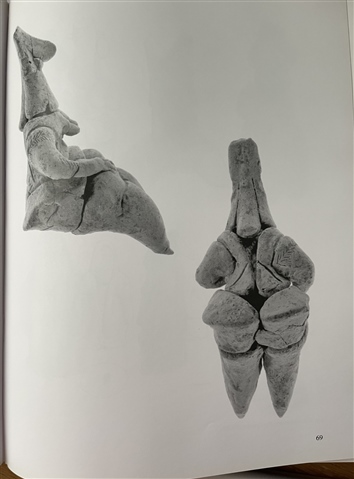
  • Iconographic analysis of 119 of the limestone pebbles has made the interpretation as a pebble figurine widely accepted by archaeologists. This is because the most detailed pebbles in the group bear a high degree of schematization which is believed to reflect the same image as that of the clay figurines from the same Neolithic settlement at Sha’ar Hagolan. Most of the figurines were found within the domestic setting.

    The most common interpretation is of a goddess, 

    Other interpretations have been been put forward, so your suggestion is a possibility. Others include toy, fertility object, and game piece.

    The photos below show three pebble figurines and on the right a clay figurine from the same site.

    https://whitelevy.fas.harvard.edu/publications/shaar-hagolan-vol-iii

    The book includes the photographs and analysis of each of the 119 pebble figurines at Sha’ar Hagolan, plus analysis of the clay figurines and zoomorphic figurines. 


  • It is a pale pebble, perhaps pale pebbles were used to test the depth of colour in an ochre mix, before it was used for another purpose. The natural Makapansgat pebble, a manuport dating to about 3 million years ago is much more suggestively anthropomorphic than this pebble.

  • Are we so sure those grooves weren't for wraping twine around or something like that. Could easily be a primative textile tool of some sort?