University philosophy courses: a bucketful of ethical sh*t

Full disclosure: I am a highly biased party that has no bearing on your individual positions. This is my rant, since I am about to fail 2 term papers.

I hate philosophy. I hate ethics. I hate the goddamn trolley problem, with all its false dilemmas and no real answers, and strutting along the moral high ground, when there are TWO EASY SOLUTIONS.

Oh no! a mysterious trolley is hurdling down a nonexistent track towards people I don't know. Solution number one: I AM NOT A TROLLEY CONDUCTOR. Solution number two: I SAVE THE PEOPLE I CARE ABOUT MORE.
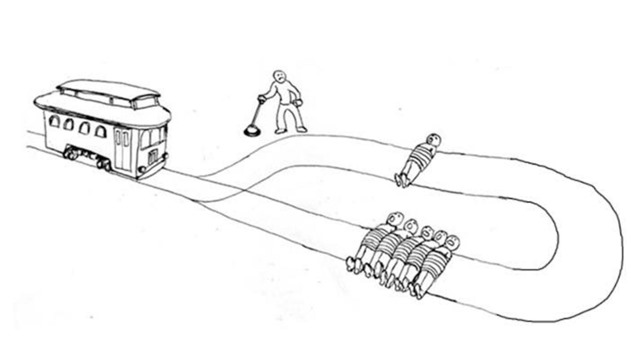
But seriously, this might just be me, since I have autistic friends who study/love philosophy and plan on continuing on the philosophical path of higher education, could prattle on about Socrates or Kant or Hume or whoever forever and ever. But I SIMPLY. DON'T. GET IT. Why do philosophers use so many air-headed words to say so very little. Most of my books are just empty space taken up by aristocratic armchairs who liked pontificating over the simplest quandaries. I write what I think is the most obvious response to the essay prompts, and receive a subpar grade, unlike all of my other classes, where I receive high marks. When questioned, the teacher simply replies, "You didn't pull from the material." And when I reply that I, in fact, pulled directly from the material and his very own lectures, he sighs and tells me my arguments "had no base."

Um HELLO. I'm quoting YOU. Apparently there is a guide for people on which ethical rules are just assumed and which ones are brand new revelations, but I have more of a background in East Asian philosophy, which makes a hell of a lot more sense to me. So, I truly respect the field, I do, but I struggle so very, very much with understanding what the hell this man wants from me, why I should care, and HOW TO SURVIVE PHILOSOPHY AS AN AUTIST.

HELP. IT'S SO INCREDIBLY POINTLESS. I am tempted to drive my trolley right over the cliffs of remedial education. 

Love and confusion and JESUS CHRIST HOWWWW,

Max

  • The ‘game’ brings to light our ethical and moral decision making processes. Is killing by omission the lesser evil? In effect, you have said yes. Is it morally the lesser evil to save those you know from death, rather than those you don’t know. You can argue for yes or no. Philosophy addresses moral and ethical decision making in academia and in museum and conservation studies. Curators use philosophical arguments in choosing how and why they make particular items available for public viewing. E.g., think of Hitler’s writing implements or human bodies on display. Glorification or something else?  Curators have to discuss and argue for and against in these things, and well thought out arguments using philosophical frameworks are key.

  • You say that you hate philosophy and ethics.  Then the obvious solution is do a course in a subject you actually enjoy.

  • but that in itself is still a choice. The trolly problem is mostly pointless but it's one saving grace is it renforces the message inaction is still a choice.

  • My choice is to refuse to chose, this is a silly game and I refuse to play it, i'd ask questions about the sanity of the sort of person who engages with sort of thought experiment and certainly the sort of person who expects others to engage with it. I've been asked this question before and had some epic arguements about why I won't play.

  • You know if you tweek the lever just at the right time you can get the trolly to do the splits and kill them all.

  • My sympathies on your grapple with the trolley problem. 

    I am unclear if you are simply needing a good rant about not ‘getting’ it, or if you are seeking help on how to write something that will satisfy your tutor or examiner. If it is the second,  perhaps you could arrange an appointment with your tutor to go over some of the difficulties.

    the teacher simply replies, "You didn't pull from the material." And when I reply that I, in fact, pulled directly from the material and his very own lectures, he sighs and tells me my arguments "had no base."

    Your tutor or examiner is likely looking for you to critically examine and elaborate on why you make your choices in the moral dilemma of action v. inaction. You will get marks if you can illustrate your analysis of your moral and ethical thinking by using a framework of philosophical terminology and processes to argue for your own conclusion. 

    Apparently there is a guide for people on which ethical rules are just assumed and which ones are brand new revelations

    This would suggest you haven’t seen and understood the guide. If you are wanting to continue on the philosophical path, it would be beneficial to study or to find an alternative source to help you grasp and challenge your personal bias and moral and ethical decision making.  

    Solution number one: I AM NOT A TROLLEY CONDUCTOR. Solution number two: I SAVE THE PEOPLE I CARE ABOUT MORE

    Because the trolley problem has no satisfactory conclusion, you are forced to make a decision which shows personal bias. Some might be biased in favour of the utilitarian approach of saving more lives. What if you are against killing? You could argue through a deontological approach. Ultimately, the point of the problem is that you are forced to think of personal bias and the value of human life through the framework of philosophical reasoning. This has application for moral and ethical decision making within political, scientific, healthcare, technology and other spheres. 

    You already know this, so perhaps the bigger questions for you are why are you doing the philosophy course and what can you do about your situation to make things better? What is the point of philosophy for you? A rant is certainly a good start. 

    All the very best going forward.

  • Cheat,  delegate the problem to someone else who is better suited for this task, good managers do that.  Or get AI to give you an answer.

  • Hello! 

    I'm studying Philology and Linguistics, and I used to work for a company as a tutor some years ago, helping Philology students write their thesis. Philosophy is one of my favourite subjects in the field.

    It's not easy to understand philosophy. Philosophers don't just assume stuff. Philosophy is the art of logical thinking which leads you to conclusions about everything!

    Why do philosophers use so many air-headed words to say so very little

    That's the process! They have to analyse every argument and every possible concept so they can make conclusions.

    I AM NOT A TROLLEY CONDUCTOR

    In real life, you are! There are decisions you must make everyday. And philosophy teaches you how to think, so you can make better decisions. Slight smile