Of course it does, though I had the misfortune of listening to someone proclaim their lack of belief a few weeks ago. Here’s my response:[edited by moderator]
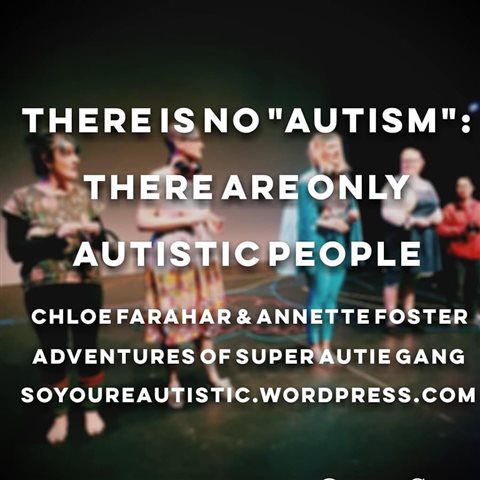
I prefer 'autistic person' over 'person with autism', though I'm not sure what you're trying to prove with the picture.
This quote in the picture above is basically stating that ‘autism’ is only a concept, a pathologising description of our autistic community which has only existed since the 1930’s, whereas our autistic community has existed and evolved throughout history. Autistic people have always existed without autism ever existing.
Also, the quote highlights that ‘autism’ as a thing is very different to lived autistic experiences. ‘Autism’ is a list of deficits (as described in the incredibly flawed DSM) whereas our autistic experiences are instead a different way of being human and experiencing the world. Using language such as autistic or autistic experiences helps avoid talking about our community as a subject and instead focusing on the similarities and differences between our communication style, sensory experience, monotropic cognition, emotional expression etc
Does this make sense?
Here is a video which goes into more detail about the important distinction between autism and autistic experiences:
https://www.youtube.com/live/YliO_uxSm-Q?si=6ltf3rpaOaHgvtb_
This quote in the picture above is basically stating that ‘autism’ is only a concept, a pathologising description of our autistic community which has only existed since the 1930’s, whereas our autistic community has existed and evolved throughout history. Autistic people have always existed without autism ever existing.
Also, the quote highlights that ‘autism’ as a thing is very different to lived autistic experiences. ‘Autism’ is a list of deficits (as described in the incredibly flawed DSM) whereas our autistic experiences are instead a different way of being human and experiencing the world. Using language such as autistic or autistic experiences helps avoid talking about our community as a subject and instead focusing on the similarities and differences between our communication style, sensory experience, monotropic cognition, emotional expression etc
Does this make sense?
Here is a video which goes into more detail about the important distinction between autism and autistic experiences:
https://www.youtube.com/live/YliO_uxSm-Q?si=6ltf3rpaOaHgvtb_
You are welcome! The quotation is very thought provoking as is the entire Aucademy YouTube channel.
Thank you for taking the time to explain. Food for thought.