
Have you ever questioned why music affects us so? I don't mean in the standard way of our explanations ('That song makes me happy'/'That song makes me sad'/'That piece of instrumental music reminds me of a certain time in my life' etc etc) but the very heart of it all, the strange thought-image language of music. How music 'achieves' expression, almost as if it needed to be heard as much as we need to hear it.
What is it about, say, a bending guitar-note that suggests sorrow or yearning? Why is distant, muted brass suggestive of urban wastelands or even of poignant, wasted regret? Why does the slow, emergent swelling of stringed instruments - moving from quietude to full presence - suggest overwhelming emotion coming to bloom? Or even resolution, in its suggested movement from personal resignation to determination? How is all this communication made possible, through the medium of our minds? And why should music so successfully speak to and for us? Finally, is it reflecting us...or might it be something beyond the mere interplay of human beings, the obviousness of the mutually-shared rhythms of our lives?
Every age uses the phenomena of its time - be it hydraulics or electricity or computers and so on - as models of explanation. So, in that spirit, is music a virus set only on propagation? Arguably, that in itself might imply a purpose of one or several kinds...
I think the solution is necessarily mysterious and complex, but still possible to begin to uncover. Your ideas are welcomed.
-------------
-------------
Roll the credits:
Thread inspiration courtesy of my NAS forum friends.
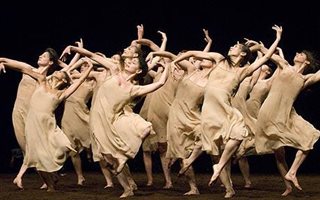
Photographs: Beatles fans, Huddersfield 1963. Dancers performing, accompanied by Stravinsky’s 'The Rite of Spring'.
Mr Steven's hair by Acme Explosions.
Teeth by Steinway Pianos ltd.
Numerous questions courtesy of Autism and poor education respectively.
Music courtesy of itself.