“Trendy” diagnoses

I’ve got some negative experience and also some thoughts. It’s about the self diagnosis in mental health conditions being not accepted mostly by professionals. 
There are various online tests - screening tools. AQ50, AQ10, RAADS, and many others. There are also tests for ADHD. These are screening tools, not designed to diagnose. When you fill out the test, you get the result. If your result is significantly high, you get a message- you might have xyz condition, it’s better to contact a mental health professional. What is the reality? If you fill out the test or even few of them and their results together point to this condition and you go to the professional, there is a high chance, that they will not take you seriously, there high risk of hearing the stupid  “trendy” comments about diagnoses that everyone wants to have, that you just want attention, you’re just lazy not willing to work on yourself, or laugh and question if you know it from TikTok. 
There is a huge ocean of information and also misinformation out there, we as non professionals often lack the ability to differentiate what is true, what is not, but it also depends on where do we look for the information. Social media is more likely to deliver us more misinformation than books, but it’s not all black and white. 
the truth is that we ourselves know best what we experience and a professional who questions that, who tells us “you are exaggerating, creating your problems yourself, or that “this is not a problem” erode our trust and make us more cautious about contacting them. I heard from a psychotherapist (psychiatrist and psychologist, with long experience, doctor, lecturer at a university) that lack of friends is not a problem when I told her it is. When I was a teenager, I was suicidal because of this. And then I heard such a thing. 
So I feel it like - if you think that xyz condition describes your problems and explains the why’s, better stay as you are and don’t dare self diagnosing or reaching out to professionals with your insignificant problems. I hope I will finally find someone treating me seriously. I hope others here have better experience. In my case I was told by few professionals that Im probably autistic, the first one - the lecturer gave me her “trendy” comment after I described her my problems. I haven’t even mentioned anything about autism. I will see if it leads me anywhere or I stay as I am trying to cope. At least the self dx helped me manage my life in a way that is a bit easier for me and recognize how to name actually my struggles and strength and weaknesses. I’m not sure why I’m sharing this, just want to share some thoughts and experience. Can anyone relate? Sorry for a long post

  • This may all be technically true, but it's a bit "which came first, the chicken or the egg." All tests - even proper formal diagnosis are subject to false positives and false negatives. It is impossible not to have these. Unless god himself comes down and tells us who is really autistic, then we have to understand that any test can be wrong - even formal.

    As pixiefox says, "And if you mis-diagnose yourself, I can't see what harm there would be for anyone to manage their life as if they were autistic - it just means a quieter, more stress free existence in which you may use things like headphones and sunglasses and avoid crowds."

  • the RAADS was part of my diagnosis too. It was a shorter version too (RAADS-14), so I only got 29 - but the threshold was 14. I don't know why it was the short one.

    I was also given the AQ10 - what was nice about this was that my wife did it too (for me, not her) and she scored me the same as I did myself Heart eyes.

    I agree with what Debbie says in another post. It is a very insightful comment, and was what I was trying to say with my letter/spirit long-winded comment... "It's all just semantics"

  • With regard to the 'online questionnaires ... research shows are unreliable for diagnosing autism' can you direct me to that research please.
    While AQ May be less accurate, the RAADS seems to be very accurate.

    I posted a reply about this yesterday to Lillibet, but it's currently awaiting attention in spam prison.

    Whilst I support self diagnosis, I also feel it's important to be mindful that - in the absence of a subsequent, professional assessment - screening tools (whether using one or several of them) can still lead us to reach inaccurate conclusions.

    For example: this 2021 UK study concluded that "used as a self-report measure pre-full diagnostic assessment, the RAADS-R lacks predictive validity and is not a suitable screening tool for adults awaiting autism assessments."

    In the study of 50 patients who went on to have NHS assessments, 98% of patients met the threshold score for ASD under the RAADS-R, but only 34% were then diagnosed as autistic.

    The report states that:

    • "there was no difference between RAADS-R scores for patients who received an ASD diagnosis and those who did not"
    • "When used as a self-report tool, the RAADS-R had no clinical value"

    And recommends further research to identify appropriate screening tools.

    The Effectiveness of RAADS-R as a Screening Tool for Adult ASD Populations

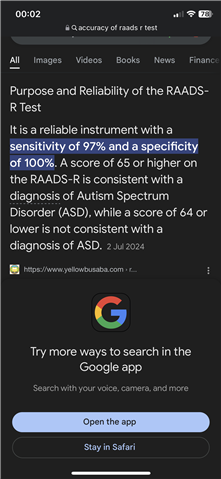
  • the RAADS seems to be very accurate. My score was above 190 I don’t remember exactly maybe I find the screenshot. Here what I found about the accuracy of it. 

    The RAADS test is highly respected and formed part of my official NHS (National Health Servicre) diagnosis.

    My result was 175.

    In case anyone is interested, here is a link to the criteria:

    https://www.autism.org.uk/advice-and-guidance/topics/diagnosis/assessment-and-diagnosis/criteria-and-tools-used-in-an-autism-assessment

  • While AQ May be less accurate, the RAADS seems to be very accurate. My score was above 190 I don’t remember exactly maybe I find the screenshot. Here what I found about the accuracy of it. 

  • I don't believe there is such a thing as self-diagnosis. It's a a logical impossibility, the nature and definition of diagnosis means you can't do it to yourself, particularly since you are not a trained qualified professional who is able to make diagnoses.

    I think that's semantics.

    I agree re the use of the word 'diagnosis'.  It's a medical term.

    I've used 'self recognised or realised' before.

    This is in fact one of the negative consequences of the self-diagnosis crowd - it means autism doesn't get taken seriously any more.

    Self-diagnosis and over-diagnosis from paid diagnosis mills has real world harms to people with autism, in terms of diluting the limited help available and making it less likely for autistic people to get the help they need - this already happened recently in Australia. It means people with autism don't get taken seriously and it's one of the reasons I don't tell people I'm autistic, because they'll just think I'm part of the trendy crowd jumping on the bandwagon. It won't be taken seriously.

    There are enormous communities now on TikTok and Reddit and YouTube and other social media, of mostly self-diagnosed people who all have convinced themselves they have autism because of online questionnaires which have very high rates of false positives, and research shows are unreliable for diagnosing autism

    I don't think that anyone here is a member of a 'crowd'.

    With regard to the 'online questionnaires ... research shows are unreliable for diagnosing autism' can you direct me to that research please.

    I was given some of those tests to get to my diagnosis by medical professionals so I'm surprised.

    I've had a discussion here once before with a member of the forum and I'll say what I said then, and I hope I don't trigger anyone.

    If we have two groups of people - those diagnosed by 'professionals' and those self-recognised, the main thing that concerns me is the criteria.

    I believe that if we talk about autistic people generally, then both should be using the same criteria, and in the conversation I had before, I believe that wasn't the case.

    With regard to professional diagnosis, that can be incorrect anyway.

    I've lost count of the number of times members of the forum were denied a diagnosis partly because they 'made eye contact' or were in a relationship.

    In the end, we are all here, with the same experiences and sufferings and we can all support one another in that, whether or not we are tied together by a piece of paper.

  • For some people who aren't sure themselves, yes - however people who have had a formal diagnosis say that you just get told "yes, you're autistic" and then they are left in their own with no support as to understanding what it means or managing their issues.

    And if you mis-diagnose yourself, I can't see what harm there would be for anyone to manage their life as if they were autistic - it just means a quieter, more stress free existence in which you may use things like headphones and sunglasses and avoid crowds.

  • I've been thinking of this in the night. I think it is similar to when people talk about "the spirit of the law" and "the letter of the law".

    Following the letter of the law is robotic and can sometimes not help with what the original spirit of the law was trying to achieve.

    I think self realisation is more in line with the spirit of the law and a formal diagnosis is like the letter of the law.

    I've been diagnosed now, so I can say it. But I didn't really have the mental strength to do any of it at the time. It was my wife who nudged me and got me over the line. There must be lots of SpikeyMark equivalents out there who don't have the support and are therefore undiagnosed, but still as autistic as me.

    What helps people? Is it the certificate that says "Congratulations, you are deemed by experts to be autistic" that doesn't really do anything. Or is it the realisation that you are autistic that allows you to seek out people like yourself, coping methods and things like that? (Sadly, as Germany is more of a 'letter of the law' mentality, I know that more avenues are shut to you without the formal diagnosis - but I think that my point still stands overall)

  • I’ve heard few times from professionals that I’m on the spectrum but I don’t need dx because it wouldn’t have helped me. I don’t want meds anymore, I’ve tried at least 3 different ones and nothing helps. For me I’m not sure, if I need a label and for what. I would like to meet some people, to join a local support group I need dx, but there is also a risk that I would have not fit the other people out there. I think there are also ways of meeting people without having diagnoses, I will talk to the psychologist I have an appointment booked. Here in Germany I noticed higher level of quality in health services generally. The psychiatrist who directed me to psychologist here and gave me list of psychologists to help me find one, he said, that such a “trendy” comment was highly unprofessional and it shouldn’t have taken place at all. I’m not trying to be smarter than mental health professionals, I’m just afraid of them based on my negative experience. The psychiatrist who prescribed me meds for Tourette’s and my family who forced me to take it when I was still minor, they stuck in my memory the most. Despite my complaints about the side effects they didn’t listen until I started threatening the worst. 

  • If anything, I’ve learned that being ND is about tolerance and acceptance. I don’t have a formal diagnosis and doubt that I will seek one now, in my mid-life. I suspect that I would struggle to get one, given what I’ve read about experiences like this and I wonder what effect that would have on my mental state. Probably not good. 

    Instead, I’m continuing to learn about my condition, to accept it and tolerate it. The more I do this the more I recognise similar traits in others and the acceptance and tolerance of them in myself helps me to accept and tolerate them in others. My wife and I now recognise that she might also be “somewhere on the scale”.

    I don’t wish to seem judgemental but I think for some, diagnosis might not be that important and perhaps it shouldn’t be sought. If you can, a quiet and calm acceptance of what you are, without the need for a label, can work. I accept that might not be good for everyone, particularly if medication is needed. Thankfully I can cope without it and so with this approach I can get by. I think there may be many like me who don’t need to be medicated and yet who fret and worry about trying to get a label that’s not really going to help them either way. 

  • My long route to a dx of Asperger's(ASD) started in 2000 with a google search,  re my verbal intelligence being significantly better than my non verbal intelligence. That lead to sites about non verbal learning disorder, and from there autism. I had already been thinking that a schizoaffective dx didn't explain everything . Armed with the info I sought more help and support. . I was refused it. I persisted. That persistence peed of my then mental  health  team, and resulted in my dx being changed from schizoaffective mixed to pd nos and then paranoid pd.  I found out several years later on receiving my psych records , that I was labelled 'awkward, demanding, and troublesome'- a 'very dependent narcissist'.

    Periodic attempts after my wife died to raise the question re more going on than just SMI were for the most part ignored. I did persuade my then care co to arrange an appointment to discuss things with a psychiatrist. That was a total disaster. He asked a few irrelevant questions,then abruptly ended the discussion.

    In 2017 I moved from Essex to Wiltshire to be near my daughter. She came with me to my 1st psych appt there in October. 2018. She mentioned autism . Unlike those in Essex he took time to ask questions , and after finishing stated the best fits were schizophrenia and ASD.

    2 weeks later I got a referral letter stating that I'd start to be assessed in February 2019 for autism. The diagnosis came in May 2019.

  • I can only speak to my experience which is in the UK. I don't think that there is any difference between private and National Health Service. It's the same organisations carrying them out as far as I can tell, its just that the NHS pay them or you pay them privately. At least that was the case with my diagnosers.

  • I’m wondering why is private diagnosis considered less reliable. Is it true? 
    for me, maybe the word self diagnosis is wrong, but the realisation means a lot, especially because I suffered being “blocked” from inside, feeling unable to actually recognize and name my problems, or even if I did in some cases I wasn’t believed. So finding out I’m not alone and there are other people having very similar experience also helps. 
    being special or in the center of attention is not something I need or want. 

  • That is surely the whole point of a diagnosis, to understand what you have to deal with, and  find strategies for a better life. But it does seem to be a difficult world in which to find these things. 

  • I totally feel your jewellery pain. What's worse, I'm a (retired at the ripe old age of 35) professional goldsmith; I used to make jewellery for a living, and now I cannot wear any of it!
    I also have to wear sunglasses and noise cancelling headphones in public, it's calmer, but still not great.
    Clothes and food are both disasters too; clothing has to be soft, loose and stretchy, food needs to be 'real' food (processed foods make me go into meltdown), and absolutely no conflicting textures (aka, husks in porridge!!!).

    Yep that sounds like dyspraxia. I'm forever bumping into things; it's got to a point where I don't really notice (unless it really hurts), the only thing that really annoys me is dropping cutlery and crockery...

    Explaining sensory issues to a neurotypical; this is where tiktok, youtube, etc come into their own; there are plenty of people sharing their stories explaining what it's like. Perhaps your husband needs to do some virtual neurodiverse research :)  

  • I think maybe the idea of "wanting to feel special" is key here - I think that maybe there are some NT people who want to feel special and join a group, as they have a drive to want to be included and given attention. I don't want attention or to feel special, I just wanted to be able to reduce my anxiety, avoid depression, regulate my emotions better, and have good relationships with a few people.

    I'm sorry if this offends any NT people who might read this, but we already have to negotiate a world designed by NTs that overloads us and causes anxiety, now it's possible we may have our very identity invalidated because some NT people feel left out.

    Rant over - I'll get my coat.

  • I will respect that if the professional tells me I have autistic traits but not strong enough to be autistic, but I get upset hearing the “trendy” comments after just telling the psychologist my problems. 
    I Already had a psychiatrist misdiagnosing me with Tourette and forcing me on awful meds (I wasn’t adult yet) and a psychologist telling me that I just need to paint my favorite pictures and smile more and gave me meds for depression. None of this helped because the core problem was that I felt inferior to others. My problem was not lack of motivation to do anything, I always loved doing things, but felt terribly stressed in a company of people. She would just need to ask me more questions to deeper understand what’s the problem. So they both didn’t help me. That one saying the trendy thing told me there is nothing I can do about being too fragile and bursting easily into tears. I’m looking for help, for a professional that will help me maybe my problem has to do with trauma for example. 
    i agree with your point and admit to be in the crowd doing the wrong thing, but it’s a result of me being numerous times mistreated and also misdiagnosed by those who were supposed to help. 

  • I have enountered individuals who have expressed scepticism about some self diagnosers, this person was pretty disparaging in his comments, saying it was about needing to feel special. He said he's been diagnosed himself, though. 

    I have never had a diagnosis as an adult, as a child it was another matter. But it wasn't called autism then. The idea it might be that didn't make me feel special though, it brought up some very painful feelings. I'd like to know one way or another though, but as my medical notes, which I caught sight of by accident, are in the UK and I'm not, the elusive diagnosis will most likely remain elusive.