“Trendy” diagnoses

I’ve got some negative experience and also some thoughts. It’s about the self diagnosis in mental health conditions being not accepted mostly by professionals. 
There are various online tests - screening tools. AQ50, AQ10, RAADS, and many others. There are also tests for ADHD. These are screening tools, not designed to diagnose. When you fill out the test, you get the result. If your result is significantly high, you get a message- you might have xyz condition, it’s better to contact a mental health professional. What is the reality? If you fill out the test or even few of them and their results together point to this condition and you go to the professional, there is a high chance, that they will not take you seriously, there high risk of hearing the stupid  “trendy” comments about diagnoses that everyone wants to have, that you just want attention, you’re just lazy not willing to work on yourself, or laugh and question if you know it from TikTok. 
There is a huge ocean of information and also misinformation out there, we as non professionals often lack the ability to differentiate what is true, what is not, but it also depends on where do we look for the information. Social media is more likely to deliver us more misinformation than books, but it’s not all black and white. 
the truth is that we ourselves know best what we experience and a professional who questions that, who tells us “you are exaggerating, creating your problems yourself, or that “this is not a problem” erode our trust and make us more cautious about contacting them. I heard from a psychotherapist (psychiatrist and psychologist, with long experience, doctor, lecturer at a university) that lack of friends is not a problem when I told her it is. When I was a teenager, I was suicidal because of this. And then I heard such a thing. 
So I feel it like - if you think that xyz condition describes your problems and explains the why’s, better stay as you are and don’t dare self diagnosing or reaching out to professionals with your insignificant problems. I hope I will finally find someone treating me seriously. I hope others here have better experience. In my case I was told by few professionals that Im probably autistic, the first one - the lecturer gave me her “trendy” comment after I described her my problems. I haven’t even mentioned anything about autism. I will see if it leads me anywhere or I stay as I am trying to cope. At least the self dx helped me manage my life in a way that is a bit easier for me and recognize how to name actually my struggles and strength and weaknesses. I’m not sure why I’m sharing this, just want to share some thoughts and experience. Can anyone relate? Sorry for a long post

Parents
  • I don't believe there is such a thing as self-diagnosis. It's a a logical impossibility, the nature and definition of diagnosis means you can't do it to yourself, particularly since you are not a trained qualified professional who is able to make diagnoses.

    I think that's semantics.

    I agree re the use of the word 'diagnosis'.  It's a medical term.

    I've used 'self recognised or realised' before.

    This is in fact one of the negative consequences of the self-diagnosis crowd - it means autism doesn't get taken seriously any more.

    Self-diagnosis and over-diagnosis from paid diagnosis mills has real world harms to people with autism, in terms of diluting the limited help available and making it less likely for autistic people to get the help they need - this already happened recently in Australia. It means people with autism don't get taken seriously and it's one of the reasons I don't tell people I'm autistic, because they'll just think I'm part of the trendy crowd jumping on the bandwagon. It won't be taken seriously.

    There are enormous communities now on TikTok and Reddit and YouTube and other social media, of mostly self-diagnosed people who all have convinced themselves they have autism because of online questionnaires which have very high rates of false positives, and research shows are unreliable for diagnosing autism

    I don't think that anyone here is a member of a 'crowd'.

    With regard to the 'online questionnaires ... research shows are unreliable for diagnosing autism' can you direct me to that research please.

    I was given some of those tests to get to my diagnosis by medical professionals so I'm surprised.

    I've had a discussion here once before with a member of the forum and I'll say what I said then, and I hope I don't trigger anyone.

    If we have two groups of people - those diagnosed by 'professionals' and those self-recognised, the main thing that concerns me is the criteria.

    I believe that if we talk about autistic people generally, then both should be using the same criteria, and in the conversation I had before, I believe that wasn't the case.

    With regard to professional diagnosis, that can be incorrect anyway.

    I've lost count of the number of times members of the forum were denied a diagnosis partly because they 'made eye contact' or were in a relationship.

    In the end, we are all here, with the same experiences and sufferings and we can all support one another in that, whether or not we are tied together by a piece of paper.

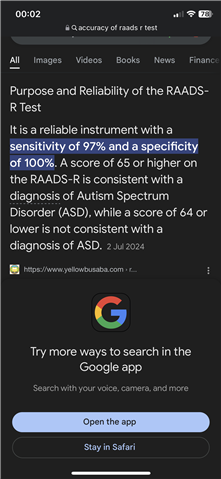
  • While AQ May be less accurate, the RAADS seems to be very accurate. My score was above 190 I don’t remember exactly maybe I find the screenshot. Here what I found about the accuracy of it. 

Reply Children
  • This 'chicken or egg' analogy was exactly my battle when doing extensive research before diagnosis, I was trying to decipher which came first, the trauma or the autism, due to the mass overlap between symptoms of trauma and autistic overwhelm.

    The clue was found in 'what' was triggering the symptoms (a vital link often overlooked in deciphering between the two). Thankfully the psychiatrist who carried out my assessment was really well trained in neurodivergence and trauma, and she stated I didn't present as a typical PTSD profile, but instead as a traumatised autistic, and those words were what I needed to hear, they were specific enough to stop the analogy dead in its tracks.

    I guess in my case, I needed a trained professional to undo the damage that untrained professionals had inflicted by trying to make me a better version of something I never was (e.g. reenforce the mask).

    The tests were helpful, but they require you to be honest with yourself, which in a high masking neurodivergent, my take some time.


  • Unless god himself comes down and tells us who is really autistic

    Trump is rather busy at the moment.

  • This may all be technically true, but it's a bit "which came first, the chicken or the egg." All tests - even proper formal diagnosis are subject to false positives and false negatives. It is impossible not to have these. Unless god himself comes down and tells us who is really autistic, then we have to understand that any test can be wrong - even formal.

    As pixiefox says, "And if you mis-diagnose yourself, I can't see what harm there would be for anyone to manage their life as if they were autistic - it just means a quieter, more stress free existence in which you may use things like headphones and sunglasses and avoid crowds."

  • the RAADS was part of my diagnosis too. It was a shorter version too (RAADS-14), so I only got 29 - but the threshold was 14. I don't know why it was the short one.

    I was also given the AQ10 - what was nice about this was that my wife did it too (for me, not her) and she scored me the same as I did myself Heart eyes.

    I agree with what Debbie says in another post. It is a very insightful comment, and was what I was trying to say with my letter/spirit long-winded comment... "It's all just semantics"

  • With regard to the 'online questionnaires ... research shows are unreliable for diagnosing autism' can you direct me to that research please.
    While AQ May be less accurate, the RAADS seems to be very accurate.

    I posted a reply about this yesterday to Lillibet, but it's currently awaiting attention in spam prison.

    Whilst I support self diagnosis, I also feel it's important to be mindful that - in the absence of a subsequent, professional assessment - screening tools (whether using one or several of them) can still lead us to reach inaccurate conclusions.

    For example: this 2021 UK study concluded that "used as a self-report measure pre-full diagnostic assessment, the RAADS-R lacks predictive validity and is not a suitable screening tool for adults awaiting autism assessments."

    In the study of 50 patients who went on to have NHS assessments, 98% of patients met the threshold score for ASD under the RAADS-R, but only 34% were then diagnosed as autistic.

    The report states that:

    • "there was no difference between RAADS-R scores for patients who received an ASD diagnosis and those who did not"
    • "When used as a self-report tool, the RAADS-R had no clinical value"

    And recommends further research to identify appropriate screening tools.

    The Effectiveness of RAADS-R as a Screening Tool for Adult ASD Populations

  • the RAADS seems to be very accurate. My score was above 190 I don’t remember exactly maybe I find the screenshot. Here what I found about the accuracy of it. 

    The RAADS test is highly respected and formed part of my official NHS (National Health Servicre) diagnosis.

    My result was 175.

    In case anyone is interested, here is a link to the criteria:

    https://www.autism.org.uk/advice-and-guidance/topics/diagnosis/assessment-and-diagnosis/criteria-and-tools-used-in-an-autism-assessment