Getting together with a research request

Afte seeing another request for participants in research about ASC in young people, I thought 'again, why is there never anything aimed at people my age?' There are so many of us latelings here and I feel that we're being forgotten AGAIN, as we have through so much of our lives.

I was wondering if there would be any interest in writing a joint letter to research organisations asking for research into our difficulties and experiences and as we move into old age how that will affect the services we recieve, from what I can see organisations who deal with older people haven't a clue about autism. This needs to change.

How about it folks? I'm happy to write the letter, but would love to include your concerns, to do it as a group, a group will have more power, by weight of numbers alone, but also because we experience the world differently. I would of course post the proposed letter here for your comments before sending it

  • The Wikipedia article is enlightening. Now if there was an equivalent version with social sciences/archaeology publications I would be tempted … Nature occasionally has material that I’m interested in, but much of the stuff I would like is hidden unless I were to pay. Some universities are getting better than they used to be at releasing recent archaeological reports and research papers.

    The PDF link is concise and crystal clear, really excellent. I’ve books on how to do literature reviews/research proposals, yet much of the material contained is irrelevant for people beginning postgraduate research. 

    The tricky thing is that research and societal responses are somewhat reactive and long winded in how issues are addressed perhaps?

    By the time the problem is identified and a solution proposed, let alone put in place, the problem has often moved on...

    Notwithstanding the need for a scientific background for much of the research, it would be a huge undertaking for anyone.

  • I think there would need to be a huge attitude shift amongst staff  as well as the procedures in care settings. Things like dietary needs nit being met, allergies not being taken notice of. As well as people who think it's ok to just ignore any requests for adjustments. Going on previous experiences of being in hospitals I think I'd end up starving to death as I've thrown up everything thats been put in front of me.

  • Are there other research papers that are available only to academics/autism professionals through university libraries or publication subscriptions?

    Yes. the current means of research publication has a weird system founded on people doing a lot of work that in order to be respected and disseminated has to be handed over to organisations that charge a ridiculous amount of money for others to access it.  The public end up paying twice for research.

    To some extent publishers might justify their costs in that peer review or "fact and process" checking is necessary if we are to trust the research - however the publishers have a history of some pretty major failings in this that are worthy of noting...

    Fortunately there is some "push back" against restricting access to research however this taking place in a world where the big players in this are keen to litigate in order to protect their business model and interests.  "SciI-Hub" is an example of this Sci-Hub - Wikipedia

    Truly novel work into gaps in understanding is critical - here's a free paper that i can commend for reading.

    (PDF) Understanding Research Novelty and Research Gaps: Strategies for Identifying Unexplored Areas and Pioneering Innovative Contributions

    To take a quote from this: "Conducting research that appraises policy solutions not only fills gaps in academic knowledge but also contributes directly to societal well-being."

    The tricky thing is that research and societal responses are somewhat reactive and long winded in how issues are addressed perhaps?

    By the time the problem is identified and a solution proposed, let alone put in place, the problem has often moved on...

    So whilst we might work collaboratively towards major societal change this I suspect is a generational problem - it will take generations of people before this takes place for the better :-( 

    In the meantime being stubborn and/or demanding better from wider society seems to have mixed results.

    I think that pragmatically the best hope for late diagnosed older adult autistic people comes from mutual support and personal development at present with the help of enlightened others wherever we are able to find them.

  • New tests need to be developed for different ages, not just based around adapted ones for little kids

    The ‘frog book’ springs to mind. 

  • Are there other research papers that are available only to academics/autism professionals through university libraries or publication subscriptions? It would be worthwhile knowing where the gaps in research are.

    we might have to wait for the the day when human society starts acting fairly and reasonably to all it's members.

    Yes. It doesn’t help that political rhetoric and societal opinion is feeding into an era of what is commonly called ‘unpopular cuts’ which impact autistic people.

  • There are research papers that look at this topic  

    The link to this search enquiry in Google Scholar might interest as there is a lot of research already made.

    what impact does late autism diagnosis have on older people - Google Scholar

    Another search brings up papers more specific to your concern about services for late diagnosed older autistic people

    services received late autism diagnosis older people - Google Scholar

    As for the practical reality of older people getting less support than younger yes there is evidence

    research-paper_autistimsurvey_2022.pdf

    So, I personally wouldn't blame the research scientists if their evidence isn't being sought out and paid attention to.  After all, generally they are not the publicists or the politicians with control of the purse-strings and priorities.

    As to why organisations who deal with older people with autism don't seem to have a clue well that has many reasons - hehe we might have to wait for the the day when human society starts acting fairly and reasonably to all it's members.

    I'm up for supporting any letter that you might wish to draw up regarding bringing that day forward!

    Best Wishes

  • It's clear that the current tests wouldn't be fit for purpose. New tests need to be developed for different ages, not just based around adapted ones for little kids. Everyone who is late diagnosed can attest to not knowing they were autistic at first, so recognising and diagnosing it in older people (or at least noting it might be possible on care charts), is in everyone's interest so proper and appropriate care can be delivered.

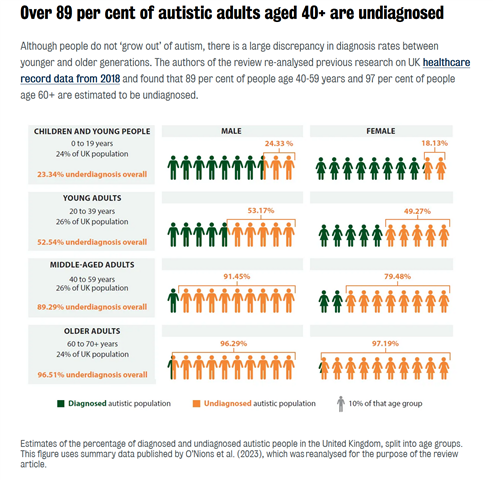
  • Agreed - it’s a great graphic and comes from the first study that I quoted yesterday, for which the King’s article is a good explainer:

    Annual Review of Developmental Psychology - Aging Across the Autism Spectrum

  • I replied to  and  but I wish I had seen your post first as some of my concerns are similar to yours. 

    As more of us older ones get towards the stage that we might one day need support, it would be helpful for those in elderly care to have some understanding. The thought of needing strangers constantly being around in a caring capacity is not something I would feel comfortable with

    That is my concern. Your idea of a record for adults similar to an EHCP plan is a very good idea. I don’t know how I could ever cope with being in a care home or hospital long term. The facilities I’ve seen in my area aren’t suitable for anybody.

  • Another bug bear for many of us is bright lights, we would need to have dimable lighting or lamps instead of an overhead strip light

    That’s a big issue for me. The newer hospitals here have less harsh lighting but it’s still far too bright. it’s not so much the personal light that causes me bother, it’s the over bed light that will get switched on when somebody does the observations or a doctor does the rounds. Even though it’s a ceiling light, there must be some way of directing the light in a more controlled fashion as they can do it in operating theatres. 

    The noise level in hospitals is dreadfully high in many wards, and it can go on all night. We need to be prioritised to have a bed in a quieter area away from ward stations, doors and TVs. 

    The thing I am most worried about is becoming incapacitated and needing to be in a care home or hospital. People where I live aren’t getting care packages fit for their needs. Ideally I would like to stay in my own home, but currently there isn’t enough social care support for that to happen. I live on my own and I have no family apart from an extended family member who I don’t see often. 

    I am trying to keep fit by eating well, walking miles every day/pilates/physiotherapy exercises, but life is a lottery.

  • I agree that would be high on the list of research priorities from the point of view of autistic people. I would guess off the top of my head that these places make people over 60 worse. It has been estimated that only 97% of autistic people over 60 have been diagnosed.

    Only a few years ago, I was mistreated by mental health services for OCD as an outpatient, even though I stated multiple times that my repetitive behaviour does not cause distress. I’m highlighting this because misdiagnosis is common among over 60s who have mental health issues, and it needs addressed.

    So I’m wondering how improved MH services will specifically help people over 60 when many are not diagnosed in the first place. It’s not even a case of recognising self-diagnosis, as many older people themselves don’t they are autistic. Does potential research first need to look at how autism is identified in adults over 60 as well as the diagnostic process? It just seems that there will be a huge majority of autistic mental health patients that research wouldn’t account for. 

  • So what would you suggest then Iain? You seem very good at shooting down the ideas lf others, but not so good at coming up with ideas of your own

    ***************************

    Homebird I think thats an excellent idea, it wouldn't be a panacea but it would be a good start. I had a conversation with a friend who's a retired nurse who specialised in dementia assessment and care, we had a very different takes on the need for personal space, as a nurse it was a red flag if someone wanted time alone, they call it "self isolating", to us it's a normal way of being and we really need that time and not to be hassled into activities that we don't want to do. For instance, if the tv in the day room had soaps and/sport on, I would choose to go elsewhere, as I intensely dislike both, I wouldn't expect others to change thier veiwing habits to accomodate me and it would seem the fairest way to deal with things.

    Another bug bear for many of us is bright lights, we would need to have dimable lighting or lamps instead of an overhead strip light. To me this would be a reasonable adjustment.

    It is said that being ND means you're more likely to suffer from various types of dementia, why is this? Could it be because some of the diagnostic criteria? For instance, I'd have problems counting backwards in 7's from 100, it's nothing to do with possible dementia, but everything to do with never having been good with numbers. I took this example from The Addenbrooks test which is the standard test administerd to those with suspected dementia. I've also never been good with tessalation tests.

    How would people with ADHD, who struggle to concentrate on tasks cope with this test?

    Research isn't about answering one question, as with many other things you answer one question and a dozen more pop up. Research can be wide or narrow, as wide as what's the general experience of older ND people? Or as narrow as what brain changes are there in ND people with dementia?

    Thank you to those who are adding to this conversation instead of trying to shut it down, there are some really good ideas here.

  • Having had experience of someone I know struggling to cope in a care situation, whom I realized retrospectively was likely autistic, I can see a need for understanding. The difficulty was that there was no diagnosis. 

    As more of us older ones get towards the stage that we might one day need support, it would be helpful for those in elderly care to have some understanding. The thought of needing strangers constantly being around in a caring capacity is not something I would feel comfortable with. There are few people I meet who really understand the difficulties. However it would be helpful if there was something that could be completed, a bit like an EHCP for children to go on record of preferences that would help anyone caring for us in future, to make life as bearable as possible. 

  • How should care and social services approach autistic adults

    I don't think they can provide a solution that will work for enough autists to be effective for them to learn to be honest. This is where I see the single biggest issue - to learn they need enough consistency to make their training viable and I just don't see this amongst the posters here.

    The solution would probably have to be one tailored for each individual based on their needs and their ability to cope with their autistic traits, as well as the host of other age related conditions that we share with neurotypicals.

    It probably won't be cost effective so we will continue to fall between the cracks as we have done in life.

    If autistic people are already struggling getting things like reasonable adjustments in the workplace, how will we be able to enforce oue rights without the research

    What exactly do you propose this research include? I think that once you get down to the nitty gritty you will find there is a huge discrepancy between individuals needs and the research will show nothing conclusive.

    There is probably more scope for success if we can focus on individual specific issues but you seem against that idea in previous posts where you call for a more holistoc approach to care.

    One of the things we see over and over again on this site is the total lack of any understanding of or provision for understanding of how late diagnosis can feel like a wrecking ball through life?

    This probably stems from the fact so many autists have built up a series of walls and defences to allow them to function in society to a greater or lesser extent and the diagnosis points these artifical constructs out for us, and when we start to look over the top we get scared with what we see.

    Everybody will have different types of walls / defences and different coping techniques plus different levels of self awareness so each will have their own journey to follow to get to wherever their personal choice of destination is.

    All will be different and I cannot see a conventional training course that will work for health care workers for this - it takes the skills and training of a psychotherapist to understand all that is involved in the mind of the individual to offer the level of help needed.

    I agree a solution would be great but I think the approach you propose here is too simplistic to work effectively. It would be like giving a half day training course on brain surgery and expecting good results - the skills will not match the magnitude of the task.

    This seems reflected in the numbers of people who get a late diagnosis without therapy and continue to struggle even years later.


  • I hope It is alright to post, I was just looking at those interesting links, and thought it was a really good info graphic showing the benefits of research that has been done already. 

    I think it is a good response to those that say there are too many people asking for a diagnosis.

    This was from that last link from King's College. I haven't read it deeply, but it's an excellent summary in visual form:
    www.kcl.ac.uk/.../up-to-90-of-middle-aged-and-older-autistic-adults-are-undiagnosed-in-the-uk-new-review-finds

  • Another consideration is that many older people may not have any family members or old friends who've known them sinse childhood to be a witness in the diagnosis process and any family that are still around may have cognitive problems themselves or be out right hostile, another thing we've seen over and over again.

  • So you think there would be no point in researching how things like how aging effects autists?

    Are older poeple more likely to be pushed towards dementia diagnosis and pathways rather than anyone wondering if they're autistic?

    How should care and social services approach autistic adults, there's a total lack of preparedness in elder care services for autistic people, a cohort thats growing larger as well as older. Should cognitive tests such as Addenbrooks one be revised for autistic people? 

    Everyone has baggage, some people have more baggage by the time they're 16 than others do at 60, that differential has always been there and always will be.

    If autistic people are already struggling getting things like reasonable adjustments in the workplace, how will we be able to enforce oue rights without the research

    One of the things we see over and over again on this site is the total lack of any understanding of or provision for understanding of how late diagnosis can feel like a wrecking ball through life? It's not therapy that people often need, it's practicle support for themselves and their families, especailly partners who may not want to accept a diagnosis and think their partner should be able to be "fixed"

    How are autistic people effected by the double whammy of being older, unemployed, in need of retraining and autistic, sadly many employers if given the choice will employ an NT, ot if they employ an ND it will be for the wrong reasons, like diversity washing?

    Theses are just the question off the top of my head, I'm sure I can come up with others, and others will come up with more.

  • I’m in full support of early diagnosis for children so they don’t have to go through what I, and I’m sure many others have been through on here. I think it’s also pertinent to highlight whilst some co occurring conditions are diagnosed as stand alone, they are also ‘flags’ for burnout as a result of getting a PhD in what feels like a lifetime of masking/camouflage. There is support for the ‘latelings’ but nowhere near as much as I thought or hoped for. This place is invaluable however. Anything that raises further awareness - I’m in!

  • Definitely, thank you. Their current projects include "a focus on traditionally under-researched groups, notably women and girls and older adults on the autism spectrum."

    They are also keen to hear from autistic people and their families who are interested in participating in research, via the contact details here:

    King's College London - ReSpect Lab: Researching Autism across the Spectrum and Lifespan

  • It's just been highlighted, but the effect being an in-patient in MH units. Research should be done on whether autistic people are being made worse by unsuitable care enviroments.