
Family History Research and DNA Tests

Having submitted a sample for genealogy DNA testing with 23andMe earlier this year, I have enjoyed exploring my genetic ancestral history and discovering more about my ancient Neanderthal and Denisovan progenitors. I took advantage of the free data upload to Living DNA which gave a more detailed breakdown of my British and Irish ancestry, and discovered some ancient relatives who had  interesting histories such as a late Roman period man who was buried at Crypta Balbi in Rome, a Ukrainian prince, and a victim of the St Brice’s Day Massacre in Dorset. I share DNA with Classical period Greeks, Romans and Egyptians, which is rather exciting as it contributes to understanding of how populations shifted around that time. I’m now ready to continue researching my more recent family history through Ancestry DNA, but unlike Living DNA, Ancestry DNA don’t accept DNA data uploads, so I’ve had to order a new test, but at least it’s less than half the usual price and it comes with a three month subscription to world wide membership for £1.

Has anybody researched their more recent family history using Ancestry UK or any other company and is it necessary or worth employing a professional genealogist? I am concerned that costs could escalate as I explore the various branches of recent family.
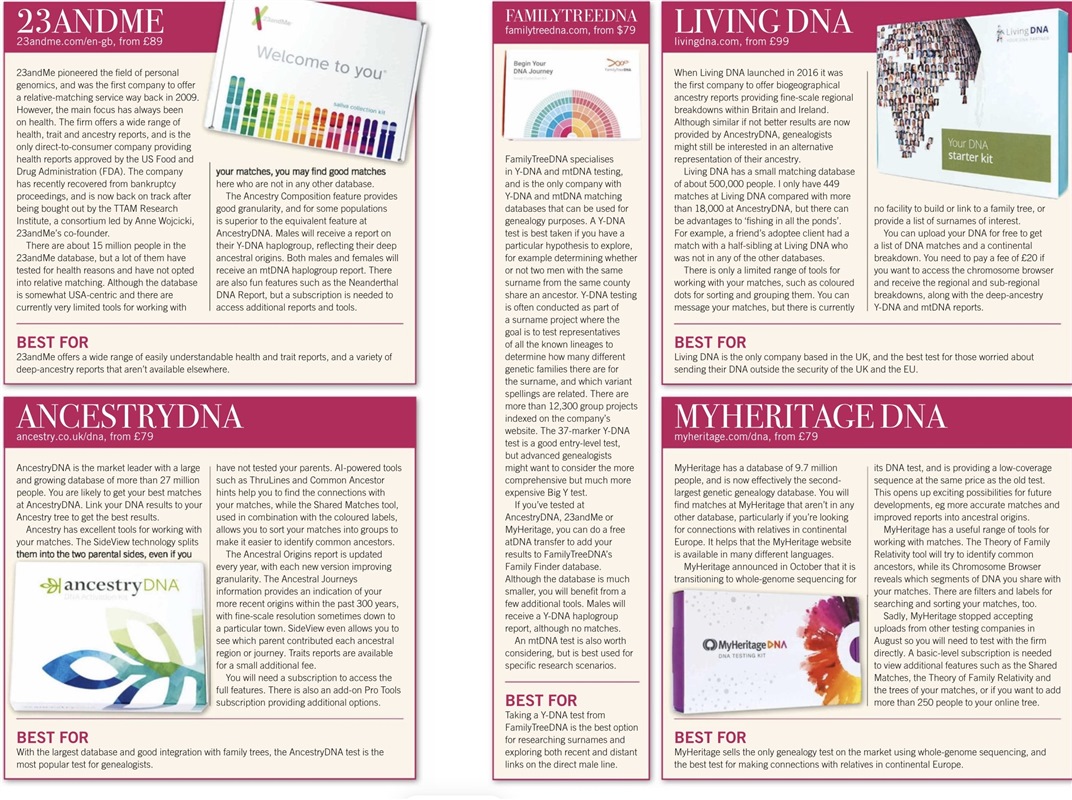

Copied from Who Do You Think You Are? Magazine, Public Library Online

Parents
  • There is a free BMD site that has quite good coverage for Britain back to 1837. I did most of my genealogical research just using either the free site or pay to view for one off payments. Intersecting with other people's trees can garner quite spectacular results.

    I also have used 23andMe and Living DNA. Most of the results fitted in with my researched ancestry. The historical matches on 23andMe were a little surprising. I am about a third Irish, and always considered, on no real evidence, that my English ancestry would be largely indigenous Celtic too. However, of 18 historical DNA matches, 12 were to Viking Age, or earlier, Scandinavians, with 9 of these being Swedes (two of whom were buried in ship burials with weapons). On Living DNA my Viking Index was 67. It appears that my English ancestry is largely Germanic and probably Viking Age in origin. My Y haplogroup also appeared in southern Scandinavia in the Early Bronze Age.

  • I have just checked out the BMD site so thanks for that tip. 

    My H haplogroup is dominant in European populations, so it is probably not meaningful to quote other people who inherited it such as Nicolaus Copernicus, Marie Antoinette and many of the royals as our common ancestor dates to around 18,000 years ago. I am hoping that a male cousin might be willing to provide a sample for DNA testing to establish the paternal haplogroup. I know some of my cousins have family trees on Ancestry, but I don’t know if they have had their DNA tested, or if my paternal uncle was tested when he was alive. 

    I might use MyHeritage in the future, just to cover all available ground. I’m not sure that I’m the best person to be attempting to compare and contrast DNA results between companies, but MyHeritage have video courses which may cover this and they have recommended using multiple testing companies.

  • My X haplogroup is H1a, it has a pan-European distribution and is found in some North African populations.

  • 23andMe shows 1.3% Scandinavian in my ancestry and 25.5% Scottish and Northern Irish, with the remainder mostly English. This is a vastly different result to the 8% Irish, 4.5% Scandinavian, 4.4% Northern Irish and SW Scottish, and the remainder mostly English of Living DNA. I assume Living DNA is more likely to accurately reflect British and Irish populations. As far as I know from my parents and grandparents, my recent Irish ancestry is of areas south of Wexford and west to Co Mayo. I had been thinking it wouldn’t be surprising if Spanish or Southern Europe had shown up somewhere. 

Reply
  • 23andMe shows 1.3% Scandinavian in my ancestry and 25.5% Scottish and Northern Irish, with the remainder mostly English. This is a vastly different result to the 8% Irish, 4.5% Scandinavian, 4.4% Northern Irish and SW Scottish, and the remainder mostly English of Living DNA. I assume Living DNA is more likely to accurately reflect British and Irish populations. As far as I know from my parents and grandparents, my recent Irish ancestry is of areas south of Wexford and west to Co Mayo. I had been thinking it wouldn’t be surprising if Spanish or Southern Europe had shown up somewhere. 

Children
No Data