What was a Roman Dodecahedron used for?

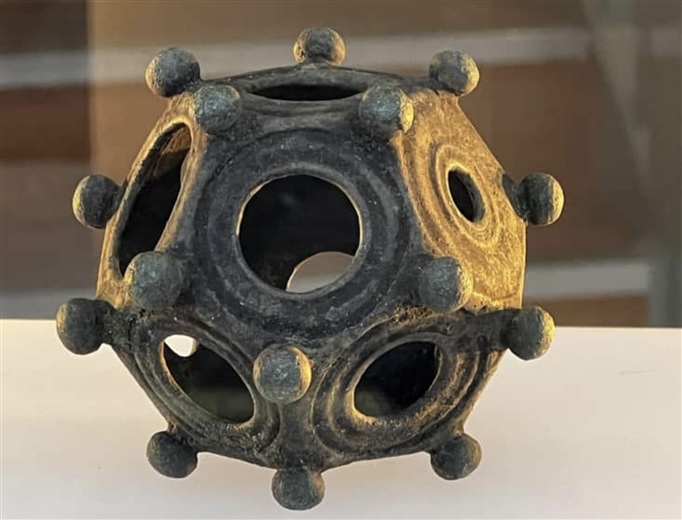
Roman dodecahedra have been found in Britain, much of Europe, but not Italy. The context of use is uncertain, but some have been found in areas of military or funerary activity. Others have been discovered in coin hoards, suggesting they were objects of value. Some dodecahedra were found in baths, one was found in a theatre, another on a river bed.

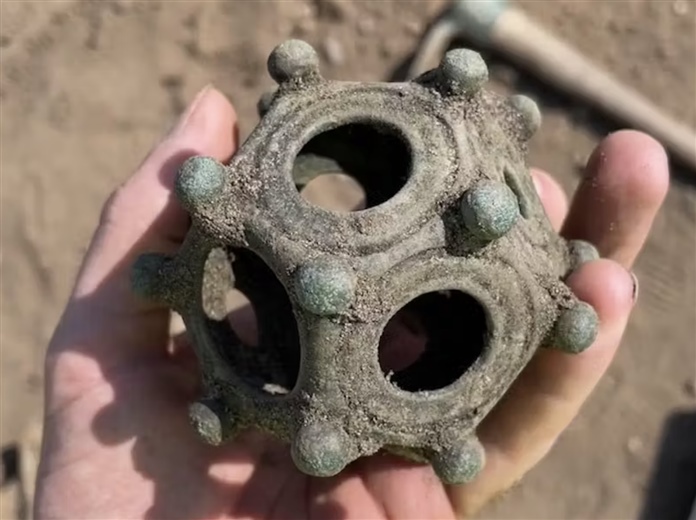
Dodecahedra are usually cast in copper alloy, of varying design, size between around 4cm to 11cm diameter. The holes on each face are of different sizes and decoration varies with circles, lines and dots being common.

To date, the purpose of these objects has eluded archaeologists, but suggestions have included: Measuring device, knitting tool, metal worker practice piece, or less seriously, spaghetti measure.

What did the Romans call these dodecahedra?

How did the Romans use them?

There are no incorrect answers, as yet!
        
Norton Disney Archaeology Group

https://theconversation.com/beautifully-crafted-roman-dodecahedron-discovered-in-lincoln-but-what-were-they-for-229131

https://en.wikipedia.org/wiki/Roman_dodecahedron

Parents
  • Wikipedia has a section on Platonic solids

    The Platonic solids are prominent in the philosophy of Plato, their namesake. Plato wrote about them in the dialogue Timaeus c. 360 B.C. in which he associated each of the four classical elements (earth, air, water, and fire) with a regular solid. Earth was associated with the cube, air with the octahedron, water with the icosahedron, and fire with the tetrahedron. Of the fifth Platonic solid, the dodecahedron, Plato obscurely remarked, "...the god used [it] for arranging the constellations on the whole heaven". Aristotle added a fifth element, aither (aether in Latin, "ether" in English) and postulated that the heavens were made of this …  https://en.wikipedia.org/wiki/Platonic_solid

    It might provide additional inspiration in the right direction or it might send you down a rabbit hole.

Reply
  • Wikipedia has a section on Platonic solids

    The Platonic solids are prominent in the philosophy of Plato, their namesake. Plato wrote about them in the dialogue Timaeus c. 360 B.C. in which he associated each of the four classical elements (earth, air, water, and fire) with a regular solid. Earth was associated with the cube, air with the octahedron, water with the icosahedron, and fire with the tetrahedron. Of the fifth Platonic solid, the dodecahedron, Plato obscurely remarked, "...the god used [it] for arranging the constellations on the whole heaven". Aristotle added a fifth element, aither (aether in Latin, "ether" in English) and postulated that the heavens were made of this …  https://en.wikipedia.org/wiki/Platonic_solid

    It might provide additional inspiration in the right direction or it might send you down a rabbit hole.

Children